Modern manufacturing industries are increasingly adopting automatic assembly line automation using PLC to improve production speed, accuracy, quality, and overall efficiency. A PLC-based assembly line automation system can coordinate conveyors, sensors, motors, pneumatic systems, servo drives, robots, inspection equipment, and other machine components to create a reliable automated production process.
For manufacturers searching for assembly line automation solutions in Pune, PLC programming services in Pune, or an industrial automation system integrator in Pune, PLC-based automation provides a flexible solution for both new production lines and modernization of existing machines.
What is Automatic Assembly Line Automation?
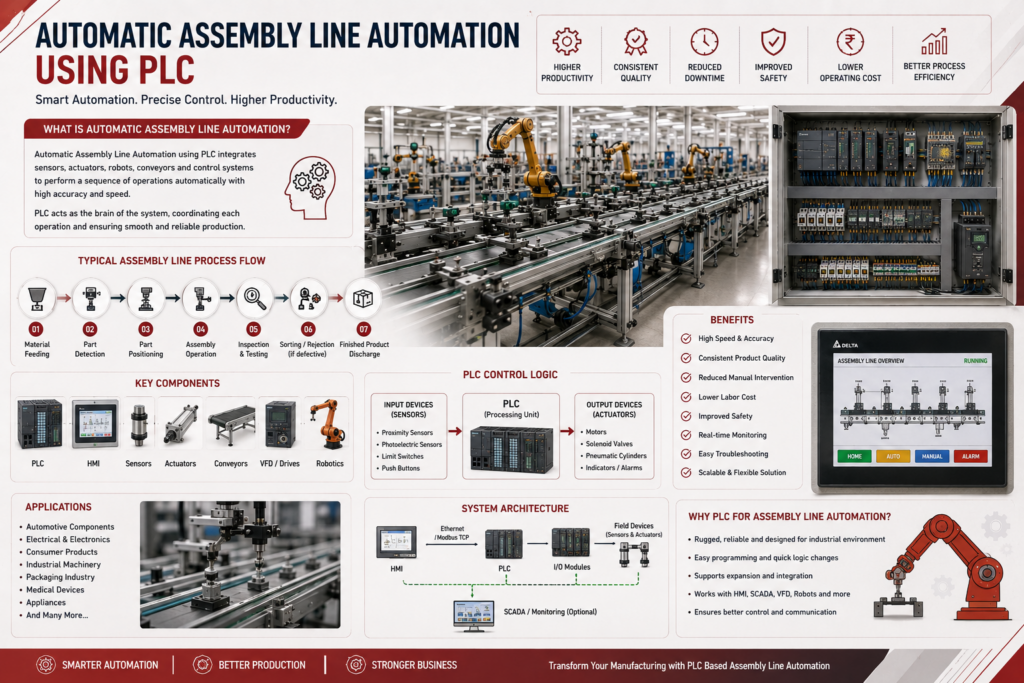
An automatic assembly line consists of multiple workstations connected through a controlled production flow. Each station performs a specific operation such as feeding, positioning, assembling, fastening, testing, inspection, or packaging.
A PLC for assembly line automation acts as the central control system. It receives signals from sensors and processes them according to the programmed sequence before controlling motors, cylinders, valves, conveyors, servo drives, and other actuators.
Typical operations include:
- Automatic component feeding
- Part detection and positioning
- Conveyor automation
- Assembly and pressing
- Pneumatic cylinder control
- Screw fastening
- Product inspection
- Defect detection and rejection
- Production counting
- Automatic product transfer
- Final testing and packaging
PLC Programming for Assembly Line Automation
Reliable PLC programming for industrial automation is essential for coordinating different stations and maintaining the correct production sequence.
PLC logic can be designed for:
- Sequential machine operation
- Sensor-based control
- Timers and counters
- Motor and conveyor control
- Pneumatic automation
- Servo positioning
- Interlocking and safety logic
- Fault detection
- Alarm management
- Auto/manual operation
- Production counting
- Emergency-stop functions
A properly designed PLC automation system helps reduce incorrect sequences, machine collisions, production errors, and unnecessary downtime.
HMI and SCADA Integration
An HMI for assembly line automation provides operators with a simple interface for monitoring and controlling the production line. Operators can view machine status, production counts, alarms, cycle times, sensor conditions, and operating parameters.
For larger production facilities, SCADA system integration can provide centralized monitoring, production data collection, alarm management, reporting, and real-time visualization.
This combination of PLC, HMI and SCADA automation provides better visibility and control over the complete manufacturing process.
PLC Control Panel for Assembly Lines
A properly engineered PLC control panel for assembly line automation is an important part of the system. Depending on the application, the panel can include:
- PLC and I/O modules
- VFDs and servo drives
- Contactors and relays
- Power supplies
- Circuit protection
- Safety relays
- Communication modules
- Terminal blocks
- HMI
Professional industrial control panel design and manufacturing helps provide organized wiring, reliable operation, easier troubleshooting, and improved machine safety.
Benefits of Assembly Line Automation
Implementing industrial automation solutions for assembly lines can help manufacturers achieve:
- Higher production speed
- Improved assembly accuracy
- Consistent product quality
- Reduced manual intervention
- Lower production costs
- Reduced downtime
- Improved operator safety
- Automatic quality inspection
- Real-time production monitoring
- Better production traceability
- Easier troubleshooting
- Improved overall productivity
Smart Manufacturing and Assembly Automation
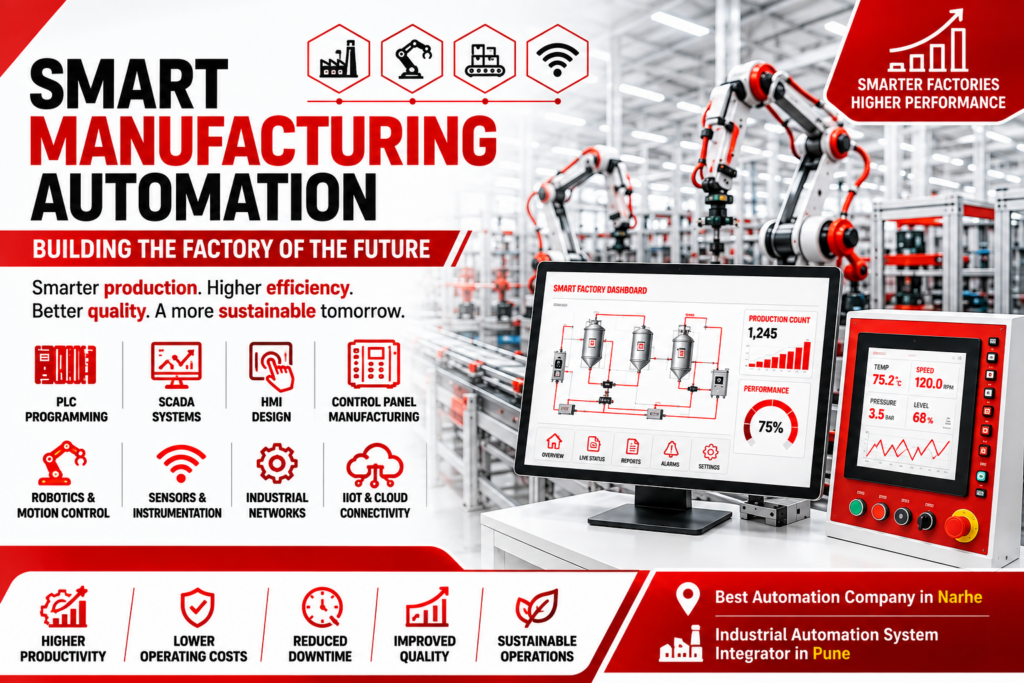
Modern smart manufacturing automation goes beyond basic PLC control. PLC systems can be integrated with HMI, SCADA, industrial networking, sensors, servo systems, VFDs, robotics, and Industrial Internet of Things (IIoT) technologies.
This allows manufacturers to collect production data, monitor machine performance, identify faults, track production efficiency, and make data-driven decisions.
For companies searching for machine automation solutions in Pune, PLC control panel manufacturers in Pune, assembly machine automation, or a PLC automation system integrator in Pune, integrating these technologies can help create scalable and future-ready production systems.
Manufacturers looking for the best automation company in Narhe can consider PLC-based assembly automation for applications ranging from individual automated machines to complete production lines.
Applications of PLC-Based Assembly Automation
Automatic assembly line automation using PLC is suitable for various industries, including:
- Automotive components
- Electrical and electronics manufacturing
- Consumer products
- Packaging
- Pharmaceutical manufacturing
- Food and beverage
- Industrial machinery
- Engineering components
- Medical equipment
- Appliance manufacturing
From component feeding and assembly to inspection and final product handling, PLC machine automation provides precise control throughout the production process.
Key SEO Keywords
Automatic Assembly Line Automation, Assembly Line Automation Using PLC, PLC-Based Assembly Line Automation, PLC Programming Services in Pune, Assembly Line Automation Solutions in Pune, Industrial Automation System Integrator in Pune, PLC Control Panel Manufacturer in Pune, Machine Automation Solutions in Pune, Assembly Machine Automation, HMI Automation, SCADA System Integration, Smart Manufacturing Automation, PLC Automation System Integrator in Pune, Best Automation Company in Narhe.
#AssemblyLineAutomation #PLCAutomation #PLCProgramming #MachineAutomation #IndustrialAutomation #SmartManufacturing #HMI #SCADA #ControlPanel #AutomationPune #PLCControlPanel #Industry40