In modern manufacturing plants, precise motor control is essential for improving production efficiency, reducing energy consumption, and maintaining consistent process performance. VFD-based motor speed control and industrial automation provide an effective solution for controlling the speed, acceleration, and stopping of AC motors used in conveyors, pumps, fans, compressors, mixers, and production machinery.
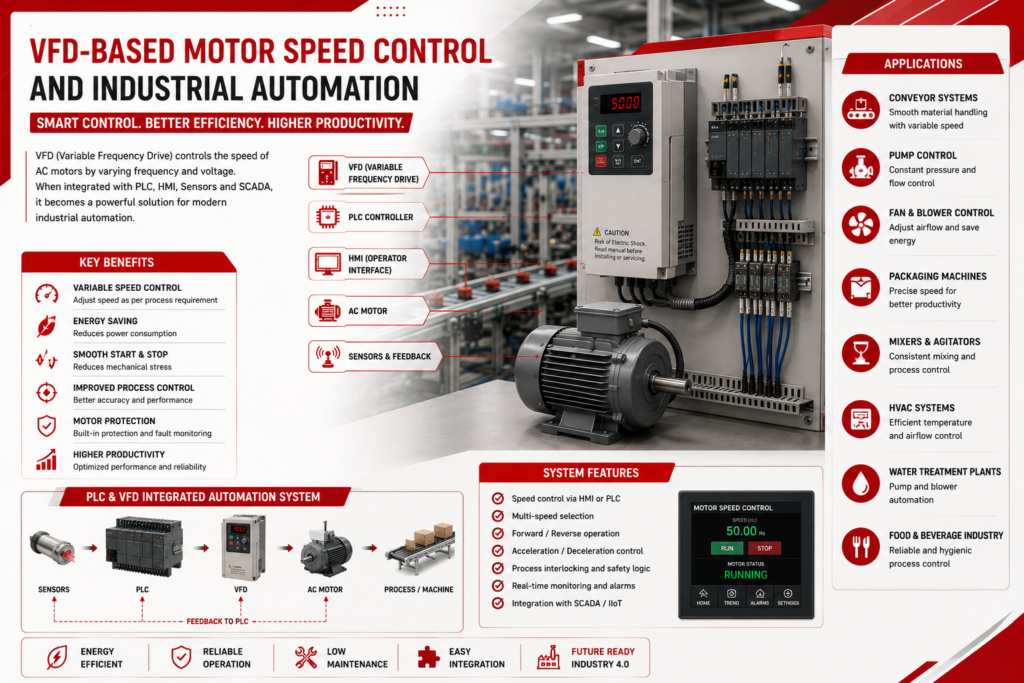
A Variable Frequency Drive (VFD) controls the speed of an AC motor by varying the frequency and voltage supplied to the motor. When integrated with a PLC, sensors, HMI, and other automation equipment, a VFD becomes an important part of a PLC-based industrial automation system.
VFD Automation in Industrial Applications
VFD automation is widely used in manufacturing and process industries where motor speed needs to change according to production requirements. A conveyor, for example, can operate at different speeds depending on the production stage, while a pump can adjust its speed according to pressure or flow requirements.
VFD-based motor control is commonly used for conveyor automation, pump speed control, fans and blowers, mixing machines, packaging machines, material handling systems, HVAC systems, water treatment plants, food and beverage processing, and chemical processing applications.
For manufacturers searching for industrial automation solutions in Pune, VFD automation can be integrated into individual machines as well as complete automated production lines.
PLC and VFD Integration
A PLC and VFD automation system allows the PLC to control motor operation according to programmed machine logic. The PLC can send commands such as start, stop, forward, reverse, and speed reference to the VFD, while feedback signals can be used to monitor motor status, speed, current, and faults.
A typical PLC-based motor speed control system consists of a PLC, VFD, AC motor, sensors, and HMI. The PLC processes signals from field sensors and controls the VFD according to the required machine sequence.
PLC programming can include motor interlocking, sequential operation, timer-based control, automatic/manual modes, speed selection, fault handling, and safety logic. This makes PLC programming services in Pune valuable for industries looking to automate and upgrade conventional motor-control systems.
HMI-Based Motor Speed Control
An HMI for VFD motor control gives operators an easy way to monitor and control motor operation. Depending on the application, the HMI can display motor speed, frequency, current, operating status, alarms, and fault information.
Operators can select different speed settings, start or stop motors, monitor machine conditions, and identify VFD faults directly from the HMI. This combination of PLC, HMI and VFD automation improves machine visibility and makes operation easier.
VFD Control Panels for Industrial Automation
A properly designed VFD control panel provides safe and organized integration of VFDs with PLCs and other electrical components. A typical PLC and VFD control panel may include circuit protection, contactors, VFDs, PLC modules, power supplies, terminal blocks, communication devices, cooling arrangements, and safety components.
Professional industrial control panel design and manufacturing is important for reliable operation, proper heat management, organized wiring, easier maintenance, and safe electrical installation.
Industries looking for a PLC control panel manufacturer in Pune or VFD panel manufacturer in Pune can use customized control panels according to motor ratings, machine requirements, communication architecture, and safety requirements. An experienced industrial automation system integrator in Pune can also integrate the VFD panel with PLC, HMI, SCADA, sensors, and other plant equipment.
Benefits of VFD-Based Motor Control
Integrating VFDs into industrial machine automation can provide several advantages, including variable motor-speed control, smooth starting and stopping, reduced mechanical stress, improved process control, better motor performance, reduced maintenance, and improved production efficiency.
In suitable applications, controlling motor speed according to the actual process requirement can also help reduce energy consumption. VFDs can additionally provide useful motor protection and fault-monitoring functions.
VFD, PLC, HMI and SCADA Integration
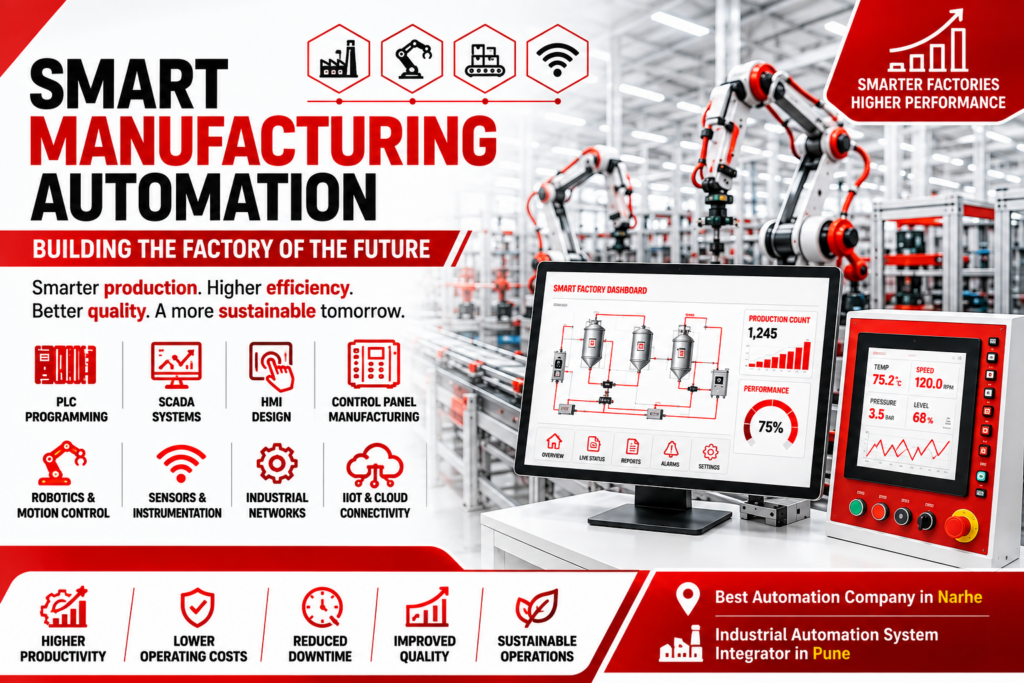
Modern smart manufacturing automation combines VFDs with PLCs, HMIs, SCADA systems, sensors, and industrial communication networks. This allows motor parameters and machine performance to be monitored in real time.
SCADA integration with PLC and VFD systems can provide centralized monitoring of motor status, operating parameters, alarms, energy consumption, and production processes. These capabilities are particularly useful for manufacturers implementing Industry 4.0 automation and connected manufacturing systems.
For companies looking for machine automation solutions in Pune, VFD-based automation can be used to modernize existing machinery, improve motor control, and integrate machines into larger production systems. It is suitable for applications ranging from a single automated machine to complete manufacturing lines.
For manufacturers searching for the best automation company in Narhe, a complete solution can combine VFD automation, PLC programming, HMI design, SCADA integration, industrial control panels, sensors, and industrial communication according to the specific production requirements.
Whether the requirement is conveyor automation, pump control, packaging automation, material handling, or process automation, VFD-based motor speed control provides a flexible and scalable approach to modern industrial automation.