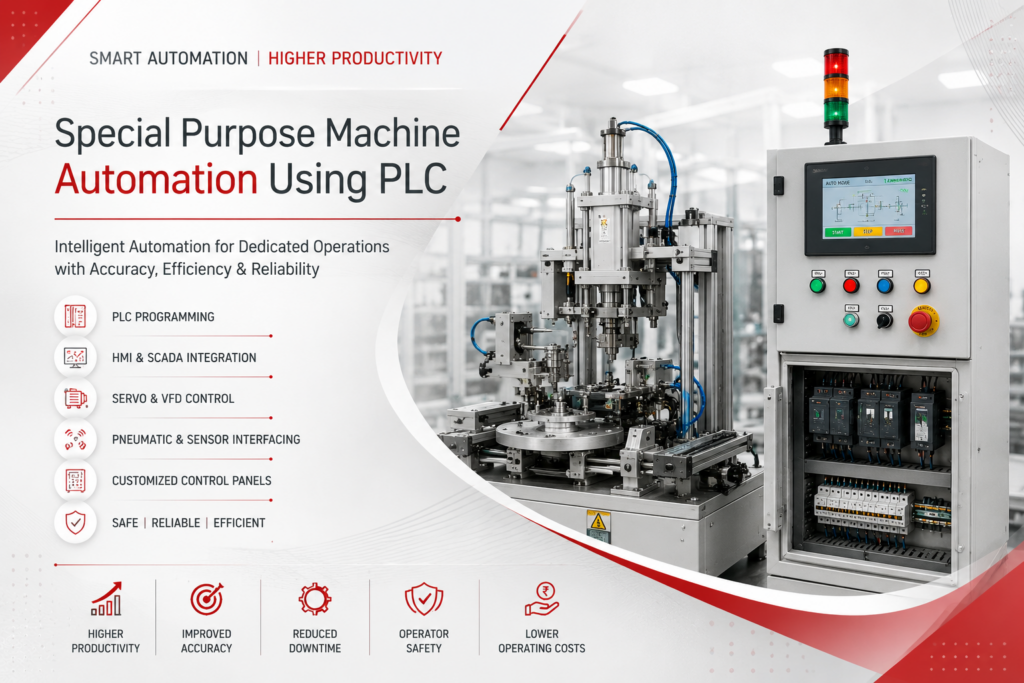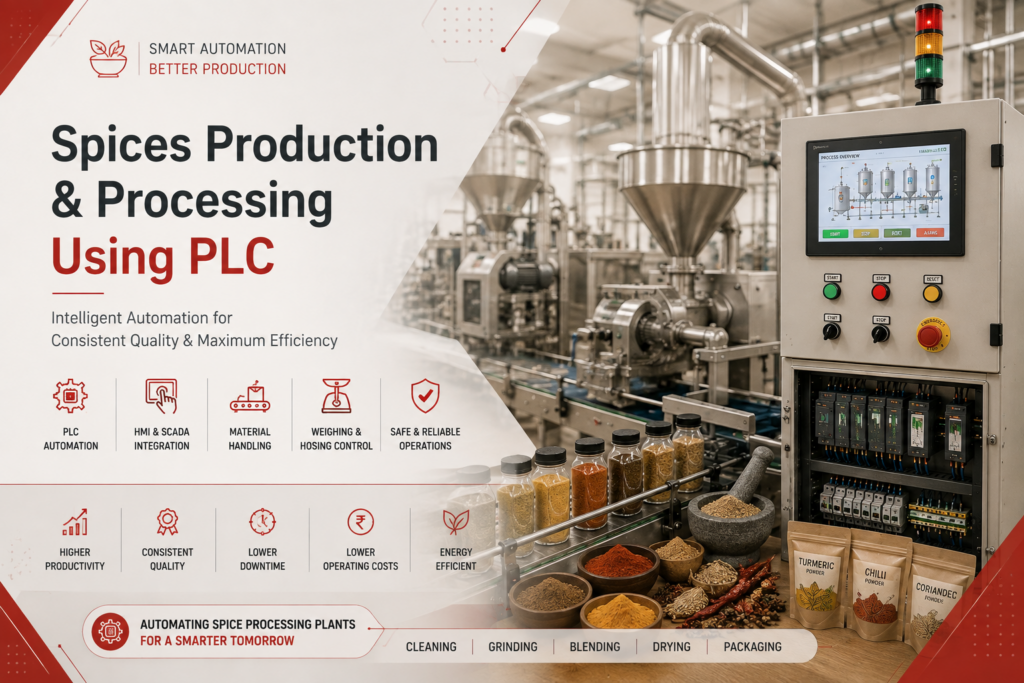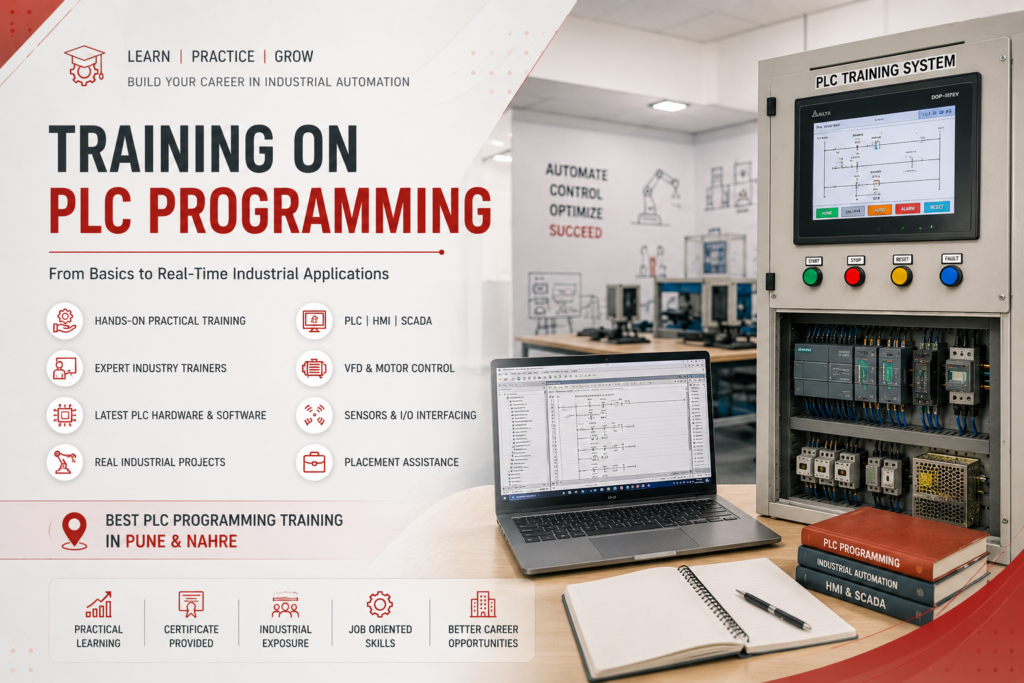
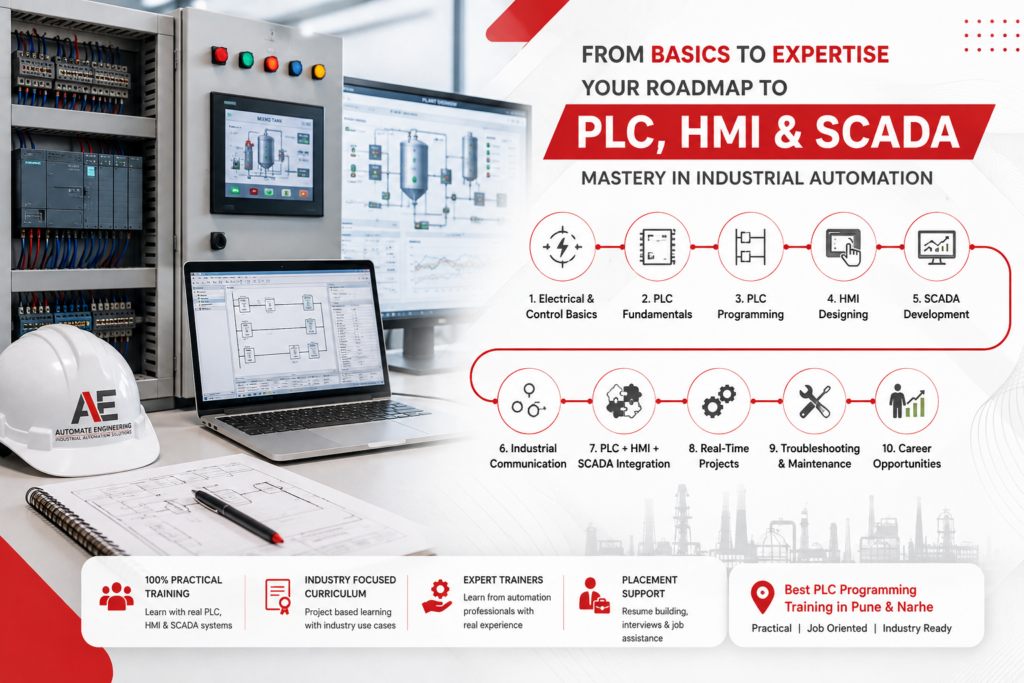
Industrial automation is transforming modern manufacturing by improving productivity, accuracy, safety, quality, and machine reliability. Among the most important technologies used in industrial automation are PLC, HMI, and SCADA.
If you are an engineering student, electrical or electronics professional, automation engineer, maintenance engineer, or someone planning to build a career in industrial automation, learning PLC programming, HMI designing, and SCADA development can provide a strong foundation for working with automated machines and industrial processes.
For students and professionals looking for PLC programming in Pune, choosing practical training that includes real PLC hardware, industrial control panels, HMI systems, SCADA software, sensors, VFDs, and troubleshooting is particularly important.
What is PLC, HMI and SCADA?
PLC – Programmable Logic Controller
A PLC (Programmable Logic Controller) is an industrial controller used to automate machines and manufacturing processes.
PLC programming involves developing control logic that receives signals from field devices such as sensors and switches, processes the inputs according to the program, and controls outputs such as motors, valves, contactors, solenoids, and actuators.
Common PLC programming concepts include:
- Digital Inputs and Digital Outputs
- Analog Inputs and Analog Outputs
- Ladder Logic
- Function Block Diagram
- Structured Text
- Timers and Counters
- Comparators
- Data registers
- PID control
- Interlocks
- Alarms
- Motor control
- Sequential machine operation
- Communication protocols
Popular PLC platforms used in industry include Siemens, Allen-Bradley, Mitsubishi, Delta, Schneider and Omron.
HMI – Human Machine Interface
An HMI (Human Machine Interface) allows operators to monitor and control machines through a graphical interface.
A properly designed HMI can display:
- Machine status
- Motor status
- Process values
- Temperature and pressure
- Production counters
- Alarms
- Setpoints
- Manual/Auto operation
- Fault information
- Trends
- Recipe parameters
HMI training should not be limited to screen designing. Students should understand how the HMI communicates with the PLC and how real-time machine data is displayed and controlled.
SCADA – Supervisory Control and Data Acquisition
SCADA is used for centralized monitoring, supervisory control, data acquisition, alarm management, and historical data analysis.
SCADA systems are commonly used in:
- Manufacturing plants
- Water treatment plants
- Food processing
- Pharmaceutical industries
- Chemical plants
- Power systems
- Oil & gas
- Building management
- Process industries
A SCADA training program should cover tags, graphics, alarms, trends, data logging, user management, reports, communication, and industrial databases.
Complete PLC, HMI and SCADA Learning Roadmap
A structured learning path can help beginners progress from electrical control fundamentals to advanced industrial automation.
Step 1: Learn Electrical and Industrial Control Fundamentals
Before starting advanced PLC programming, understand the fundamentals of industrial electrical systems.
Important topics include:
- AC and DC fundamentals
- Three-phase systems
- Control circuits
- Contactors
- Relays
- Overload relays
- MCB, MCCB and protection devices
- Push buttons
- Selector switches
- Proximity sensors
- Photoelectric sensors
- Limit switches
- Solenoid valves
- Motors
- VFDs
- Control panel components
This knowledge makes PLC troubleshooting and panel wiring much easier.
Step 2: Understand PLC Architecture
The next step is understanding how a PLC works.
Learn:
- CPU
- Power supply
- Digital input modules
- Digital output modules
- Analog input modules
- Analog output modules
- Communication modules
- Memory
- PLC scan cycle
- Input processing
- Program execution
- Output processing
You should also understand the difference between conventional relay-based control and PLC-based automation.
Step 3: Start PLC Programming
PLC programming is the core skill required for industrial automation.
Start with simple logic:
- Start/Stop control
- Latching circuits
- Motor control
- Interlocking
- Timers
- Counters
- On-delay and off-delay operations
- Sequential control
- Auto/Manual operation
Then progress to advanced concepts:
- Data handling
- Analog signal processing
- PID control
- High-speed counters
- Motion control
- Recipe management
- Fault handling
- Alarm logic
- Machine sequencing
For anyone searching for the best PLC programming in Pune, a practical program should include extensive hands-on PLC programming rather than only theoretical classroom sessions.
Step 4: Learn HMI Designing
Once PLC programming is understood, connect the PLC to an HMI.
Learn how to develop:
- Main screens
- Machine overview screens
- Motor control screens
- Manual operation screens
- Auto operation screens
- Alarm screens
- Parameter screens
- Trend screens
- Production dashboards
- User login screens
Students should also learn HMI-to-PLC communication and tag configuration.
Step 5: Learn SCADA Development
After mastering PLC and HMI fundamentals, move toward SCADA.
Important SCADA topics include:
- SCADA architecture
- Tags
- Tag databases
- Graphics
- Animations
- Alarms
- Alarm history
- Trends
- Data logging
- Reports
- User management
- Historical data
- PLC communication
- Industrial networking
Popular SCADA platforms include Siemens WinCC, Rockwell FactoryTalk View and other industrial SCADA solutions.
Step 6: Learn Industrial Communication
Industrial automation professionals must understand how different devices communicate.
Important communication technologies include:
- Ethernet
- Modbus RTU
- Modbus TCP
- RS-232
- RS-485
- Profinet
- Profibus
- EtherNet/IP
- OPC UA
A good PLC HMI SCADA training program in Pune should include practical communication exercises between PLCs, HMIs, SCADA systems, VFDs, sensors, and other industrial devices.
Step 7: Integrate PLC + HMI + SCADA
The real value of training comes from integrating all three systems.
A typical architecture can be:
Sensors → PLC → HMI → SCADA → Database → Reports
For example, a manufacturing machine can use sensors to detect products. The PLC processes the sensor signals and controls motors and actuators. The HMI allows the operator to control and monitor the machine, while SCADA collects production information and provides centralized monitoring and historical data.
Step 8: Work on Industrial Automation Projects
Project-based learning is one of the best ways to develop practical automation skills.
Some useful training projects include:
Conveyor Automation
Develop a conveyor system with:
- Start/Stop control
- Sensors
- Motor control
- Product counting
- Emergency stop
- Auto/Manual modes
- HMI monitoring
Tank Level Control
Develop a PLC-based tank automation system using:
- Level sensors
- Pump control
- Solenoid valves
- High/low-level alarms
- HMI visualization
- Automatic operation
Automatic Bottle Filling System
A bottle filling project can include:
- Conveyor control
- Bottle detection
- Filling valve
- Level or timer-based filling
- Counting
- Reject mechanism
- HMI control
- SCADA monitoring
VFD-Based Motor Control
Learn how to control motor speed through a VFD using:
- PLC
- HMI
- Analog signals
- Digital commands
- Modbus communication
SCADA-Based Production Monitoring
Develop a production monitoring system that displays:
- Machine status
- Production quantity
- Running hours
- Downtime
- Faults
- Alarms
- Historical trends
Why Practical Training Matters
Learning PLC programming only through videos or theoretical classes may not be sufficient for industrial work.
A practical automation training program should provide exposure to:
PLC + HMI + SCADA + VFD + Sensors + Electrical Panels + Industrial Communication
Students should get opportunities to wire circuits, develop PLC programs, configure HMIs, establish communication, troubleshoot faults, and commission automation systems.
PLC, HMI and SCADA Career Opportunities
After completing practical training, learners can explore roles such as:
- PLC Programmer
- Automation Engineer
- PLC-HMI Engineer
- SCADA Engineer
- Control Panel Design Engineer
- Commissioning Engineer
- Maintenance Automation Engineer
- Electrical Automation Engineer
- Process Automation Engineer
- Industrial IoT Engineer
Practical experience with real industrial hardware can significantly improve your ability to work on automation projects.
How to Choose PLC Training in Pune
If you are searching for PLC programming Pune, PLC training Pune, or industrial automation training Pune, compare training institutes based on practical exposure rather than only course duration or certification.
Look for:
- Real PLC hardware
- Multiple PLC brands
- HMI training
- SCADA training
- VFD training
- Industrial networking
- Electrical control panel exposure
- Practical troubleshooting
- Industrial automation projects
- Experienced trainers
- Internship or project opportunities
- Job-oriented curriculum
For learners specifically searching for PLC programming in Narhe, PLC training in Narhe Pune, or industrial automation training in Narhe, accessibility to a practical automation laboratory and hands-on equipment should be an important consideration.
Recommended Learning Sequence
A beginner can follow this sequence:
Electrical Fundamentals → PLC Fundamentals → PLC Programming → HMI → VFD → Industrial Communication → SCADA → PLC-HMI-SCADA Integration → Industrial Projects → Troubleshooting & Commissioning
This progression provides a strong foundation for entering the industrial automation field.
Final Thoughts
PLC, HMI and SCADA form an important part of modern industrial automation. However, becoming an automation professional requires more than learning programming commands.
The most effective approach is to combine theory, hands-on practice, industrial hardware, real-world projects, troubleshooting, communication protocols, and system integration.
Whether you are searching for best PLC programming in Pune, PLC training in Pune, PLC training in Narhe, or a complete Industrial Automation Training program, choose a learning path that takes you from basic electrical control concepts to complete PLC-HMI-SCADA project development.
With consistent practical training and project experience, learners can build the technical skills required to work with modern automated machines, production lines, process plants, and industrial control systems.