Learning PLC programming is much more effective when you combine theory with practical automation projects. Beginners can understand ladder logic, timers, counters, sensors, motors, and HMI concepts much faster by building small projects and gradually increasing their complexity.
For students and working professionals looking for the best PLC programming in Pune, practical project-based training is one of the best ways to develop industry-ready automation skills. Training locations around Narhe, Pune are also becoming popular among engineering students and automation professionals because of their access to industrial training and technical institutes.
Why Should Beginners Practice PLC Projects?
PLC programming is not only about learning instructions such as NO/NC contacts, coils, timers, and counters. In an industrial environment, automation engineers need to understand how a PLC interacts with sensors, motors, valves, drives, HMIs, and other field devices.
Practical projects help beginners learn:
- PLC ladder logic programming
- Digital and analog I/O
- Timers and counters
- Motor control
- Sensor integration
- Interlocking and sequencing
- HMI communication
- Alarm and fault handling
- VFD and PLC communication
- Industrial troubleshooting
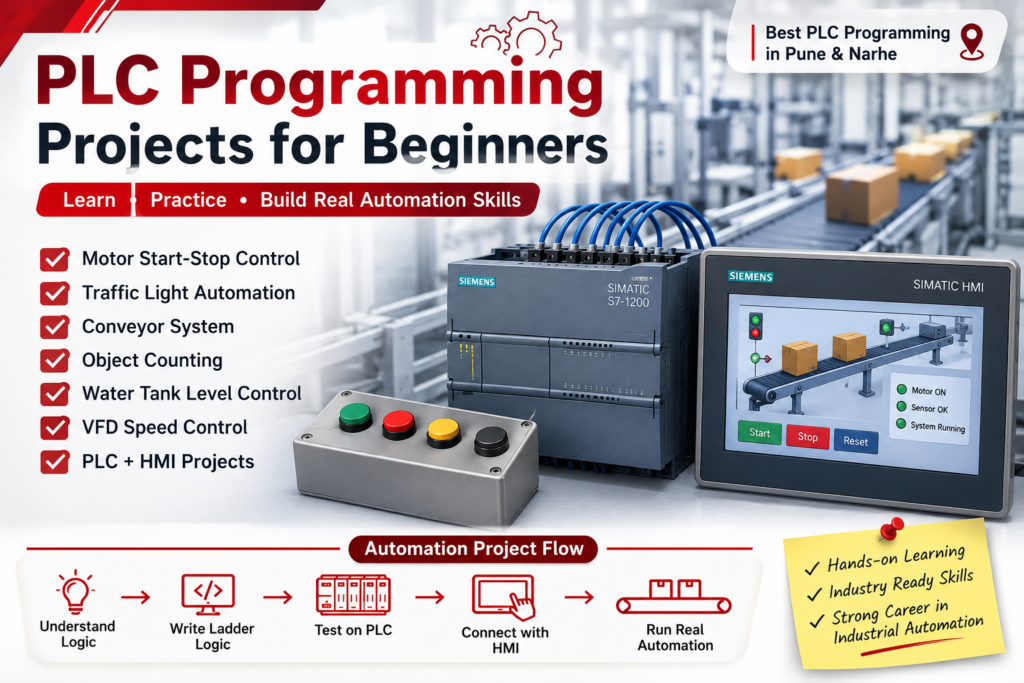
1. Motor Start-Stop Control
A basic motor start-stop circuit should be one of the first projects for every PLC beginner.
The project can include:
- Start push button
- Stop push button
- Motor contactor
- Overload protection
- Start/stop indication
- PLC digital inputs and outputs
The main objective is to understand latching logic, interlocking, and basic motor control.
2. Traffic Light Control
A PLC-based traffic light project is an excellent way to learn timers and sequential programming.
You can program:
- Green light ON
- Green light OFF
- Yellow light ON
- Yellow light OFF
- Red light ON
- Repeat the sequence
This project introduces beginners to timers, sequencing, and automatic operation.
3. Automatic Conveyor System
Conveyor automation is widely used in manufacturing, packaging, food processing, and material-handling industries.
A beginner-level conveyor project can use:
- Start/stop buttons
- Proximity sensors
- Conveyor motor
- Object detection
- Emergency stop
- PLC
- HMI
The PLC can start the conveyor when the system is enabled and stop it when a sensor detects a specific condition.
This project helps students understand how PLC programming is applied to real industrial machines.
4. Object Counting System
An object-counting project is another useful beginner exercise.
A proximity sensor detects products moving on a conveyor, while the PLC counts each detected object.
You can practice:
- Counter instructions
- Sensor inputs
- Preset values
- Reset functions
- HMI display
- Production count
For example, the system can automatically stop the conveyor after 100 products have been counted.
5. Automatic Water Tank Level Control
A water-level automation project teaches beginners how to work with sensors and pump control.
The system can include:
- Low-level sensor
- High-level sensor
- Water pump
- PLC
- HMI
- Alarm
When the tank reaches the low level, the PLC starts the pump. When the tank reaches the high level, the PLC stops the pump.
This project introduces process automation and level control concepts.
6. Star-Delta Motor Starter
After understanding basic motor control, beginners can move to a PLC-controlled star-delta starter.
The project can include:
- Main contactor
- Star contactor
- Delta contactor
- Timer
- Motor
- Overload relay
- PLC
The PLC controls the transition from star connection to delta connection after a predefined time.
This project is particularly useful for students interested in industrial automation training and electrical control systems.
7. Automatic Bottle Filling System
A bottle-filling machine is an excellent project for learning machine automation.
A typical sequence is:
Bottle Detection → Conveyor Stop → Filling Valve ON → Filling Complete → Valve OFF → Conveyor Start
Beginners can add:
- Bottle sensor
- Solenoid valve
- Conveyor motor
- Timer
- Level sensor
- Counter
- HMI
This project demonstrates how PLCs control a complete automated sequence.
8. PLC-Based Sorting System
A sorting conveyor provides a good introduction to sensors and automated material handling.
For example, sensors can detect different product characteristics and activate pneumatic cylinders to move products into different bins.
The project can involve:
- Proximity sensors
- Photoelectric sensors
- Pneumatic cylinders
- Solenoid valves
- Conveyor
- PLC
- HMI
This project helps beginners understand sensor-based automation and sequence control.
9. VFD Speed Control Using PLC
Once basic PLC programming is understood, beginners should learn how to control motor speed using a VFD.
The project can include:
PLC → VFD → Motor
Students can practice:
- Start/stop commands
- Forward/reverse control
- Speed references
- Digital inputs
- Analog outputs
- Fault monitoring
For advanced practice, PLC-to-VFD communication can be implemented using Modbus or Ethernet-based industrial communication.
10. Automatic Packaging Machine
A packaging machine combines several concepts into one project.
A basic sequence could be:
Product Detection → Conveyor Stop → Packaging Operation → Cutting/Sealing → Conveyor Start
This project can introduce:
- Sensors
- Timers
- Counters
- Pneumatics
- Motors
- Solenoid valves
- HMI
- Alarm handling
- Emergency-stop logic
It is a good stepping stone from beginner PLC programming toward machine automation.
11. HMI-Based PLC Control
After learning PLC ladder logic, beginners should connect the PLC to an HMI.
The HMI can display:
- Motor status
- Production count
- Machine mode
- Fault status
- Timer values
- Sensor status
- Start/stop controls
This teaches the relationship between PLC programming, HMI design, operator control, and industrial automation.
12. Mini SCADA Project
An advanced beginner can develop a small PLC-SCADA project.
For example, a tank automation system can display:
- Tank level
- Pump status
- Flow
- Pressure
- Alarms
- Production data
- Historical trends
This introduces the fundamentals of SCADA, industrial communication, data visualization, and process monitoring.
PLC Projects: Beginner to Advanced Roadmap
A good learning sequence is:
| Level | Project |
|---|---|
| Beginner | Motor Start-Stop |
| Beginner | Traffic Light |
| Beginner | Object Counter |
| Beginner | Water Tank Control |
| Intermediate | Conveyor Automation |
| Intermediate | Star-Delta Starter |
| Intermediate | Bottle Filling |
| Intermediate | Sorting System |
| Intermediate | VFD Control |
| Advanced | Packaging Machine |
| Advanced | PLC + HMI |
| Advanced | PLC + SCADA |
Which PLC Should Beginners Practice?
Students should ideally practice with more than one PLC platform because different industries use different automation systems.
Popular platforms include:
- Siemens S7-1200 / S7-1500
- Allen-Bradley
- Mitsubishi
- Delta
- Schneider Electric
- Omron
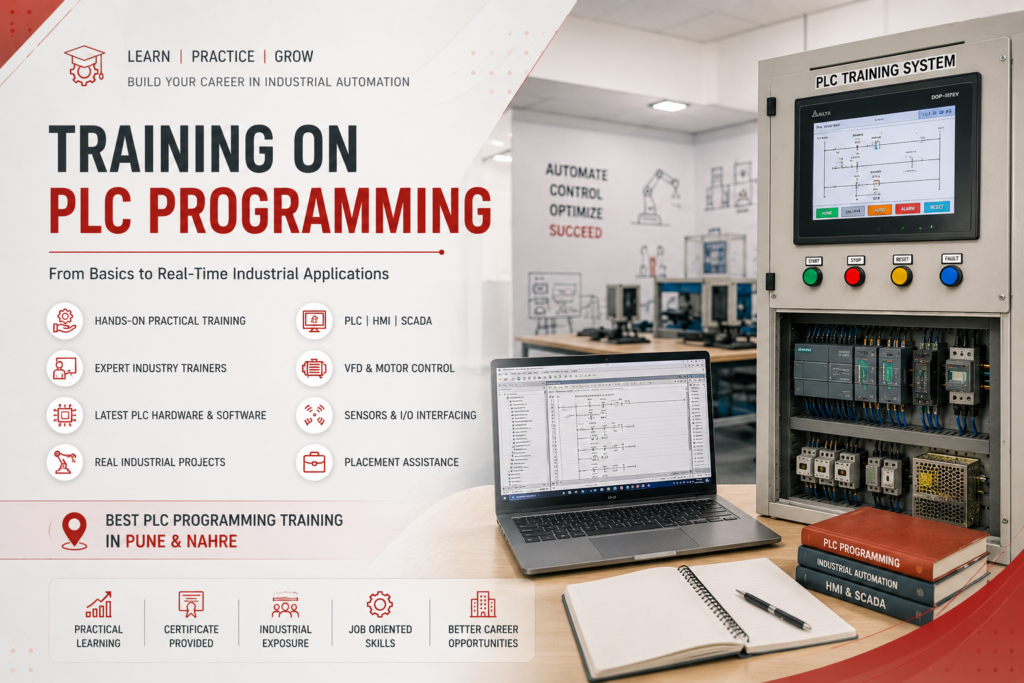
For students searching for PLC programming training in Pune, choosing a course that provides hands-on access to actual PLC hardware, HMI, VFDs, sensors, and control panels can provide much better practical exposure than learning only through simulation.
Best PLC Programming Training in Pune & Narhe
If you are searching for the best PLC programming Pune training option, look for a practical curriculum rather than a course focused only on PLC theory.
A good industrial automation training program around Narhe, Pune should cover:
- PLC programming
- Ladder logic
- HMI programming
- SCADA
- VFD
- Electrical control panels
- Industrial sensors
- Pneumatics
- Industrial communication
- Troubleshooting
- Real-time automation projects
The most valuable training is one where students actually build and troubleshoot automation systems instead of simply watching demonstrations.
Final Thoughts
PLC programming becomes much easier when beginners learn through progressively challenging projects. Starting with a simple motor-control circuit and moving toward conveyors, filling systems, VFDs, HMIs, and SCADA gives students a strong foundation in industrial automation.
Whether you are an engineering student, fresh graduate, technician, or working professional, practicing real automation projects can help you develop the practical skills required for modern manufacturing industries.
If your goal is to build a career in industrial automation, look for practical PLC programming training in Pune, particularly around Narhe, where hands-on projects, laboratory practice, and industry-oriented training can help bridge the gap between classroom learning and real industrial applications.