Modern manufacturing processes depend on accurate and reliable data from machines and production equipment. Industrial sensor integration with PLC automation allows machines to detect position, level, temperature, pressure, flow, proximity, and other process conditions, enabling automated systems to make decisions based on real-time field information.
By integrating sensors with a PLC-based industrial automation system, manufacturers can improve process accuracy, reduce manual intervention, detect faults, and create more reliable automated production systems. This approach is widely used in machine automation solutions, assembly lines, packaging systems, material handling, process industries, and smart manufacturing applications.
Role of Sensors in Industrial Automation
Sensors act as the connection between the physical process and the control system. They detect changes in the manufacturing environment and send electrical signals to the PLC.
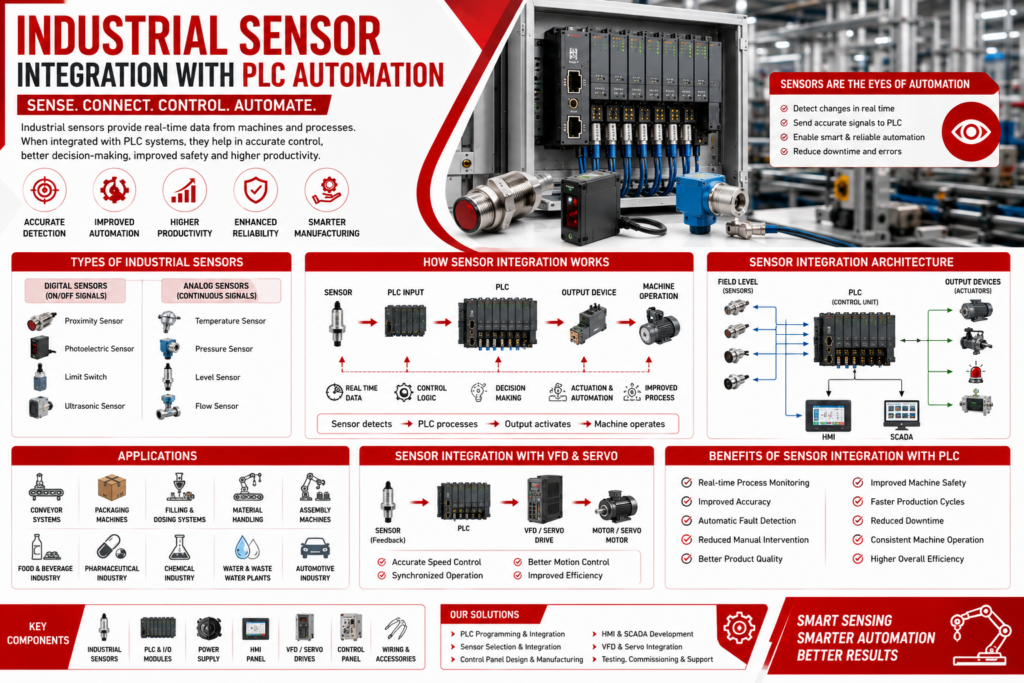
Common industrial sensors include:
- Proximity sensors
- Photoelectric sensors
- Temperature sensors
- Pressure sensors
- Level sensors
- Flow sensors
- Ultrasonic sensors
- Encoders
- Limit switches
- Inductive and capacitive sensors
For example, a proximity sensor can detect whether a component has reached a particular position on a conveyor. The PLC receives this signal and activates the next operation according to the programmed sequence.
How Sensor and PLC Integration Works
In a typical PLC sensor integration system, the sensor is connected to a PLC input module. The PLC processes the input signal and activates the required output device.
A simple automation sequence can be represented as:
Sensor → PLC → Control Logic → Output → Machine Operation
For example:
Product Sensor → PLC → Conveyor Control → VFD/Motor
When the sensor detects a product, the PLC can stop the conveyor, operate a pneumatic cylinder, start another motor, or trigger an inspection process.
Proper PLC programming for industrial automation is important for processing sensor signals, creating interlocks, managing timers and counters, detecting faults, and controlling the machine sequence.
Types of Sensor Signals
Industrial sensors can provide different types of signals depending on the application.
Digital Signals
Digital sensors provide ON/OFF signals and are commonly used for:
- Object detection
- Position detection
- Limit detection
- Door monitoring
- Part counting
- Machine safety
Analog Signals
Analog sensors provide continuously varying signals and are useful for measuring:
- Temperature
- Pressure
- Level
- Flow
- Speed
- Position
A PLC with appropriate analog input modules can process these signals and use them for automatic control.
For industries searching for PLC programming services in Pune, proper selection and configuration of PLC I/O modules is an important part of reliable automation system design.
Sensor Integration with HMI and SCADA
Sensor data can be displayed through an HMI for industrial automation, allowing operators to monitor machine conditions in real time.
An HMI can display:
- Sensor status
- Temperature values
- Pressure readings
- Product counts
- Machine position
- Fault conditions
- Process values
- Alarm notifications
For larger plants, SCADA system integration can collect sensor information from multiple machines and provide centralized monitoring, historical data, alarms, and production reports.
The combination of PLC, sensors, HMI and SCADA provides better visibility into automated manufacturing processes and supports modern smart manufacturing automation.
Industrial Sensors in Machine Automation
Sensors are essential for machine automation solutions because they allow automated machines to respond to changing conditions without continuous manual supervision.
Applications include:
- Automatic assembly machines
- Conveyor automation
- Packaging machines
- Filling and dosing systems
- Material handling
- Sorting machines
- Inspection systems
- Pharmaceutical machinery
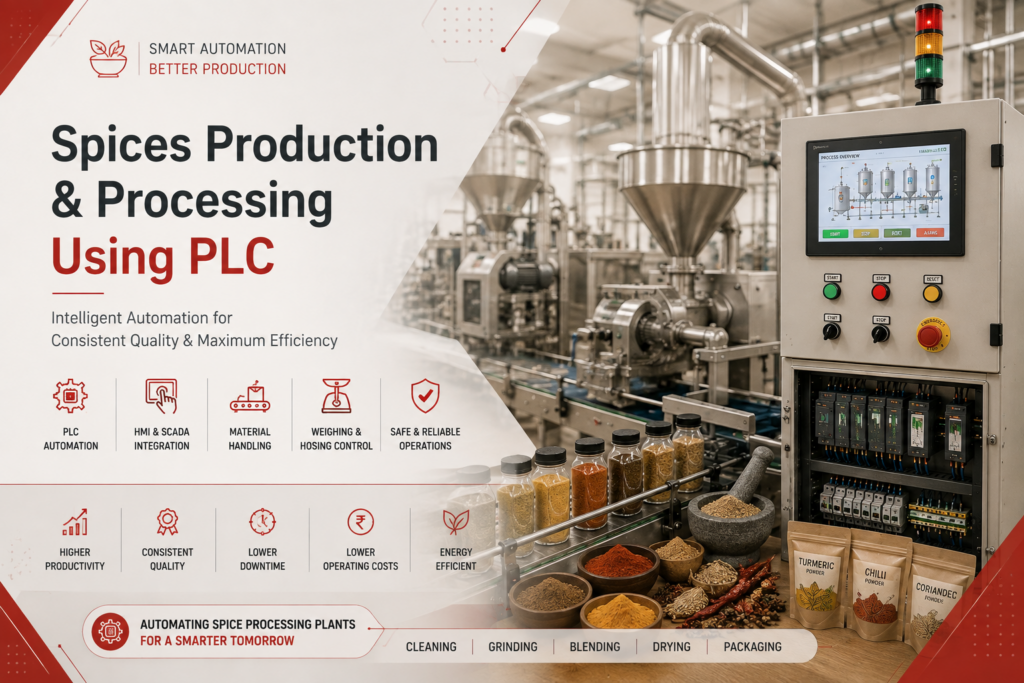
- Food and beverage processing
- Chemical process automation
- Water treatment plants
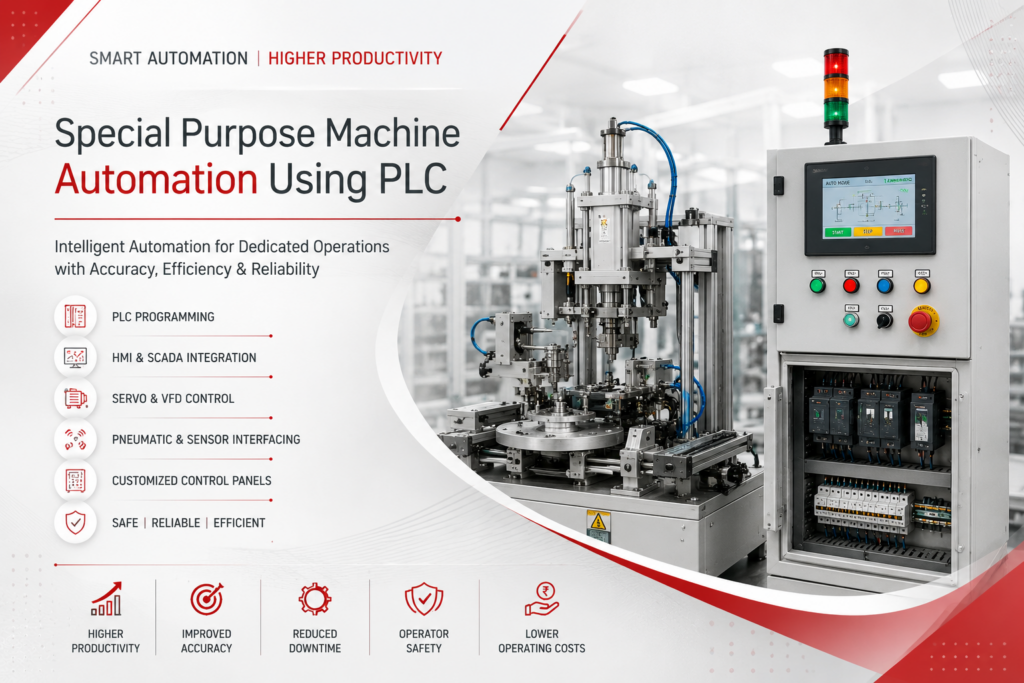
- Special Purpose Machines
In an automated assembly line, for example, sensors can verify the presence and position of components before the PLC allows the next assembly operation to begin. This helps prevent incorrect sequences and improves product consistency.
Sensor Integration with VFD and Servo Systems
Industrial sensors can also work together with VFD and servo automation. A sensor can provide feedback to the PLC, which then sends a command to a VFD or servo drive.
For example, a conveyor sensor can detect a product and the PLC can adjust the conveyor motor speed through a VFD. In high-precision applications, sensors and encoders can provide feedback for servo positioning.
This integration enables accurate motion control, synchronized machine operations, and improved production efficiency.
Industrial Control Panel for Sensor Integration
A properly designed PLC control panel provides the electrical and control infrastructure required to connect sensors with the automation system.
A typical automation control panel may contain:
- PLC and I/O modules
- 24V DC power supplies
- Terminal blocks
- Circuit protection
- Relays
- VFDs
- Servo drives
- Communication modules
- Safety components
Professional industrial control panel design and manufacturing ensures proper wiring, signal separation, protection, and easier troubleshooting.
Manufacturers searching for a PLC control panel manufacturer in Pune or an industrial automation system integrator in Pune can implement customized sensor and PLC systems according to machine and process requirements.
Benefits of Industrial Sensor Integration
Integrating sensors with PLC automation can provide:
- Real-time process feedback
- Improved machine accuracy
- Automatic fault detection
- Reduced manual intervention
- Better product quality
- Improved machine safety
- Faster production cycles
- Better process monitoring
- Reduced downtime
- Consistent machine operation
- Improved production efficiency
Sensor Integration for Smart Manufacturing
Modern Industry 4.0 automation solutions are increasingly connecting sensors, PLCs, HMIs, SCADA systems, and industrial networks. Sensor data can be collected and analyzed to monitor machine performance, production efficiency, energy consumption, and maintenance requirements.
This makes industrial sensor integration an important part of smart manufacturing automation and connected factory systems.
Manufacturers looking for industrial automation solutions in Pune, machine automation solutions in Pune, or the best automation company in Narhe can use PLC-based sensor integration to automate individual machines, production lines, and complete industrial processes.
From a simple proximity sensor controlling a conveyor to a network of process sensors connected to PLC and SCADA systems, industrial sensor integration with PLC automation provides the real-time information required for reliable, efficient, and scalable manufacturing automation.