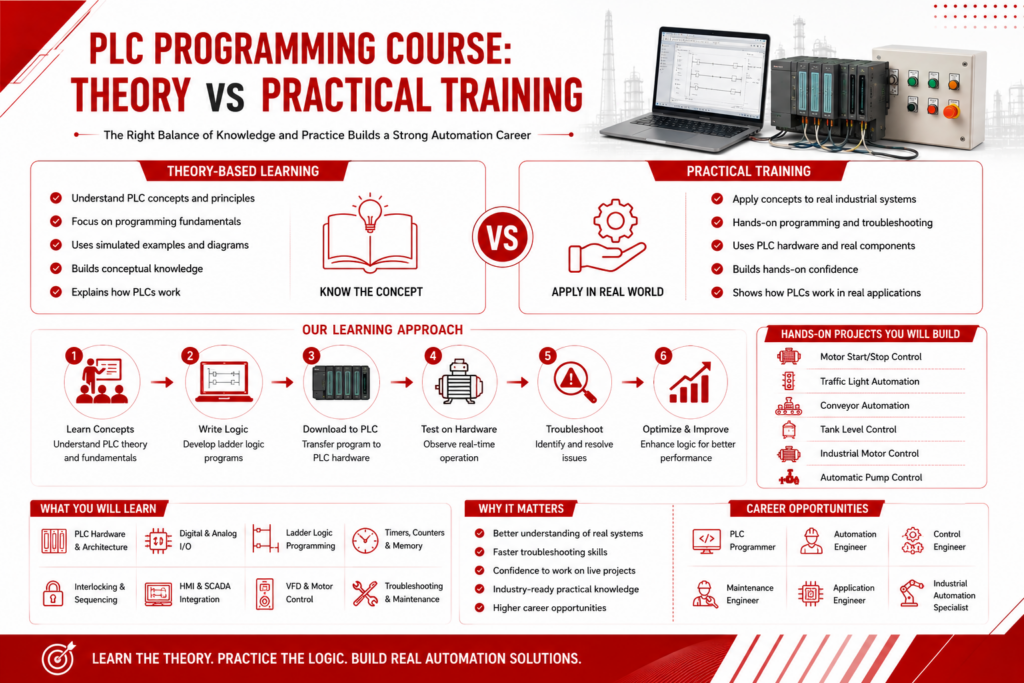
Learning PLC programming is an important step for anyone planning a career in industrial automation. While theoretical knowledge helps learners understand PLC concepts, practical training is what builds the confidence to program, troubleshoot, and work with real industrial automation systems.
A good PLC Programming Course should therefore provide the right balance between PLC theory and hands-on practical training.
Understanding PLC Theory
PLC theory provides the foundation required to understand how an automation system works. Students learn concepts such as PLC architecture, digital and analog I/O, PLC scan cycle, input/output addressing, relays, timers, counters, memory bits, latching, interlocking, and ladder logic programming.
Understanding these concepts is essential because they form the basis of machine control and automation applications.
A strong theoretical foundation helps learners understand:
- PLC hardware and CPU functions
- Digital and analog signals
- Ladder logic programming
- Timers and counters
- Set/Reset operations
- Interlocking and sequencing
- Sensors and actuators
- PLC communication
- Basic troubleshooting concepts
Why Practical PLC Training Matters
Knowing the theory is not always enough to work confidently on an actual automation project. Practical PLC training allows learners to apply programming concepts to real-world automation problems.
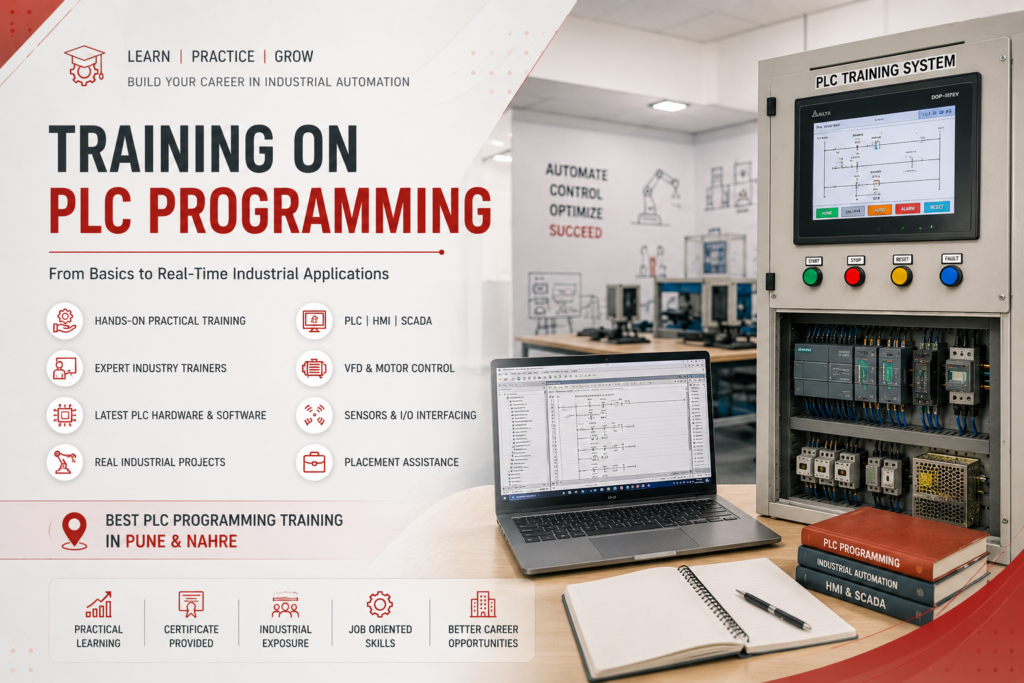
During hands-on training, students can work with PLC hardware, control panels, sensors, motors, switches, HMIs, and other industrial automation components. They can create and test ladder logic programs and observe how the actual machine or process responds.
Practical exercises may include:
Motor Start/Stop Control – Understanding contact logic, latching, and motor control.
Traffic Light Automation – Developing sequential logic using timers.
Conveyor Automation – Using sensors, motors, timers, counters, and interlocks.
Tank Level Control – Monitoring level sensors and controlling pumps automatically.
Industrial Motor Control – Implementing start/stop, overload, and fault conditions.
These projects help learners understand how PLC programming is applied in industrial automation rather than simply writing programs based on theoretical examples.
Theory vs Practical Training
| Theory-Based Learning | Practical Training |
|---|---|
| Understands PLC concepts | Applies concepts to real systems |
| Focuses on programming principles | Focuses on programming and troubleshooting |
| Uses simulated examples | Uses PLC hardware and industrial components |
| Builds conceptual knowledge | Builds hands-on confidence |
| Explains how PLCs work | Shows how PLCs work in real applications |
The ideal PLC automation training program combines both approaches. Theory explains why a system works, while practical training teaches learners how to implement and troubleshoot it.
What Should a Good PLC Course Include?
A job-oriented Industrial Automation Training Course should cover PLC programming along with related technologies such as HMI, SCADA, VFDs, sensors, control panels, industrial communication, and troubleshooting.
Learners should get opportunities to develop complete automation projects, understand wiring and I/O connections, test programs, identify faults, and modify logic according to application requirements.
This practical exposure can be especially valuable for students and beginners looking to enter the industrial automation field as PLC programmers, automation engineers, control engineers, or maintenance engineers.
Build Skills Beyond PLC Programming
PLC programming is only one part of an industrial automation system. Understanding how the PLC communicates with HMI, VFD, sensors, actuators, and control panels gives learners a better understanding of complete automation solutions.
For anyone searching for a PLC Programming Course in Pune, choosing training that combines classroom concepts with practical industrial automation projects can provide a stronger learning experience.
Learn the theory. Practice the logic. Build real automation solutions.
#PLCProgramming #PLCTraining #IndustrialAutomation #PLCAutomation #PLCProgrammingCourse #AutomationTraining #LadderLogic #HMI #SCADA #VFD #IndustrialAutomationTraining #AutomationEngineering #PLCProgrammingPune #IndustrialAutomationPune #AutomationSkills