Industrial automation is not only about PLC programming. In a modern factory, PLCs, HMIs, VFDs, sensors, remote I/O, SCADA systems and other industrial devices must communicate with each other reliably.
This is why Industrial Communication Training is an important skill for electrical engineers, automation engineers, instrumentation engineers, maintenance engineers and PLC programmers.
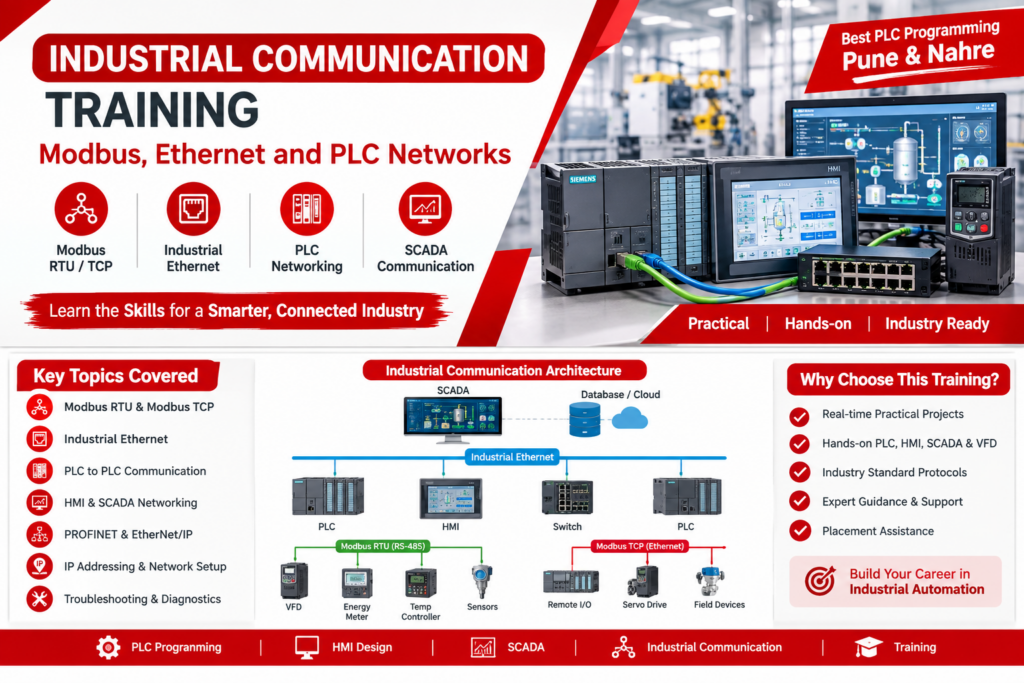
Communication technologies such as Modbus RTU, Modbus TCP, Industrial Ethernet, PROFINET, EtherNet/IP and PLC-to-PLC communication are widely used in automation systems.
What is Industrial Communication?
Industrial communication is the process of exchanging data between industrial automation devices.
For example:
- PLC to PLC communication
- PLC to HMI communication
- PLC to VFD communication
- PLC to SCADA communication
- PLC to remote I/O
- PLC to energy meter
- PLC to temperature controller
- PLC to industrial sensors
- PLC to IIoT gateway
A PLC may send commands, receive process values, monitor equipment status and exchange production data through an industrial network.
Understanding these communication systems helps engineers troubleshoot automation machines more effectively.
Why Industrial Communication Training is Important
A PLC program can control a machine successfully, but the complete automation system often requires communication between multiple devices.
For example, a packaging machine may contain:
PLC → HMI → VFD → Servo Drive → Sensors → Remote I/O → SCADA
If communication between these devices fails, the machine may stop or important process data may not reach the supervisory system.
Industrial communication training helps students and working engineers understand:
- Communication protocols
- RS-485 wiring
- Ethernet networking
- IP addressing
- Modbus registers
- PLC communication instructions
- Device configuration
- Network troubleshooting
- Data exchange between controllers
- SCADA communication
- Industrial networking architecture
Modbus RTU Training
Modbus RTU is one of the commonly encountered industrial communication protocols, particularly over RS-485 networks.
In practical training, students can learn how a PLC communicates with devices such as:
- VFDs
- Energy meters
- Temperature controllers
- Flow meters
- Pressure instruments
- Remote I/O
- Servo drives
- Other PLCs
Important Modbus concepts include:
- Master and slave/client and server concepts
- RS-485 communication
- Baud rate
- Parity
- Stop bits
- Slave/device address
- Function codes
- Holding registers
- Input registers
- Coil status
- Input status
- Read/write operations
- Register mapping
- Communication diagnostics
A practical project could involve controlling a VFD from a PLC using Modbus RTU and reading parameters such as frequency, current, voltage and fault status.
Modbus TCP Training
Modbus TCP uses Ethernet networking for communication and is useful when automation devices need to exchange data over an Ethernet-based network.
Students can learn:
- Ethernet fundamentals
- IP addresses
- Subnet masks
- TCP communication
- Modbus TCP client/server concepts
- PLC configuration
- Register mapping
- HMI communication
- VFD communication
- Troubleshooting communication errors
Modbus RTU and Modbus TCP are commonly included in industrial communication learning paths alongside industrial Ethernet technologies.
Industrial Ethernet Training
Industrial Ethernet is an important part of modern automation networking.
Training can cover:
- Ethernet basics
- Industrial Ethernet architecture
- Ethernet switches
- IP addressing
- Subnetting
- Network topology
- PLC Ethernet communication
- HMI Ethernet communication
- SCADA networking
- Device diagnostics
- Network troubleshooting
Engineers should understand the difference between an ordinary office network and the requirements of an industrial network.
PLC Networking
PLC networking allows multiple controllers and automation devices to exchange information.
Examples include:
PLC ↔ PLC
PLC ↔ HMI
PLC ↔ SCADA
PLC ↔ VFD
PLC ↔ Remote I/O
PLC ↔ Energy Meter
PLC ↔ IIoT Gateway
Practical PLC networking training can help engineers understand how to configure communication parameters, assign addresses, exchange data and diagnose communication faults.
PROFINET and EtherNet/IP
Industrial communication training can also introduce Ethernet-based industrial protocols such as PROFINET and EtherNet/IP.
PROFINET is widely associated with Siemens automation systems, while EtherNet/IP is used extensively in Rockwell Automation environments. Training programs may also cover OPC UA for communication between automation systems and higher-level software.
Students can understand:
- Network configuration
- Device addressing
- PLC communication
- Remote I/O
- Device diagnostics
- Industrial switches
- Network architecture
- Troubleshooting
PLC Communication Practical Projects
Hands-on projects make industrial communication easier to understand.
Some useful training projects include:
Project 1: PLC and VFD Modbus Communication
Configure a PLC to communicate with a VFD through Modbus RTU.
The project can include:
- Start/stop command
- Speed reference
- Frequency monitoring
- Current monitoring
- Fault monitoring
- VFD parameter reading
Project 2: PLC and Energy Meter
Connect an energy meter to a PLC using Modbus RTU or Modbus TCP.
Display:
- Voltage
- Current
- Power
- Energy
- Power factor
- Frequency
Project 3: PLC to HMI Ethernet Communication
Configure an HMI to communicate with a PLC through Ethernet.
The HMI can display:
- Machine status
- Motor status
- Production count
- Alarm information
- Process parameters
- Manual/Auto operation
Project 4: PLC to SCADA Communication
Connect a PLC with SCADA software for centralized monitoring.
The project can include:
- Real-time data
- Alarm management
- Historical trends
- Production monitoring
- User access
- Reports
Project 5: PLC-to-PLC Communication
Two PLCs can exchange process information over an industrial network.
For example:
PLC-1 → Production Data → PLC-2
PLC-2 → Machine Status → PLC-1
This type of exercise helps students understand data exchange between different control systems.
Industrial Communication Troubleshooting
Troubleshooting is one of the most important parts of industrial communication training.
Common problems include:
- Wrong IP address
- Duplicate IP address
- Incorrect baud rate
- Incorrect parity
- Wrong slave ID
- Incorrect register address
- Incorrect function code
- Loose RS-485 wiring
- Incorrect A/B wiring
- Ethernet cable problems
- Switch configuration problems
- PLC communication settings
- Incorrect data type
- Timeout errors
A systematic troubleshooting approach starts with checking the physical connection and communication parameters before moving to PLC configuration and application-level diagnostics. Industrial networking courses commonly emphasize this structured approach.
Industrial Communication and SCADA
Industrial communication is also essential for SCADA systems.
A typical architecture can be:
Field Instruments → PLC → Industrial Network → SCADA → Database → Dashboard
SCADA systems can collect data such as:
- Temperature
- Pressure
- Flow
- Level
- Motor status
- Production count
- Energy consumption
- Alarm status
This makes industrial communication an important foundation for SCADA training, IIoT solutions and Industry 4.0 applications.
Industrial Communication Training for Students and Engineers
Students from Electrical, Electronics, E&TC, Instrumentation, Mechatronics and Mechanical engineering can benefit from practical industrial networking knowledge.
Working professionals can use these skills for:
- PLC programming
- Machine automation
- Commissioning
- Maintenance
- SCADA projects
- VFD integration
- Control panel projects
- Industrial IoT
- Factory automation
- Troubleshooting
For learners searching for best plc programming pune & nahre, industrial communication should be considered an important part of practical PLC training rather than a separate theoretical topic.
Best PLC Programming Pune & Nahre – Practical Learning Approach
Searching for best plc programming pune & nahre often means looking for training that goes beyond basic ladder logic.
A practical PLC and automation training program should combine:
PLC Programming + HMI + SCADA + VFD + Industrial Communication + Control Panels + Troubleshooting
Students should get exposure to real automation concepts rather than only software-based exercises.
A strong learning roadmap can be:
- PLC fundamentals
- Digital and analog I/O
- Ladder programming
- Timers and counters
- HMI designing
- VFD programming
- Modbus RTU
- Modbus TCP
- Industrial Ethernet
- PLC-to-PLC communication
- SCADA communication
- Industrial troubleshooting
- IIoT integration
- Automation project development
Career Opportunities After Industrial Communication Training
Knowledge of industrial communication can support careers such as:
- PLC Programmer
- Automation Engineer
- Control Engineer
- SCADA Engineer
- Commissioning Engineer
- Maintenance Engineer
- Instrumentation Engineer
- Industrial IoT Engineer
- Service Engineer
- Automation Project Engineer
Communication skills become particularly useful when working on multi-device automation projects where PLCs, drives, HMIs, SCADA systems and field devices must work together.
Conclusion
Industrial communication is a core skill for modern automation engineers.
Learning Modbus RTU, Modbus TCP, Ethernet, PLC networking, PROFINET, EtherNet/IP and SCADA communication can help engineers understand how automation devices exchange information and how communication problems can be diagnosed.
For students and professionals looking for best plc programming pune & nahre, combining PLC programming with practical industrial communication, HMI, SCADA, VFD and troubleshooting skills can create a more complete industrial automation learning path.
The objective should be simple: learn the PLC, understand the network, communicate with the devices and troubleshoot the complete automation system.
#IndustrialCommunication #Modbus #PLCProgramming #IndustrialEthernet #PLCTraining #SCADA #AutomationTraining #PROFINET #EtherNetIP #IndustrialAutomation