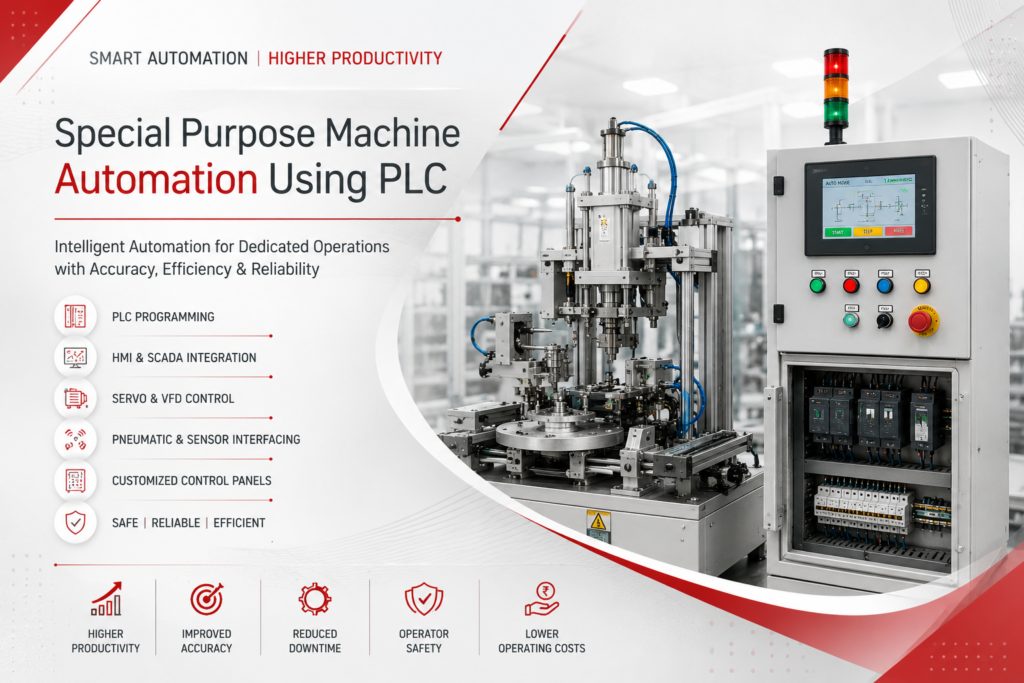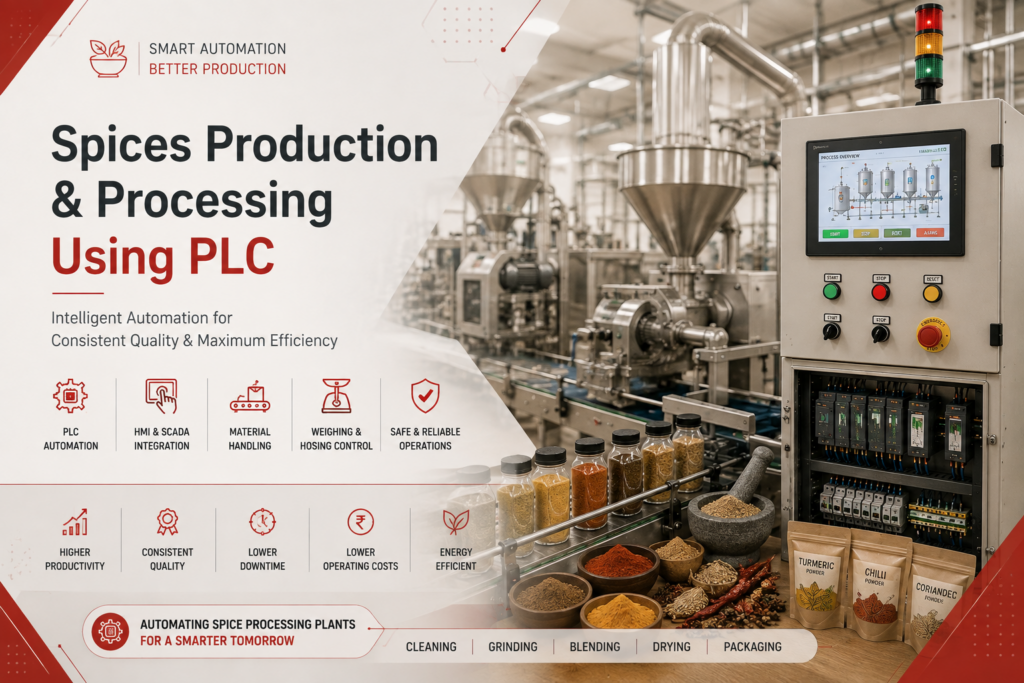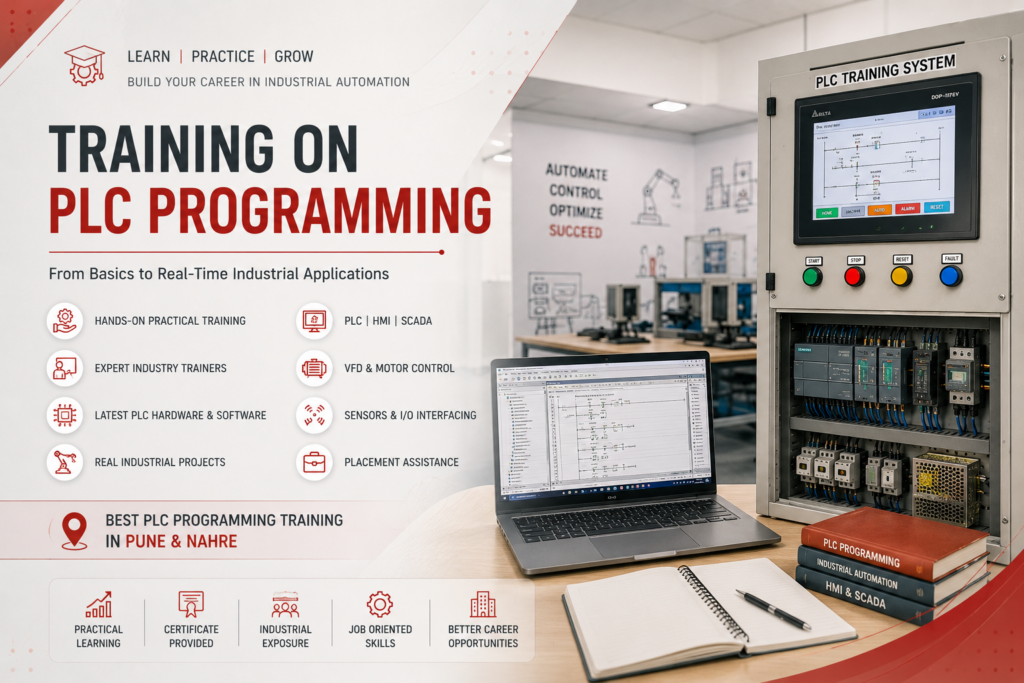
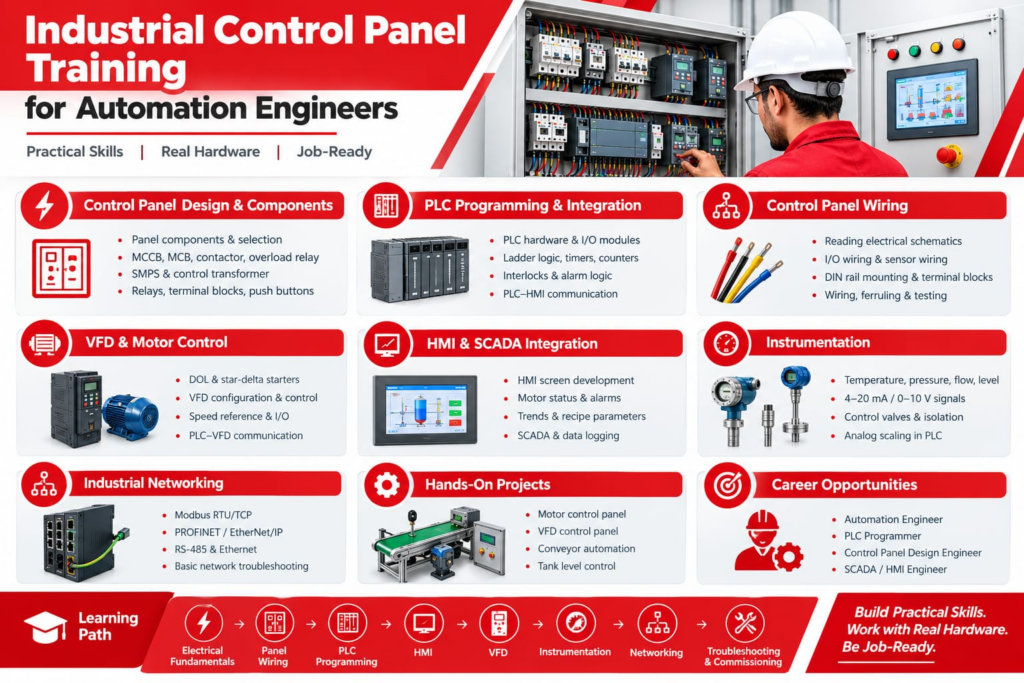
Industrial automation engineers need more than PLC programming knowledge. They should understand how a complete industrial control panel is designed, wired, tested, commissioned, and connected with field devices. A practical control panel training program helps engineers develop these skills through real-world electrical and automation applications.
Modern automation training commonly combines PLCs with control-panel hardware, HMI, SCADA, VFDs, instrumentation, industrial networking, and troubleshooting.
What Is Industrial Control Panel Training?
Industrial Control Panel Training focuses on the practical design and operation of electrical and automation control panels used in machines, production lines, process plants, utilities, and manufacturing systems.
Engineers learn how to understand electrical drawings, select panel components, perform control wiring, connect PLC I/O, configure drives, and troubleshoot panel-related problems.
The training can cover:
- Electrical control panel fundamentals
- Control panel components and selection
- MCCB, MCB, contactor and overload relay
- SMPS and control transformers
- Relays and terminal blocks
- Push buttons and selector switches
- Emergency stop circuits
- PLC panel wiring
- Digital and analog I/O wiring
- VFD and motor control
- DOL and star-delta starters
- HMI integration
- Industrial sensors
- Control panel testing and troubleshooting
Control-panel training is particularly useful because engineers need practical exposure to components such as MCCBs, contactors, VFDs, PLC I/O, relays, and terminal blocks—not just theoretical knowledge.
PLC Programming and Control Panel Integration
A PLC is the main control element in many modern automation systems. Engineers should understand the complete path from field device → panel wiring → PLC I/O → PLC program → HMI/SCADA → machine output.
Training should therefore include:
- PLC hardware architecture
- CPU and I/O modules
- Digital input/output
- Analog input/output
- PLC addressing
- Ladder logic programming
- Timers and counters
- Interlocks
- Motor sequencing
- Alarm logic
- Fault detection
- PLC troubleshooting
- PLC-to-HMI communication
Practical PLC training is valuable because programming, troubleshooting, diagnostics, and maintenance are essential skills for industrial automation professionals.
Control Panel Wiring Practical Training
One of the most important parts of industrial control panel training is practical wiring.
Engineers can learn:
- Reading electrical schematics
- Understanding power and control circuits
- Component identification
- DIN rail component mounting
- Terminal block arrangement
- Control cable routing
- Ferruling and wire numbering
- PLC I/O wiring
- Sensor wiring
- VFD control wiring
- Motor starter wiring
- Panel continuity testing
Proper documentation and wiring practices make commissioning and future troubleshooting easier.
VFD and Motor Control Training
Industrial automation engineers frequently work with motors and variable-frequency drives.
A practical course can cover:
- DOL starter
- Star-delta starter
- VFD fundamentals
- VFD parameter configuration
- Start/stop control
- Speed reference
- Digital inputs
- Analog speed reference
- PLC-VFD communication
- Modbus communication
- Motor protection
- VFD fault troubleshooting
This connects electrical control-panel knowledge with PLC programming and machine automation.
HMI and SCADA Integration
After PLC programming, engineers should learn how the control panel communicates with operator interfaces.
Typical training applications include:
- HMI screen development
- Start/stop controls
- Motor status
- Speed monitoring
- Alarm indication
- Fault reset
- Analog value display
- Trends
- Recipe parameters
- SCADA communication
- Data logging
Modern automation training increasingly combines PLC, HMI, SCADA, VFD and industrial networking as an integrated skill set.
Industrial Instrumentation
For process automation applications, control-panel engineers should also understand basic instrumentation.
Important topics include:
- Temperature sensors
- RTD and thermocouple
- Pressure transmitters
- Flow transmitters
- Level sensors
- 4–20 mA signals
- 0–10 V signals
- Digital sensors
- Control valves
- Signal isolation
- Analog scaling in PLC
This knowledge is useful for applications in food and beverage, chemical, pharmaceutical, water treatment, manufacturing, HVAC and process industries.
Industrial Networking
Modern control panels are no longer isolated systems. PLCs, HMIs, VFDs, remote I/O and SCADA systems often communicate over industrial networks.
Training can include:
- Ethernet
- Industrial Ethernet
- Modbus RTU
- Modbus TCP
- PROFINET
- EtherNet/IP
- RS-485
- PLC-HMI communication
- PLC-VFD communication
- Basic network troubleshooting
Hands-On Control Panel Projects
The best way to understand control panels is through practical projects.
Project 1 – Motor Control Panel
PLC + contactor + overload + motor + HMI
Project 2 – VFD Control Panel
PLC + VFD + motor + HMI with speed control
Project 3 – Conveyor Automation
PLC + sensors + VFD + motor + HMI
Project 4 – Tank Level Control
Level sensor + pump + PLC + HMI + control valve
Project 5 – Batch Process Control
Temperature + level + flow + pressure + PLC + HMI/SCADA
These projects help engineers connect electrical wiring, PLC programming, instrumentation, operator interface and troubleshooting into one complete automation system.
Best PLC Programming Pune & Nahre
For engineers searching for best plc programming pune & nahre, practical industrial automation training should go beyond software-based PLC programming.
A strong learning path should include:
Electrical Fundamentals → Control Panel Wiring → PLC Programming → HMI → VFD → Instrumentation → SCADA → Industrial Networking → Troubleshooting → Commissioning
This approach helps automation engineers understand how PLC software interacts with real industrial hardware.
Career Opportunities After Control Panel Training
After completing practical Industrial Control Panel Training, engineers can target roles such as:
- Automation Engineer
- PLC Programmer
- Control Panel Design Engineer
- Electrical Automation Engineer
- Commissioning Engineer
- Maintenance Engineer
- PLC-HMI Programmer
- SCADA Engineer
- Control Panel Wiring Engineer
- Service Engineer
- Industrial Automation Engineer
Conclusion
Industrial Control Panel Training for Automation Engineers provides the practical foundation required to work with real industrial automation systems. Learning panel design, electrical wiring, PLC programming, HMI, VFD, instrumentation, SCADA and industrial networking together can help engineers become more capable of handling automation projects from design and wiring to programming, testing and commissioning.
For anyone looking for best plc programming pune & nahre, combining PLC programming with practical control-panel training is a strong path toward becoming a job-ready industrial automation engineer.
SEO Keywords: Industrial Control Panel Training, Control Panel Design Training, PLC Programming Training, Industrial Automation Training, PLC HMI SCADA Training, VFD Training, Control Panel Wiring, Automation Engineer Training, Electrical Automation Training, best plc programming pune & nahre, PLC Training, Industrial Automation Engineer, Control Panel Troubleshooting.
#IndustrialAutomation #ControlPanelTraining #PLCProgramming #AutomationEngineer #PLCTraining #ControlPanelDesign #VFDTraining #SCADA #HMI #IndustrialAutomationTraining