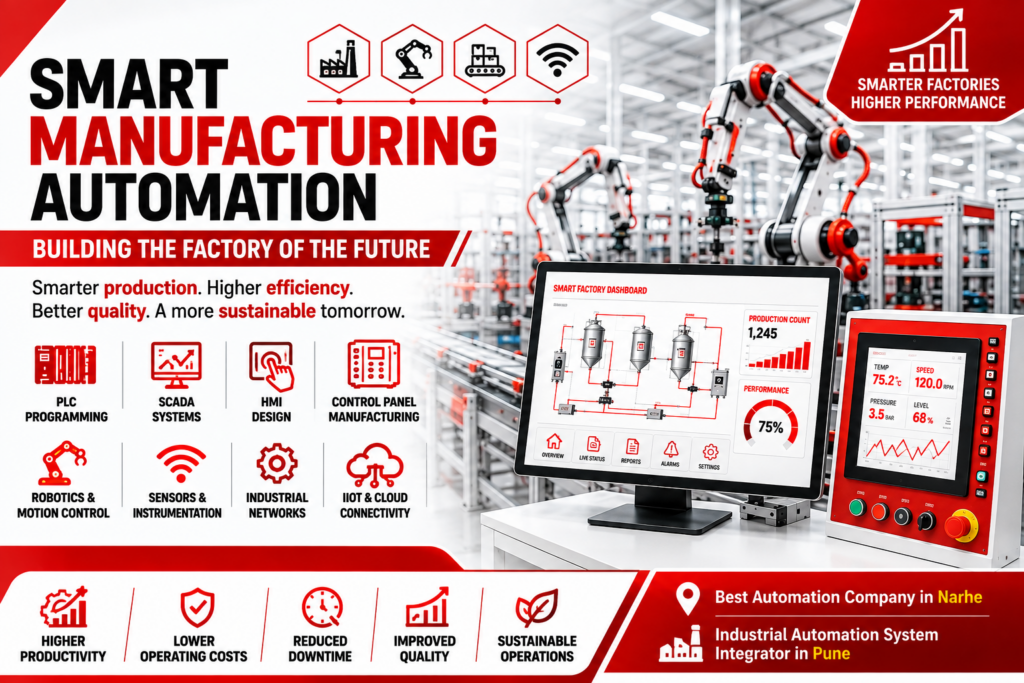
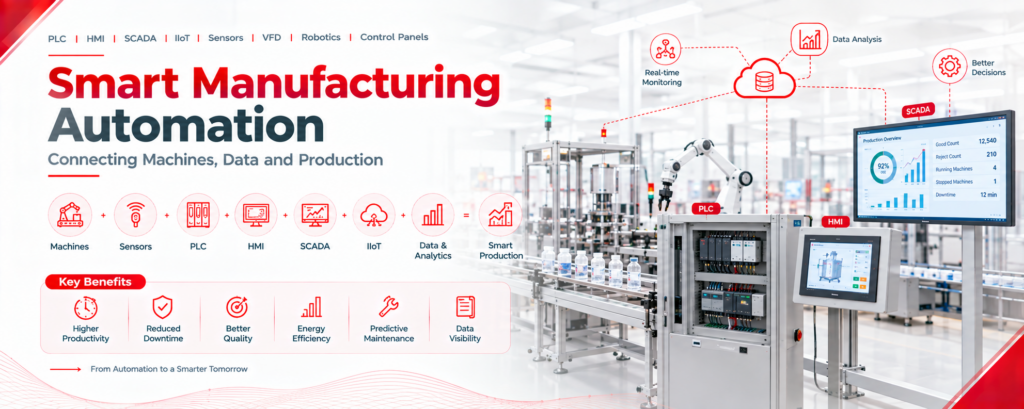
Modern manufacturing is moving from standalone machines to connected production systems where machines, sensors, automation systems, and production data work together. This approach helps manufacturers monitor operations, understand machine performance, reduce downtime, and make better production decisions.
Smart Manufacturing Automation combines PLC, SCADA, HMI, industrial communication, IIoT, sensors, VFDs, robotics, control panels, and data analytics to create connected and more visible manufacturing environments.
What is Smart Manufacturing Automation?
Smart manufacturing automation is the integration of industrial automation and digital technologies to connect machines, production processes, and data.
A basic smart manufacturing architecture can be represented as:
Machines & Sensors → PLC → HMI/SCADA → Industrial Network → Data Collection → Analytics → Production Decisions
Instead of operating machines independently, connected systems allow production information to be collected and monitored across different levels of the factory.
Connecting Machines with PLC
A PLC (Programmable Logic Controller) is often used as an important control layer between machines and higher-level monitoring systems.
PLC applications include:
- Machine sequence control
- Motor control
- Conveyor automation
- Sensor monitoring
- Valve control
- Equipment interlocking
- Alarm generation
- Production counting
- Machine status monitoring
The PLC receives information from field devices and controls machines according to programmed logic.
Role of Sensors in Smart Manufacturing
Sensors provide real-time information from machines and production processes.
Common industrial sensors include:
| Sensor | Typical Application |
|---|---|
| Proximity Sensor | Object/position detection |
| Photoelectric Sensor | Product detection |
| Temperature Sensor | Process temperature |
| Pressure Sensor | Pressure monitoring |
| Level Sensor | Tank level |
| Flow Sensor | Flow measurement |
| Vibration Sensor | Equipment condition |
| Encoder | Speed and position |
| Energy Meter | Electrical energy monitoring |
Sensor data can be processed by the PLC and made available to HMI, SCADA, or higher-level systems.
HMI for Machine-Level Monitoring
An HMI (Human Machine Interface) provides operators with a local view of machine operation.
Typical HMI information includes:
- Machine status
- Production count
- Machine speed
- Temperature
- Pressure
- Motor status
- Sensor status
- Alarm messages
- Fault information
- Production parameters
Operators can also use HMI systems for suitable machine settings and manual/automatic operation.
SCADA for Production Monitoring
SCADA (Supervisory Control and Data Acquisition) connects monitoring information from different machines and process areas.
SCADA can provide:
- Real-time production monitoring
- Machine status
- Production counts
- Alarm management
- Historical trends
- Downtime monitoring
- Energy monitoring
- Production reports
- Equipment performance information
For example, a manufacturing plant may monitor multiple production lines from a centralized SCADA system.
Industrial Communication
Communication networks are essential for connecting industrial devices.
Common industrial communication technologies include:
- Industrial Ethernet
- Modbus TCP/IP
- Modbus RTU
- PROFINET
- PROFIBUS
- EtherNet/IP
- OPC UA
The appropriate communication method depends on the equipment, control architecture, data requirements, and plant design.
Connecting Production Data
Once machines are connected, important production information can be collected.
Examples include:
- Production quantity
- Machine running time
- Machine idle time
- Downtime
- Cycle time
- Reject quantity
- Energy consumption
- Alarm history
- Maintenance information
This data can be used to understand production performance and identify areas for improvement.
OEE Monitoring in Smart Manufacturing
Overall Equipment Effectiveness (OEE) is commonly used to evaluate manufacturing equipment performance.
OEE considers three major factors:
Availability × Performance × Quality
For example:
- Availability: How much time the machine was available for production
- Performance: How efficiently it operated compared with its expected speed
- Quality: Percentage of good products produced
Automation systems can collect the required machine and production data for OEE monitoring.
VFD and Smart Motor Monitoring
VFDs (Variable Frequency Drives) provide controlled motor operation and can also provide useful operating information.
VFD applications include:
- Pumps
- Fans
- Conveyors
- Blowers
- Compressors
- Material handling systems
Monitoring motor speed, current, faults, and operating conditions can help maintenance teams understand equipment performance.
Robotics and Smart Manufacturing
Robotic systems can be integrated into connected manufacturing environments.
Applications include:
- Pick and place
- Welding
- Assembly
- Material handling
- Packaging
- Palletizing
- Machine tending
- Inspection
Robot status and production information can be connected to PLC and SCADA systems for centralized monitoring.
Digital Production Monitoring
A smart manufacturing dashboard can display important production information in real time.
A typical dashboard may show:
- Production target
- Actual production
- Machine status
- Running machines
- Stopped machines
- Downtime
- Rejection
- Energy consumption
- Active alarms
- Production trends
This gives production teams a clearer view of what is happening on the shop floor.
Predictive Maintenance
Connected machine data can support condition-based and predictive maintenance strategies.
For example, abnormal changes in:
- Vibration
- Motor current
- Temperature
- Bearing condition
- Operating hours
- Pressure
may indicate that equipment requires inspection.
Instead of relying only on fixed maintenance schedules, historical machine data can help maintenance teams identify developing equipment problems earlier.
Control Panels in Smart Manufacturing
Automation control panels remain an important part of connected manufacturing systems.
A typical control panel may contain:
- PLC
- HMI
- VFD
- Remote I/O
- Power supplies
- MCB/MCCB
- Contactors
- Relays
- Communication modules
- Industrial Ethernet switches
- Terminal blocks
Proper control panel design and manufacturing helps provide reliable machine control and communication.
IIoT in Smart Manufacturing
Industrial Internet of Things (IIoT) extends traditional automation by connecting industrial equipment and production data to higher-level monitoring and analytics platforms.
A typical IIoT architecture can be represented as:
Sensors → PLC → SCADA → Industrial Gateway/Network → IIoT Platform → Analytics → Dashboard
IIoT applications include:
- Remote machine monitoring
- Production dashboards
- Energy monitoring
- Equipment performance analysis
- Predictive maintenance
- Production reporting
- Historical data analysis
Practical Example: Connected Production Line
Consider an automated packaging line.
The process may include:
Product Feeding → Filling → Sealing → Inspection → Labeling → Packing
Sensors detect products at each stage. The PLC controls conveyors, motors, pneumatic actuators, and machine sequences.
The HMI displays machine status and production parameters.
SCADA collects:
- Production count
- Reject count
- Machine status
- Downtime
- Alarms
- Process data
The collected information can then be analyzed to identify production losses and improve machine performance.
Benefits of Smart Manufacturing Automation
Smart manufacturing can provide:
- Real-time machine monitoring
- Better production visibility
- Reduced manual data collection
- Faster fault identification
- Improved downtime analysis
- Production data tracking
- Energy monitoring
- Better maintenance planning
- Improved decision-making
- Support for continuous improvement
Industry 4.0 and Smart Factories
Smart manufacturing is a major part of Industry 4.0.
A connected factory can integrate:
Field Devices → PLC → HMI → SCADA → Industrial Network → IIoT → Data Analytics → Management Dashboard
This creates a flow of information from the physical production process to digital monitoring and analysis systems.
The objective is not simply to automate machines, but to connect machines, data, and production decisions.
Conclusion
Smart Manufacturing Automation connects machines, sensors, PLCs, SCADA systems, industrial networks, and data platforms to create more connected and visible manufacturing operations.
From machine control and production monitoring to OEE, energy monitoring, predictive maintenance, and IIoT, connected automation helps manufacturers understand production performance and make data-driven decisions.
For companies looking for an Industrial Automation System Integrator in Pune, solutions involving PLC Programming, SCADA Automation, HMI Programming, VFD Automation, Industrial Communication, Control Panel Manufacturing, IIoT, Machine Automation, and Smart Manufacturing can be developed according to specific manufacturing requirements.
#SmartManufacturing #SmartFactory #Industry40 #IndustrialAutomation #ManufacturingAutomation #PLCAutomation #PLCProgramming #SCADA #SCADAAutomation #HMI #IIoT #IndustrialIoT #IndustrialCommunication #MachineAutomation #VFDAutomation #OEE #PredictiveMaintenance #ProductionMonitoring #EnergyMonitoring #ControlPanel #PLCControlPanel #DigitalManufacturing #FactoryAutomation #IndustrialAutomationSolutions #PuneAutomation