Industrial automation is becoming an important part of modern manufacturing. From conveyors and packaging machines to water treatment plants, pharmaceutical production, automotive systems and process industries, PLCs are used to control machines and industrial processes.
If you are an electrical, electronics, instrumentation, mechatronics or mechanical engineering student or professional, learning PLC programming can open the door to a career in industrial automation.
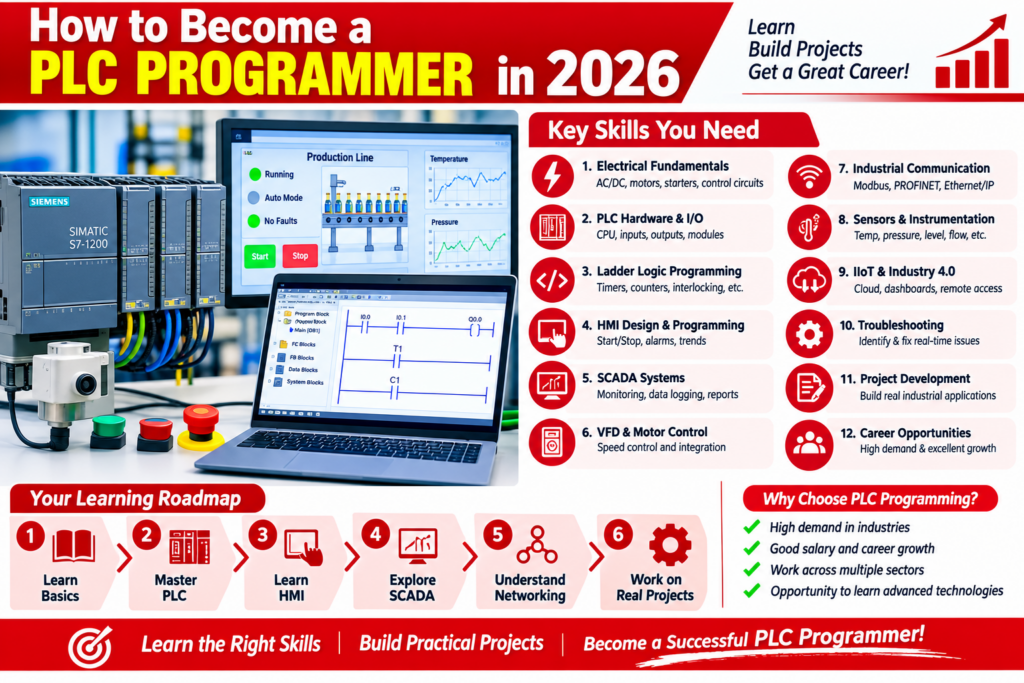
In 2026, becoming a PLC programmer is not only about learning Ladder Logic. A good PLC programmer should understand PLC programming, HMI, SCADA, VFD, industrial networking, sensors, instrumentation, troubleshooting and machine automation.
What Is a PLC Programmer?
A PLC programmer develops and maintains control programs for Programmable Logic Controllers used in industrial machines and processes.
A PLC programmer may work on:
- Conveyor automation
- Packaging machines
- Bottling plants
- Chemical and pharmaceutical plants
- Water treatment plants
- HVAC and BMS systems
- Manufacturing machines
- Material handling systems
- Robotics and automation
- Batch process automation
- Energy and utility systems
The job combines programming knowledge with electrical and industrial process understanding. Modern PLC roles commonly involve programming, testing, commissioning and troubleshooting control systems.
Why Learn PLC Programming in 2026?
Factories are increasingly adopting automation, connected machines and Industry 4.0 technologies. PLCs remain a fundamental technology for machine and process control, while HMI, SCADA, industrial networking and IIoT are becoming increasingly important complementary skills.
For a beginner, this creates an opportunity to build a practical automation career by learning one skill at a time.
The important point is that you should not focus only on software. Employers generally value engineers who can understand the complete system—from sensors and electrical panels to PLC logic, HMI and communication networks.
Step 1: Learn Electrical Fundamentals
Before starting PLC programming, learn the basics of industrial electrical systems.
Important topics include:
- AC and DC fundamentals
- Voltage, current and resistance
- Relays and contactors
- NO and NC contacts
- Overload relays
- MCB, MCCB and fuses
- Control circuits
- Motor starters
- DOL starter
- Star-delta starter
- VFD basics
- Electrical drawings
- Panel wiring
- Industrial safety
A PLC programmer frequently needs to troubleshoot problems involving both the program and the physical machine.
Step 2: Understand PLC Hardware
Next, learn how a PLC is constructed and how its different components work.
Understand:
- CPU
- Digital Inputs
- Digital Outputs
- Analog Inputs
- Analog Outputs
- Communication modules
- Power supply
- Remote I/O
- Memory
- PLC scan cycle
- Addressing
- Hardware configuration
You should be able to identify what happens when a field sensor sends a signal to a PLC and how the PLC activates an output device.
Step 3: Master Ladder Logic Programming
Ladder Logic is one of the most important programming methods for PLC engineers.
Start with:
- NO and NC contacts
- Coils
- Latching
- Interlocking
- Timers
- Counters
- Comparators
- Set/Reset
- One-shot logic
- Data movement
- Arithmetic operations
- Sequencing
- Fault handling
- Alarm logic
After learning the basics, build small programs instead of only watching tutorials.
For example:
Start/Stop Motor → DOL Starter → Star-Delta → Conveyor → Tank Level Control → Pump Control → Automatic Sequence
Practical projects help you understand how PLC logic behaves in a real machine.
Step 4: Learn a Popular PLC Platform
You do not need to learn every PLC brand at the beginning.
Start with one major platform and understand its programming environment properly.
Popular platforms include:
- Siemens S7-1200 / S7-1500 with TIA Portal
- Allen-Bradley / Rockwell Automation
- Mitsubishi PLC
- Schneider Electric PLC
- Delta PLC
- Omron PLC
Siemens and Allen-Bradley are particularly useful platforms to study for industrial automation careers, while other platforms can be added as you gain experience.
The most important thing is to understand the programming concepts rather than simply memorizing software menus.
Step 5: Learn HMI Programming
A PLC controls the machine, but operators generally need an interface to monitor and control it.
That is where an HMI comes in.
Learn how to create:
- Start/Stop controls
- Motor status screens
- Auto/Manual modes
- Alarm screens
- Setpoint screens
- Parameter screens
- Production counters
- Fault indications
- Password/user levels
- Recipe screens
- Trend displays
A PLC programmer who can develop both PLC logic and HMI screens can handle a larger portion of an automation project.
Step 6: Learn SCADA
After HMI, move toward SCADA.
SCADA systems are commonly used for centralized monitoring, control, alarms, trends and historical data.
Important SCADA concepts include:
- Tag creation
- PLC communication
- Graphics
- Alarms
- Trends
- Historical data
- Reports
- User management
- Data logging
- OPC communication
- Database connectivity
SCADA skills become especially useful when working with larger machines, utilities and complete industrial plants.
Step 7: Learn Sensors and Instrumentation
PLC programming becomes much more useful when you understand field devices.
Learn how to interface:
- Proximity sensors
- Photoelectric sensors
- Temperature sensors
- Pressure sensors
- Level sensors
- Flow sensors
- Encoders
- Limit switches
- Solenoid valves
- Control valves
- Motors
- Pumps
For analog applications, understand signals such as:
0–10 V, 4–20 mA and RTD
You should also learn basic signal scaling and how an analog signal is converted into an engineering value inside the PLC.
Step 8: Learn VFD and Motor Control
Most industrial automation applications involve motors.
A PLC programmer should understand how to control a motor through:
- Contactor
- DOL starter
- Star-delta starter
- Soft starter
- VFD
Learn how PLCs communicate with VFDs through digital signals, analog signals and industrial communication protocols.
Practice applications such as:
PLC → VFD → Motor → Speed Control → Feedback
This will give you practical knowledge that can be demonstrated during interviews and projects.
Step 9: Learn Industrial Communication
Modern automation systems are connected systems.
Important communication technologies to learn include:
- Modbus RTU
- Modbus TCP
- PROFINET
- EtherNet/IP
- PROFIBUS
- OPC UA
- MQTT
Start with Modbus because it is relatively easy to understand and widely used for learning industrial communication.
Then move toward Ethernet-based industrial communication and OPC UA/MQTT for higher-level integration and IIoT applications.
Step 10: Learn IIoT and Industry 4.0
In 2026, PLC programmers can increase their value by understanding how machine data moves beyond the PLC.
A basic Industry 4.0 architecture can look like:
Sensors → PLC → HMI → Industrial Gateway → Cloud/Database → Dashboard
Learn concepts such as:
- Real-time machine monitoring
- Production data collection
- Energy monitoring
- OEE
- Remote monitoring
- MQTT
- Cloud dashboards
- Data logging
- Predictive maintenance concepts
This creates a bridge between traditional PLC automation and modern digital manufacturing.
Step 11: Build Real PLC Projects
Projects are one of the best ways to demonstrate your skills.
Instead of only completing theoretical exercises, build projects such as:
Project 1: Conveyor Automation
- Start/Stop
- Sensor detection
- Motor control
- Counting
- Emergency stop logic
- HMI monitoring
Project 2: Tank Level Control
- Level sensor
- Pump control
- High/low-level alarms
- Auto/manual operation
- HMI screen
Project 3: Automatic Batch Process
- Multiple process steps
- Timers
- Valves
- Pumps
- Temperature monitoring
- Recipe selection
- Alarm handling
Project 4: VFD Speed Control
- PLC-to-VFD communication
- Start/Stop
- Speed reference
- Fault monitoring
- HMI speed setting
Project 5: IIoT Monitoring
- PLC data acquisition
- Gateway communication
- Dashboard
- Production monitoring
- Historical data
A portfolio containing these projects can be much more useful than simply listing “PLC knowledge” on a resume.
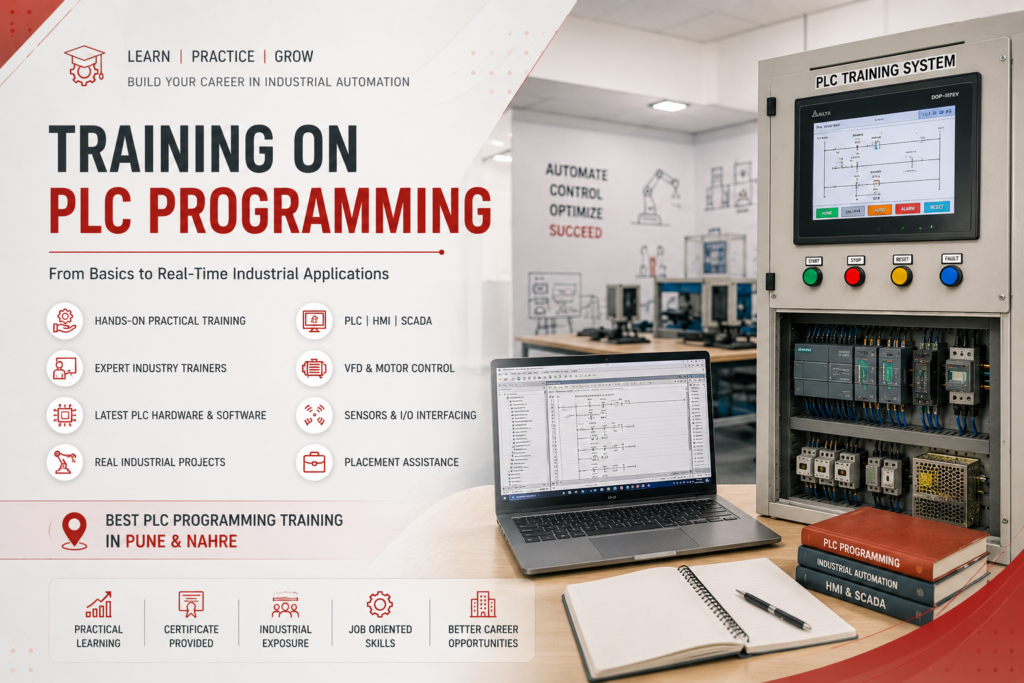
Best PLC Programming Training Approach in Pune & Nahre
If you are searching for best plc programming pune & nahre, look for training that provides practical exposure rather than only theoretical classes.
A good PLC programming course should cover:
- Electrical control circuits
- PLC hardware
- Ladder Logic
- Siemens PLC
- Allen-Bradley PLC
- HMI programming
- SCADA
- VFD
- Industrial sensors
- Instrumentation
- Industrial networking
- Panel wiring
- Troubleshooting
- Commissioning
- Industrial automation projects
- IIoT fundamentals
Hands-on training is particularly valuable because PLC programming is closely connected with physical inputs, outputs, machines and field devices.
PLC Programmer Career Roadmap for 2026
A practical learning sequence can look like this:
Month 1 – Electrical Fundamentals
Electrical basics → Control circuits → Motors → Starters → Sensors
Month 2 – PLC Fundamentals
PLC hardware → I/O → Scan cycle → Ladder Logic → Timers → Counters
Month 3 – Advanced PLC
Analog I/O → Data handling → Sequencing → PID basics → Troubleshooting
Month 4 – HMI & SCADA
HMI screens → Alarms → Trends → SCADA → Data logging
Month 5 – Drives & Networking
VFD → Modbus → PROFINET/EtherNet → PLC communication
Month 6 – Projects
Conveyor → Process control → Batch system → VFD application → IIoT project
The actual time required varies according to your previous technical knowledge, practice time and access to hardware. A strong portfolio should demonstrate what you can actually build and troubleshoot rather than simply how many topics you have completed.
What Qualification Do You Need to Become a PLC Programmer?
There is no single mandatory degree for every PLC programming position.
Candidates commonly come from:
- Diploma in Electrical Engineering
- Diploma in Electronics
- Diploma in Instrumentation
- Diploma in Mechatronics
- BE/BTech Electrical Engineering
- BE/BTech Electronics
- Instrumentation Engineering
- Mechatronics Engineering
- Mechanical Engineering
However, practical automation skills are extremely important. Employers may look for the ability to understand electrical systems, PLC logic, machine operation and troubleshooting in addition to formal qualifications.
PLC Programmer Skills Checklist for 2026
Before applying for jobs, try to become comfortable with:
☑ Electrical control circuits
☑ PLC hardware and I/O
☑ Ladder Logic
☑ Timers and counters
☑ Analog signals
☑ HMI programming
☑ SCADA
☑ VFD programming
☑ Sensors and instrumentation
☑ Industrial networking
☑ Modbus
☑ PROFINET or EtherNet/IP
☑ Troubleshooting
☑ Panel wiring
☑ Machine sequencing
☑ Basic PID control
☑ IIoT fundamentals
☑ Technical documentation
☑ Industrial safety
Common PLC Programmer Job Roles
After developing these skills, you can explore roles such as:
- PLC Programmer
- PLC Automation Engineer
- Automation Engineer
- Controls Engineer
- PLC SCADA Engineer
- HMI Programmer
- Commissioning Engineer
- Industrial Automation Engineer
- Control Panel Design Engineer
- Maintenance Automation Engineer
- IIoT / Industry 4.0 Engineer
Final Thoughts
Becoming a PLC programmer in 2026 requires more than learning Ladder Logic from a software simulator.
The strongest candidates understand the complete automation system:
Electrical → Sensors → PLC → HMI → VFD → SCADA → Industrial Network → IIoT
Start with fundamentals, choose one PLC platform, practise regularly and build real projects. Once your foundation is strong, add HMI, SCADA, VFD, industrial communication and IIoT skills.
If you are looking for best plc programming pune & nahre, focus on a practical learning program where you can work with PLC hardware, sensors, motors, VFDs, HMIs and industrial automation projects.
The goal should not simply be to become someone who can write PLC code.
The goal is to become an automation engineer who can understand, program, troubleshoot and commission a complete industrial system.