Industrial automation is transforming manufacturing industries by making production faster, safer, and more efficient. From automotive manufacturing to pharmaceutical plants, companies use Programmable Logic Controllers (PLCs) to control machines and industrial processes.
As industries adopt advanced automation technologies, skilled PLC programmers and automation engineers have opportunities to build successful technical careers.
If you are an engineering student, diploma holder, or working professional planning to enter the automation industry, understanding the essential PLC programming skills is the first step toward becoming job-ready.
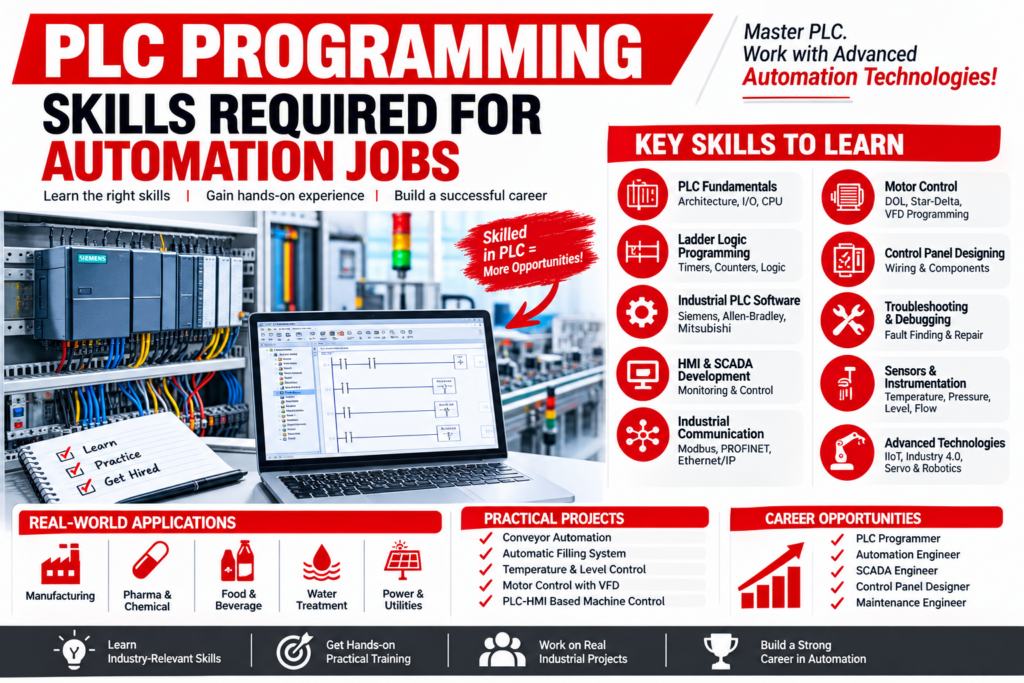
1. Understanding PLC Fundamentals
Before learning PLC programming, it is important to understand how a PLC works.
A PLC is an industrial controller used to automate machines and processes based on input signals and programmed logic.
Important concepts include:
- PLC architecture and working principles
- Digital and analog inputs and outputs
- PLC CPU, power supply, and I/O modules
- Sensors, switches, relays, and contactors
- PLC wiring and hardware configuration
- PLC scan cycle and memory addressing
A strong understanding of PLC fundamentals helps engineers develop reliable automation programs.
2. Ladder Logic Programming
Ladder Logic is one of the most widely used PLC programming languages in industrial automation.
It uses graphical symbols similar to electrical relay circuits, making it easier for electrical and automation engineers to understand.
Important programming skills include:
- NO and NC contact logic
- Set and reset instructions
- Timers and counters
- Comparison and mathematical instructions
- Motor start-stop programming
- Interlocking and sequential control
- Alarm and fault-handling logic
Practical knowledge of Ladder Logic is essential for many entry-level PLC programming jobs.
3. Knowledge of Industrial PLC Software
Automation companies work with different PLC brands. Learning industry-relevant PLC programming software can improve your career opportunities.
Important PLC platforms include:
Siemens PLC
- SIMATIC S7-1200 and S7-1500
- TIA Portal programming software
- Ladder Logic, FBD, and SCL programming
Allen-Bradley PLC
- MicroLogix and CompactLogix controllers
- RSLogix 500 and Studio 5000
- PLC programming and troubleshooting
Mitsubishi PLC
- FX Series PLC
- GX Works programming software
- Industrial machine automation
Learning multiple PLC platforms can help engineers work on different industrial automation projects.
4. HMI and SCADA Development
PLC programmers should also understand Human Machine Interface (HMI) and Supervisory Control and Data Acquisition (SCADA) systems.
These technologies allow operators to monitor machines, control processes, and view production information.
Important skills include:
- HMI screen designing
- PLC-HMI communication
- SCADA screen development
- Alarm monitoring and management
- Real-time data visualization
- Data logging and trending
- Industrial process monitoring
Knowledge of PLC, HMI, and SCADA together can open opportunities in machine automation, process control, and industrial plant automation.
5. Industrial Communication Protocols
Modern automation systems require communication between PLCs, HMIs, drives, sensors, and other industrial devices.
PLC programmers should understand commonly used industrial communication protocols.
Important protocols include:
- Modbus RTU and Modbus TCP
- PROFINET
- PROFIBUS
- Ethernet/IP
- OPC UA
- RS232 and RS485 communication
Understanding industrial networking helps automation engineers integrate different machines and control systems.
6. Electrical Control Panels and Motor Control
PLC programming is closely connected with electrical control systems.
Automation engineers should understand electrical drawings, control panel components, and motor control circuits.
Important skills include:
- Reading electrical wiring diagrams
- DOL and Star-Delta starter circuits
- VFD programming and operation
- Motor control using PLC
- MCC and PLC control panel wiring
- Electrical safety and protection devices
- Troubleshooting electrical control circuits
Practical knowledge of control panels helps PLC programmers understand real industrial applications.
7. PLC Troubleshooting and Debugging
Troubleshooting is one of the most valuable skills for automation engineers.
Industries require engineers who can identify machine faults and restore operations quickly.
Important troubleshooting skills include:
- Monitoring PLC inputs and outputs
- Online program monitoring
- Identifying wiring and sensor faults
- Checking PLC communication errors
- Diagnosing motor and VFD faults
- Understanding machine interlocks
- PLC program backup and restoration
Developing troubleshooting skills through practical training can significantly improve job readiness.
8. Practical Industrial Automation Projects
Practical experience is important for developing confidence in PLC programming.
Students should work on automation projects that demonstrate real industrial applications.
Recommended projects include:
- PLC-based conveyor automation
- Automatic bottle filling system
- Water level monitoring and control
- Motor control using PLC and VFD
- Traffic light control system
- Temperature monitoring and control
- Pneumatic cylinder automation
- PLC-HMI-based machine control
These projects help students understand how PLC programming is used in manufacturing industries.
9. Additional Skills for Automation Engineers
Apart from PLC programming, engineers can improve their career opportunities by learning additional industrial technologies.
These include:
- Industrial sensors and instrumentation
- Pneumatics and hydraulics
- Servo and stepper motor control
- Industrial Internet of Things (IIoT)
- Industry 4.0 technologies
- Industrial networking
- Basic robotics and motion control
Combining PLC programming with these technologies helps engineers develop broader industrial automation skills.
10. Career Opportunities After Learning PLC Programming
Candidates with practical PLC programming knowledge can explore different job roles in the automation industry.
Popular career opportunities include:
- PLC Programmer
- Industrial Automation Engineer
- PLC and SCADA Engineer
- Automation Maintenance Engineer
- Electrical Control Panel Engineer
- Automation Service Engineer
- Commissioning Engineer
- Control Systems Engineer
Industries such as automotive, pharmaceutical, food processing, packaging, chemical manufacturing, and water treatment require automation professionals for machine control and process automation.
11. How to Become Job-Ready Through PLC Programming Training
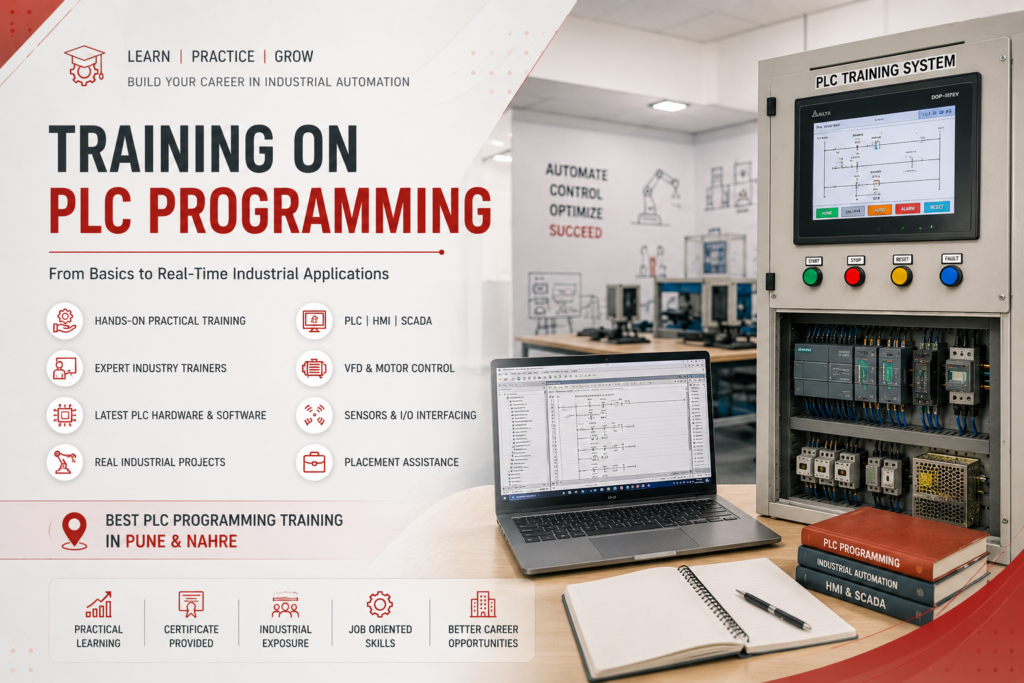
For students searching for the best plc programming pune & nahre, choosing practical industrial automation training is an important step toward building technical skills.
A good PLC programming training program should provide hands-on experience with real PLC hardware, industrial software, HMI systems, electrical control panels, and automation projects.
At Automate Engineering, we focus on developing practical industrial automation knowledge through technical training and industry-oriented learning.
Our training areas include:
- Siemens, Allen-Bradley, and Mitsubishi PLC programming
- HMI and SCADA development
- Electrical control panel designing and wiring
- VFD and motor control applications
- Industrial sensors and instrumentation
- Industrial communication protocols
- Industrial IoT and Industry 4.0
- Practical automation projects
The objective is to help engineering students, diploma holders, and professionals develop skills relevant to industrial automation jobs.
Conclusion
PLC programming is an important technical skill for building a career in industrial automation.
However, becoming a successful automation engineer requires more than theoretical programming knowledge. Practical experience with PLC hardware, HMI, SCADA, electrical control panels, industrial communication, and troubleshooting is equally important.
By developing these skills and working on real automation projects, students can prepare themselves for opportunities in manufacturing and industrial automation.
Start Your Industrial Automation Career with Automate Engineering!
Website: www.automateengg.com
Email: connect@automateengg.com
Contact: +91 9371063103
SEO Keywords
PLC Programming Skills, PLC Programming Training, Industrial Automation Training, PLC Programmer Jobs, Automation Engineer Skills, Siemens PLC Training, Allen Bradley PLC Programming, HMI SCADA Training, PLC Ladder Logic, Industrial Automation Jobs, best plc programming pune & nahre, Practical PLC Training, PLC SCADA Engineer, Automation Engineering Career
#PLCProgramming #IndustrialAutomation #AutomationTraining #PLCTraining #AutomateEngineering