In modern manufacturing, unexpected machine faults and process abnormalities can lead to production delays, equipment damage, and increased maintenance costs. An effective Alarm Management and Fault Monitoring System helps industries detect abnormal conditions quickly, notify operators, and take corrective action before a minor issue becomes a major production problem.
As part of modern Industrial Automation Solutions, alarm management can be integrated with PLC, HMI, SCADA, sensors, VFDs, and industrial control panels to provide operators with clear information about machine and process conditions.
What is Alarm Management?
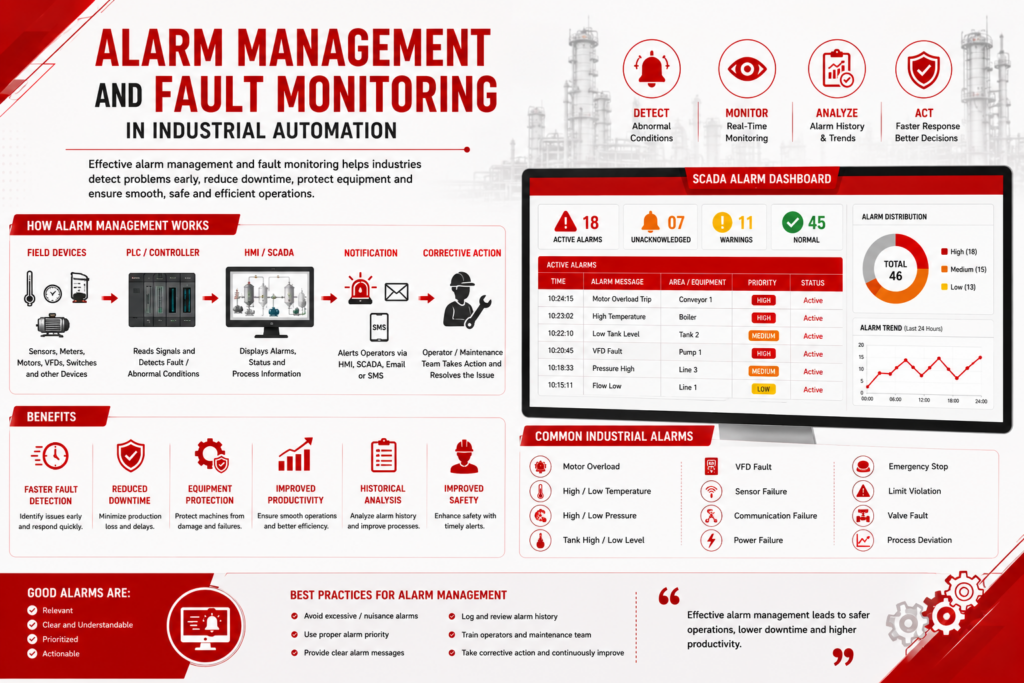
Alarm management in industrial automation is the process of detecting, displaying, recording, and managing abnormal conditions within a machine or industrial process.
When a sensor, PLC, motor, VFD, or other field device detects an abnormal condition, the automation system can generate an alarm. The alarm can then be displayed on an HMI or SCADA system, allowing operators to understand the problem and respond quickly.
Common industrial alarms include:
- Motor overload and trip
- High or low temperature
- High or low pressure
- Tank high/low level
- Sensor failure
- VFD fault
- Communication failure
- Emergency stop activation
- Power supply failure
- Process limit violations
How Fault Monitoring Works
A Fault Monitoring System continuously monitors machine inputs, outputs, equipment status, and process parameters. The PLC processes signals from sensors and field devices and identifies conditions that require operator attention.
The HMI can display the current alarm, fault description, affected equipment, and status. In larger automation systems, SCADA alarm management can provide centralized alarm monitoring, historical alarm records, event logs, and notifications.
A typical fault monitoring sequence can be:
Field Sensor/Device → PLC → Alarm Logic → HMI/SCADA → Operator Notification → Corrective Action
This approach provides faster fault identification and improves the overall reliability of the industrial automation system.
Benefits of Effective Alarm Management
A well-designed Industrial Alarm Management System provides several operational benefits.
Faster Fault Detection: Operators can immediately identify abnormal machine or process conditions.
Reduced Downtime: Early detection helps maintenance teams respond before faults result in extended production stoppages.
Improved Troubleshooting: Clear fault messages help technicians understand where and why a problem occurred.
Better Equipment Protection: Monitoring overloads, temperature, pressure, levels, and other parameters can help prevent equipment damage.
Improved Safety: Critical alarms, interlocks, and emergency conditions can be incorporated into the control system.
Historical Analysis: SCADA systems can store alarm and event history, helping teams identify recurring problems and improve maintenance strategies.
HMI and SCADA for Alarm Monitoring
HMI-based alarm monitoring is commonly used for individual machines and smaller processes. Operators can view active alarms, acknowledge faults, and access basic diagnostic information directly from the machine interface.
For larger plants, SCADA-based alarm management provides centralized monitoring across multiple machines and production lines. SCADA can display alarm priorities, timestamps, trends, event history, and reports, giving production and maintenance teams a broader view of plant performance.
Combining PLC automation, HMI, SCADA, VFDs, sensors, and industrial communication networks creates a reliable platform for real-time fault monitoring and alarm management.
Building a Reliable Fault Monitoring System
Effective alarm management is not simply about generating more alarms. Alarms should be clear, relevant, prioritized, and actionable. Operators should be able to understand what happened, which equipment is affected, and what action may be required.
A properly designed Industrial Automation System can therefore help organizations reduce nuisance alarms, improve response time, identify recurring equipment problems, and maintain more stable production operations.
As an Industrial Automation System Integrator in Pune, Automate Engineering provides solutions involving PLC Programming, HMI Programming, SCADA Automation, Industrial Control Panels, VFD Automation, Machine Monitoring, Alarm Management, and Fault Monitoring Systems.
With effective Alarm Management and Fault Monitoring, industries can move toward safer, more reliable, and more efficient operations while reducing unnecessary downtime and improving machine availability.
Automate Engineering – Industrial Automation Solutions for reliable machine monitoring, intelligent fault detection, and efficient industrial operations.
#IndustrialAutomation #AlarmManagement #FaultMonitoring #SCADA #HMI #PLCAutomation #MachineMonitoring #IndustrialControl #SCADAAutomation #HMIAutomation #PredictiveMaintenance #IndustrialAutomationSolutions #FactoryAutomation #SmartManufacturing #PuneAutomation