Modern process industries require accurate control of ingredients, process parameters, timing, and production sequences to achieve consistent product quality. Automatic batch process control using PLC provides a structured way to automate these operations by controlling valves, pumps, motors, mixers, heaters, sensors, and other field equipment according to a predefined batch recipe.
A PLC-based batch process automation system is suitable for industries such as food and beverage, pharmaceuticals, chemicals, cosmetics, paints, water treatment, and specialty manufacturing. It can help reduce manual intervention, improve process repeatability, and provide better monitoring of each production batch.
What Is Batch Process Automation?
In a batch process, a product is manufactured through a series of defined steps. Each batch may involve activities such as material dosing, filling, mixing, heating, cooling, holding, transferring, and cleaning.
A PLC can execute these operations automatically according to the programmed sequence.
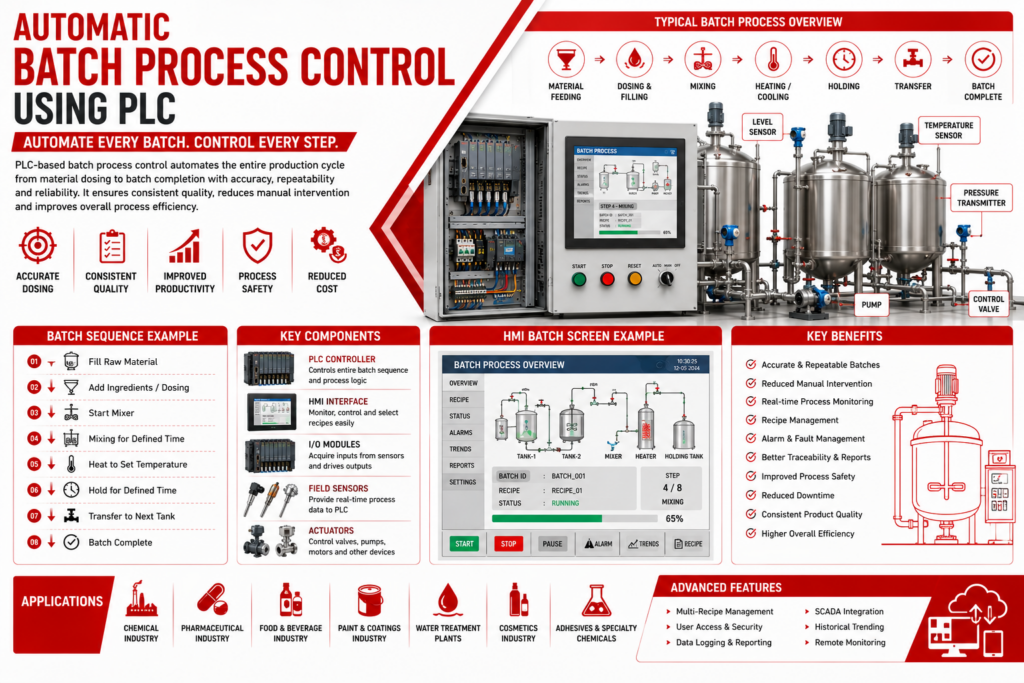
A typical batch process can follow:
Material Feeding → Dosing → Mixing → Heating/Cooling → Holding → Transfer → Batch Completion
The PLC receives signals from field sensors, processes the programmed logic, and controls the corresponding equipment at each stage.
PLC-Based Batch Control
A PLC for batch process control acts as the main controller of the production sequence. The PLC can monitor temperature, pressure, level, flow, motor status, valve position, and other process conditions.
PLC programming can include:
- Step-by-step batch sequencing
- Timers and counters
- Recipe-based operation
- Temperature control
- Level monitoring
- Pump and motor control
- Valve sequencing
- Automatic/manual modes
- Alarm and fault handling
- Safety interlocks
- Batch completion logic
For manufacturers looking for PLC programming services in Pune, a properly structured batch-control program can be developed according to the process sequence and equipment requirements.
Sensors and Field Instrumentation
Accurate industrial sensor integration with PLC automation is essential for reliable batch control. Different sensors and instruments provide the PLC with real-time process information.
Common devices include:
- Temperature sensors
- Pressure transmitters
- Level sensors
- Flow meters
- Proximity sensors
- Load cells
- pH sensors
- Limit switches
For example, during a heating stage, a temperature sensor provides feedback to the PLC. The PLC can control the heater until the required temperature is reached and then automatically move the process to the next step.
HMI-Based Batch Process Control
An HMI for batch process automation allows operators to monitor and control the production process from a graphical interface.
An HMI can display:
- Current batch step
- Temperature and pressure
- Tank level
- Pump and valve status
- Batch quantity
- Recipe parameters
- Alarms
- Production status
- Batch completion
Operators can select recipes, start or stop batches, switch between operating modes, and monitor process conditions from the HMI.
The combination of PLC and HMI automation provides better process visibility and simplifies operation.
Recipe Management and Automatic Sequencing
One of the major advantages of PLC-based batch automation is the ability to manage different production recipes. Each recipe can contain parameters such as material quantity, mixing time, temperature, speed, and process sequence.
For example:
Step 1: Fill raw material
Step 2: Add required ingredient
Step 3: Start mixer
Step 4: Maintain mixing for a defined time
Step 5: Heat to the required temperature
Step 6: Maintain temperature for a specified duration
Step 7: Transfer the finished batch
The PLC automatically progresses from one step to another after the required conditions are satisfied.
Control Panels for Batch Automation
A properly designed PLC control panel for process automation provides centralized control of the electrical and automation equipment.
Depending on the application, the panel may contain:
- PLC and I/O modules
- VFDs
- Servo drives
- Contactors and relays
- Power supplies
- Circuit protection
- Communication modules
- Safety components
- Terminal blocks
Professional industrial control panel design and manufacturing helps provide organized wiring, safe operation, easier troubleshooting, and reliable process control.
Industries searching for a PLC control panel manufacturer in Pune or an industrial automation system integrator in Pune can implement customized control panels for batch processing systems.
SCADA and Batch Monitoring
For larger manufacturing plants, SCADA system integration can provide centralized monitoring of batch processes. Operators can monitor multiple tanks, machines, and production areas from a central workstation.
SCADA can also support:
- Real-time process monitoring
- Alarm management
- Historical data
- Batch records
- Production reports
- Trend monitoring
- Equipment status
- Process parameter tracking
This makes PLC, HMI and SCADA integration useful for industries that require greater process visibility and production traceability.
Benefits of Automatic Batch Process Control
Implementing automatic batch process control using PLC can provide several benefits:
- Consistent batch quality
- Accurate material dosing
- Reduced manual intervention
- Improved process repeatability
- Better production monitoring
- Reduced operator errors
- Automatic alarm handling
- Improved process safety
- Better production traceability
- Reduced downtime
- Easier recipe management
- Improved overall productivity
Applications of PLC Batch Automation
PLC-based batch process automation is commonly used in:
- Pharmaceutical manufacturing
- Chemical processing
- Food and beverage production
- Paint manufacturing
- Cosmetics
- Specialty chemicals
- Water treatment
- Dairy processing
- Adhesive manufacturing
- Mixing and blending processes
For companies searching for industrial automation solutions in Pune or machine automation solutions in Pune, batch automation can be customized according to the process, equipment, production capacity, and required level of automation.
Smart Batch Manufacturing
Modern smart manufacturing automation can connect PLCs, HMIs, SCADA systems, sensors, VFDs, industrial networks, and databases to create connected production systems.
With Industry 4.0 automation solutions, batch information and machine data can be monitored and analyzed to improve production efficiency, identify process problems, and support better maintenance decisions.
For businesses searching for the best automation company in Narhe, a complete batch automation project can combine PLC programming, HMI development, SCADA integration, sensor integration, VFD automation, control panel design, industrial networking, and commissioning.
Whether it is a small mixing system or a large multi-tank production facility, automatic batch process control using PLC provides a reliable approach to achieving consistent, efficient, and repeatable manufacturing processes.
Automate every batch. Control every step. Achieve consistent production.