Automotive manufacturing involves multiple production stages such as material handling, machining, welding, assembly, painting, inspection, testing, and packaging. These operations require accurate control, repeatable processes, fast production cycles, and continuous monitoring.
Automotive Manufacturing Automation Solutions use technologies such as PLC, SCADA, HMI, VFD, robotics, sensors, servo drives, industrial communication, and electrical control panels to automate production processes and improve manufacturing efficiency.
From individual machines to complete production lines, industrial automation can help automotive manufacturers achieve consistent operation, better monitoring, and improved production control.
What is Automotive Manufacturing Automation?
Automotive Manufacturing Automation involves using industrial control systems and automated equipment to control different stages of vehicle and component manufacturing.
Automation can be applied to:
- Material handling
- Press and stamping operations
- Welding
- Robotic assembly
- Conveyor systems
- Machining
- Painting and coating
- Component inspection
- Testing
- Packaging
- Part sorting
- Production-line monitoring
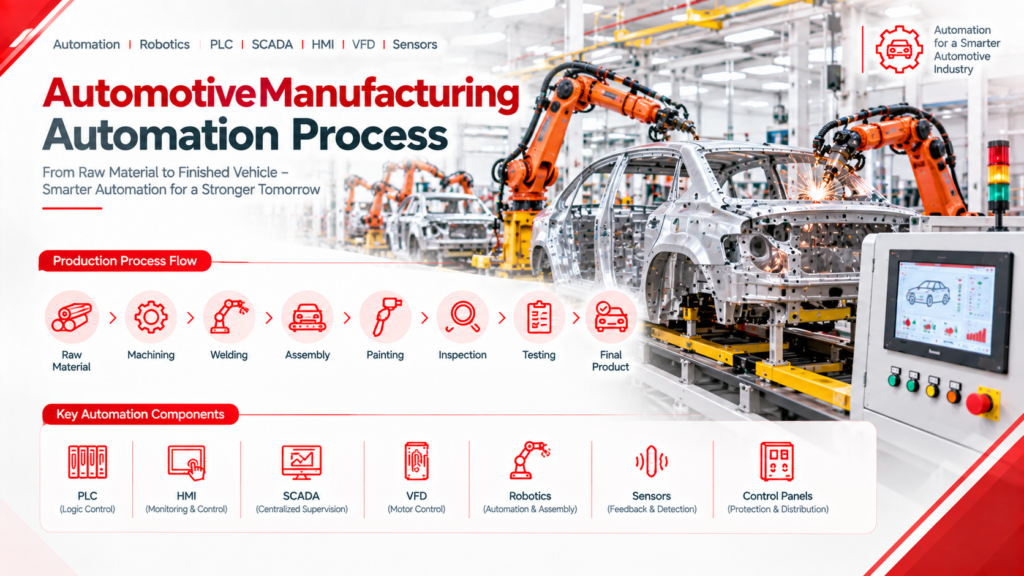
A typical automated production flow can be:
Raw Material → Machining → Welding → Assembly → Painting → Inspection → Testing → Final Product
Role of PLC in Automotive Automation
A PLC (Programmable Logic Controller) is commonly used as the main control system for automated machines and production lines.
The PLC receives signals from sensors and other field devices and controls motors, pneumatic actuators, valves, conveyors, robots, and other equipment according to programmed logic.
PLC Programming for Automotive Manufacturing can include:
- Machine sequence control
- Conveyor synchronization
- Sensor-based operations
- Motor control
- Pneumatic control
- Interlocking
- Part counting
- Fault detection
- Safety-related control logic
- Automatic and manual modes
- Production sequence management
For example, a PLC can detect a component arriving on a conveyor and initiate the next machine operation when the required conditions are satisfied.
HMI for Automotive Production Monitoring
An HMI (Human Machine Interface) allows operators to monitor and control automated machines from a centralized screen.
An automotive production HMI can display:
- Machine status
- Production count
- Conveyor status
- Motor status
- Sensor conditions
- Cycle time
- Fault messages
- Alarm conditions
- Process parameters
- Manual/automatic mode
- Maintenance information
This provides operators with real-time visibility into machine and production-line conditions.
SCADA for Automotive Manufacturing
For larger automotive plants, SCADA Automation can provide centralized supervision of multiple machines and production areas.
A SCADA System can monitor:
- Production lines
- Machine status
- Production counts
- Energy consumption
- Equipment alarms
- Downtime
- Process trends
- Historical data
- Production reports
SCADA integration can help plant teams monitor production information from a central location and identify abnormal operating conditions.
Robotics in Automotive Manufacturing
Robotics plays an important role in modern automotive production.
Industrial robots can be used for:
- Robotic welding
- Pick and place
- Material handling
- Assembly
- Painting
- Palletizing
- Machine loading and unloading
- Component positioning
Robotic systems can be integrated with PLC, HMI, sensors, safety systems, and industrial communication networks to coordinate robot operations with other production equipment.
VFD and Servo Automation
Automotive manufacturing machines often require accurate control of motors and motion systems.
VFD Automation can be used for applications such as:
- Conveyor systems
- Pumps
- Fans
- Material handling
- Machine drives
Servo systems can be used where precise position, speed, and motion control are required.
Integration of VFDs, servo drives, PLCs, and HMIs allows different machine movements to operate according to the required production sequence.
Sensors and Industrial Instrumentation
Sensors provide important feedback to the automation system.
Common devices used in automotive manufacturing include:
- Proximity sensors
- Photoelectric sensors
- Position sensors
- Pressure sensors
- Temperature sensors
- Encoders
- Vision systems
- Safety sensors
For example, a proximity sensor can detect whether an automotive component is correctly positioned before the next manufacturing operation begins.
Control Panels for Automotive Automation
A reliable Industrial Control Panel provides centralized electrical control and protection for automated machines.
An automotive PLC Control Panel may contain:
- PLC and I/O modules
- HMI
- VFDs
- Servo drives
- MCBs and MCCBs
- Contactors
- Relays
- Power supplies
- Communication modules
- Safety components
- Terminal blocks
Proper Control Panel Manufacturing, electrical design, wiring, component selection, and testing are important for reliable production-line operation.
Applications of Automotive Manufacturing Automation
Welding Automation
PLC and robotic systems can coordinate welding operations, part positioning, sensors, and safety interlocks.
Assembly Line Automation
Automated conveyors, sensors, robots, and PLCs can coordinate the movement and assembly of components.
Machining Automation
CNC machines and automated material-handling systems can be integrated with production-line controls for consistent machining operations.
Material Handling
Conveyors, robots, elevators, and automated handling systems can transfer components between different production stages.
Painting Automation
Automated systems can control material movement, spray equipment, process parameters, and production sequences.
Inspection and Quality Control
Sensors, cameras, and inspection systems can identify component conditions and communicate results to the production control system.
Benefits of Automotive Manufacturing Automation
Higher Production Efficiency
Automated production systems can support faster and more consistent manufacturing cycles.
Improved Process Consistency
PLC-controlled sequences and automated equipment help maintain repeatable operations.
Reduced Manual Intervention
Robots, conveyors, sensors, and automated machines can reduce repetitive manual operations.
Better Production Monitoring
HMI and SCADA systems provide real-time information about machines and production lines.
Faster Fault Detection
Alarm systems and machine diagnostics can help identify equipment faults and abnormal conditions.
Improved Traceability
Production data can be collected and linked with specific machines, batches, or production stages depending on the system architecture.
Flexible Manufacturing
Modern automation systems can be configured for different production requirements, product variants, and machine sequences.
Industry 4.0 in Automotive Manufacturing
Modern automotive plants are increasingly integrating Industry 4.0 and IIoT technologies with production automation.
A connected automotive production system can follow the architecture:
Sensors & Machines → PLC → HMI/SCADA → Industrial Network → Production Data → Monitoring & Analysis
Integration of PLC Programming, SCADA Automation, HMI Programming, robotics, VFD Automation, servo systems, sensors, and industrial communication can provide better visibility across manufacturing operations.
Real-time production information can support areas such as machine monitoring, downtime analysis, energy monitoring, predictive maintenance strategies, and production reporting.
Automotive Automation Solutions for Modern Manufacturing
Automotive manufacturing requires reliable coordination between machines, robots, conveyors, sensors, drives, and control systems. A properly designed Industrial Automation System can connect these systems into a coordinated production environment.
As an Industrial Automation System Integrator in Pune, Automate Engineering works with technologies including PLC, SCADA, HMI, VFD, robotics, instrumentation, control panels, and industrial communication for machine and manufacturing automation applications.
From robotic welding and assembly to conveyor automation, inspection, material handling, and production monitoring, Automotive Manufacturing Automation Solutions can support efficient, consistent, and connected manufacturing operations.
#AutomotiveAutomation #AutomotiveManufacturing #AutomotiveIndustry #ManufacturingAutomation #IndustrialAutomation #PLCAutomation #PLCProgramming #SCADA #SCADAAutomation #HMI #VFDAutomation #Robotics #IndustrialRobotics #ServoAutomation #MachineAutomation #ControlPanel #PLCControlPanel #IndustrialControlPanel #SmartManufacturing #Industry40 #IIoT #FactoryAutomation #ProductionAutomation #AutomotiveIndustryAutomation #IndustrialAutomationSolutions #PuneAutomation