Industrial Automation is one of the fastest-growing career fields for engineering students and technical professionals. With industries adopting smart manufacturing, PLC systems, robotics, SCADA, and Industrial IoT, the demand for skilled automation engineers continues to grow.
Completing an Industrial Automation Training Course can open career opportunities in manufacturing, pharmaceuticals, automotive, food processing, power plants, and many other industries.
Whether you are a Diploma student, BE/BTech graduate, or working professional, learning industrial automation can help you develop practical technical skills and prepare for industry-oriented job roles.
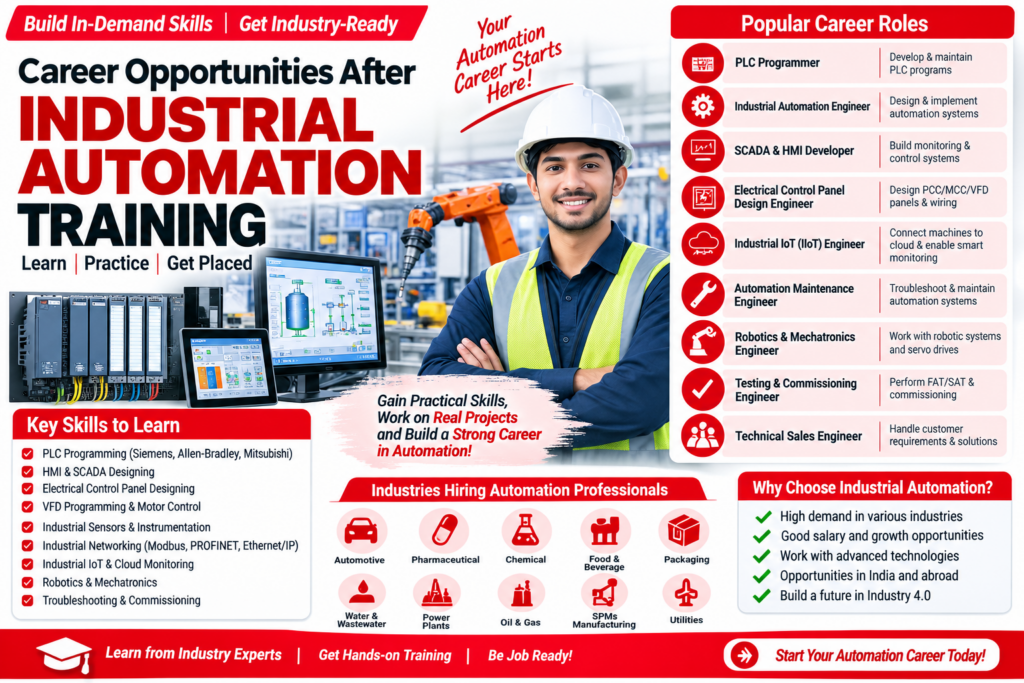
1. PLC Programmer
A PLC Programmer develops and maintains programs that control industrial machines and manufacturing processes.
Key Responsibilities:
- Develop PLC programs using Ladder Logic, FBD, and Structured Text.
- Work with Siemens, Allen-Bradley, Mitsubishi, and Delta PLCs.
- Troubleshoot PLC hardware and software issues.
- Integrate sensors, motors, VFDs, and industrial equipment.
- Test and commission automated machines.
Required Skills: PLC Programming, Ladder Logic, TIA Portal, RSLogix, GX Works, and Industrial Communication.
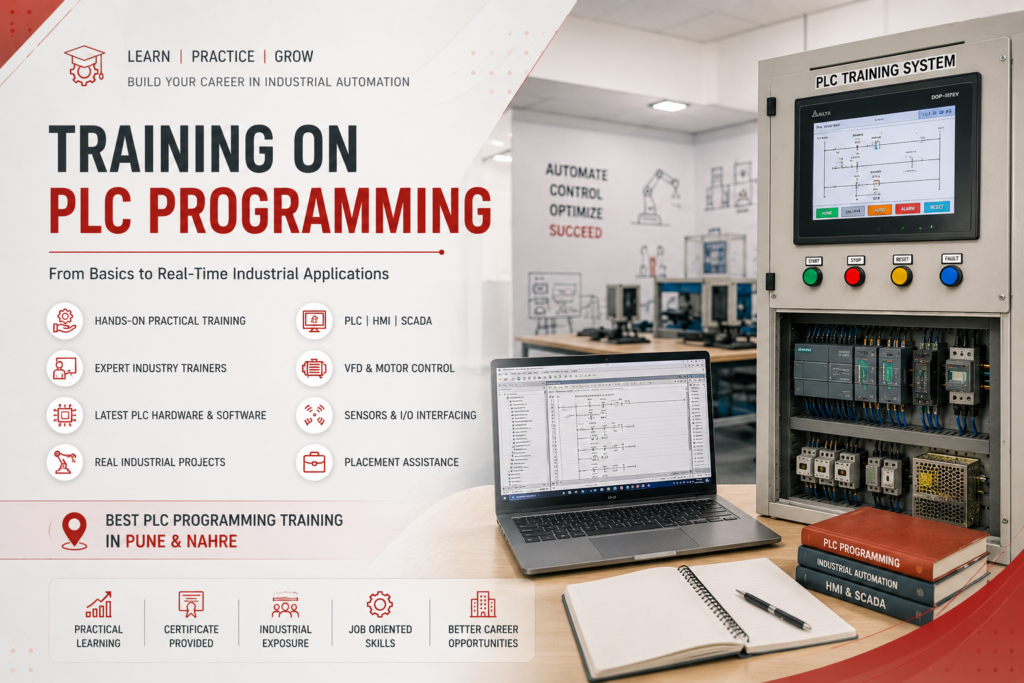
Students searching for best plc programming pune & nahre can explore practical PLC training programs that focus on real industrial applications, troubleshooting, and hands-on programming experience.
2. Industrial Automation Engineer
An Industrial Automation Engineer designs, develops, installs, and maintains automation systems used in manufacturing plants.
Key Responsibilities:
- Design PLC-based automation systems.
- Integrate PLC, HMI, SCADA, and VFD systems.
- Perform machine commissioning and troubleshooting.
- Improve manufacturing productivity through automation.
- Work on industrial control panels and electrical systems.
Required Skills: PLC, SCADA, HMI, VFD, Electrical Control Panels, Sensors, and Industrial Networking.
3. SCADA and HMI Developer
SCADA and HMI systems help operators monitor and control industrial processes.
Key Responsibilities:
- Develop HMI screens for machine operation.
- Design SCADA monitoring systems.
- Configure alarms, trends, and data logging.
- Establish communication between PLCs and SCADA software.
- Develop real-time process monitoring applications.
Required Skills: Siemens WinCC, FactoryTalk View, Wonderware InTouch, HMI Designing, and Industrial Communication Protocols.
SCADA and HMI developers can find opportunities in process industries, utilities, pharmaceuticals, and manufacturing plants.
4. Electrical Control Panel Design Engineer
Electrical Control Panel Designers develop electrical drawings and select components for industrial control systems.
Key Responsibilities:
- Design PCC, MCC, VFD, and PLC control panels.
- Prepare Single Line Diagrams (SLD).
- Develop General Arrangement (GA) drawings.
- Create power and control wiring diagrams.
- Select electrical switchgear and protection devices.
- Prepare Bill of Materials (BOM).
Required Skills: Electrical AutoCAD, Electrical Drawings, Switchgear Selection, Motor Control Circuits, and Panel Designing.
This career is suitable for Electrical Engineering and Diploma students interested in industrial electrical systems.
5. Industrial IoT Engineer
Industrial IoT (IIoT) connects industrial machines and equipment with cloud-based monitoring systems.
Key Responsibilities:
- Connect PLCs and sensors to IoT gateways.
- Develop machine monitoring applications.
- Configure cloud dashboards.
- Monitor production data and machine performance.
- Implement remote monitoring solutions.
Required Skills: PLC Communication, Modbus TCP/IP, MQTT, IoT Gateways, Cloud Dashboards, and Data Monitoring.
With the increasing adoption of Industry 4.0, Industrial IoT offers promising career opportunities for automation professionals.
6. Automation Maintenance Engineer
Automation Maintenance Engineers ensure that industrial machines and automation systems operate efficiently.
Key Responsibilities:
- Troubleshoot PLC and electrical control systems.
- Maintain sensors, actuators, and VFDs.
- Diagnose machine breakdowns.
- Perform preventive maintenance.
- Reduce machine downtime.
Required Skills: Electrical Troubleshooting, PLC Diagnostics, VFD Programming, Sensors, and Motor Control Systems.
Automation Maintenance Engineers are required in automotive, packaging, pharmaceutical, and manufacturing industries.
7. Robotics and Mechatronics Engineer
Robotics and Mechatronics Engineers work with automated machines, robotic systems, and mechanical-electrical integration.
Key Responsibilities:
- Integrate robotic systems with PLCs.
- Work with servo motors and motion controllers.
- Develop automated material-handling systems.
- Troubleshoot robotic and mechatronic equipment.
- Support machine automation projects.
Required Skills: PLC Programming, Robotics, Servo Drives, Pneumatics, Sensors, and Motion Control.
8. Automation Testing and Commissioning Engineer
Testing and Commissioning Engineers ensure that industrial automation systems function correctly before being handed over to customers.
Key Responsibilities:
- Perform PLC and HMI testing.
- Conduct Factory Acceptance Tests (FAT).
- Support Site Acceptance Tests (SAT).
- Verify electrical wiring and I/O connections.
- Troubleshoot automation systems during commissioning.
- Prepare technical documentation.
Required Skills: PLC Troubleshooting, Electrical Drawings, Instrumentation, Commissioning, and Industrial Safety.
This role may involve travelling to industrial sites and working directly with manufacturing equipment.
9. Technical Sales and Application Engineer
Industrial automation also offers career opportunities for professionals interested in technical sales and customer interaction.
Key Responsibilities:
- Understand customer automation requirements.
- Recommend PLC, HMI, VFD, and SCADA solutions.
- Prepare technical quotations and proposals.
- Demonstrate industrial automation products.
- Coordinate with engineering and project teams.
Required Skills: Industrial Automation Products, Technical Communication, Application Knowledge, and Basic Project Estimation.
10. Industries Hiring Industrial Automation Professionals
After completing industrial automation training, candidates can explore opportunities in various industries, including:
- Automotive and Automobile Manufacturing
- Pharmaceutical and Chemical Industries
- Food and Beverage Processing
- Packaging and Bottling Plants
- Water Treatment and Wastewater Treatment Plants
- Power Generation and Utilities
- Oil and Gas Industries
- Special Purpose Machine (SPM) Manufacturing
- Robotics and Smart Manufacturing
- Industrial Automation System Integrators
11. Skills Required to Build a Career in Industrial Automation
To become an industry-ready automation professional, students should focus on developing practical skills in the following areas.
PLC Programming: Siemens, Allen-Bradley, Mitsubishi, and Delta PLCs.
HMI and SCADA: HMI Screen Designing, SCADA Development, Alarm Management, and Data Logging.
Electrical Automation: Control Panel Wiring, Electrical Drawings, MCC Panels, VFDs, and Motor Starters.
Industrial Instrumentation: Temperature, Pressure, Level, Flow Sensors, and Transmitters.
Industrial Networking: Modbus RTU, Modbus TCP/IP, PROFINET, Ethernet/IP, and OPC UA.
Industry 4.0: Industrial IoT, Cloud Monitoring, Smart Manufacturing, and Data Analytics.
Practical training with real PLC hardware, industrial sensors, control panels, and automation projects helps students understand how automation systems operate in actual industries.
12. Why Choose Practical Industrial Automation Training?
Theoretical knowledge is important, but industrial automation requires hands-on technical experience.
A practical industrial automation training program helps students:
- Understand real industrial automation applications.
- Gain experience with PLC hardware and programming software.
- Learn electrical panel wiring and troubleshooting.
- Develop HMI and SCADA applications.
- Work with industrial sensors and communication protocols.
- Build confidence for technical interviews.
- Understand industrial project execution and commissioning.
Students looking for best plc programming pune & nahre should consider training institutes that provide hands-on PLC programming, practical laboratory sessions, industrial projects, and experienced technical trainers.
13. Industrial Automation Training at Automate Engineering
Automate Engineering provides industry-oriented training programs designed to help engineering students and technical professionals develop practical automation skills.
Our industrial automation training covers:
- Siemens, Allen-Bradley, Mitsubishi, and Delta PLC Programming
- HMI Designing and SCADA Development
- Electrical Control Panel Designing and Wiring
- VFD Programming and Motor Control
- Industrial Sensors and Instrumentation
- Pneumatics and Mechatronics
- Industrial IoT and Industry 4.0
- Industrial Communication Protocols
- Practical Automation Projects
- Industrial Troubleshooting and Applications
Our training approach focuses on developing technical knowledge through practical demonstrations, laboratory sessions, and real-world industrial applications.
Explore Industrial Automation Training at Automate Engineering
Website: www.automateengg.com
Email: connect@automateengg.com
Conclusion
Industrial Automation offers diverse career opportunities for Diploma holders, engineering graduates, and working professionals.
From PLC Programming and SCADA Development to Industrial IoT, Robotics, Electrical Panel Designing, and Automation Commissioning, professionals can explore multiple technical career paths.
As industries continue adopting automation and smart manufacturing technologies, practical knowledge of PLC, HMI, SCADA, VFD, and industrial communication systems will remain valuable.
Start developing your industrial automation skills with practical training and prepare yourself for future opportunities in the automation industry.
SEO Keywords
Industrial Automation Training, Career After Industrial Automation Training, PLC Programming Course, PLC Programmer Jobs, Industrial Automation Engineer, SCADA Training, HMI Programming, Electrical Control Panel Designing, Industrial IoT Training, Siemens PLC Training, Allen-Bradley PLC Training, Automation Engineering Careers, Industry 4.0 Training, best plc programming pune & nahre.
#IndustrialAutomation #PLCProgramming #AutomationTraining #SCADA #AutomateEngineering