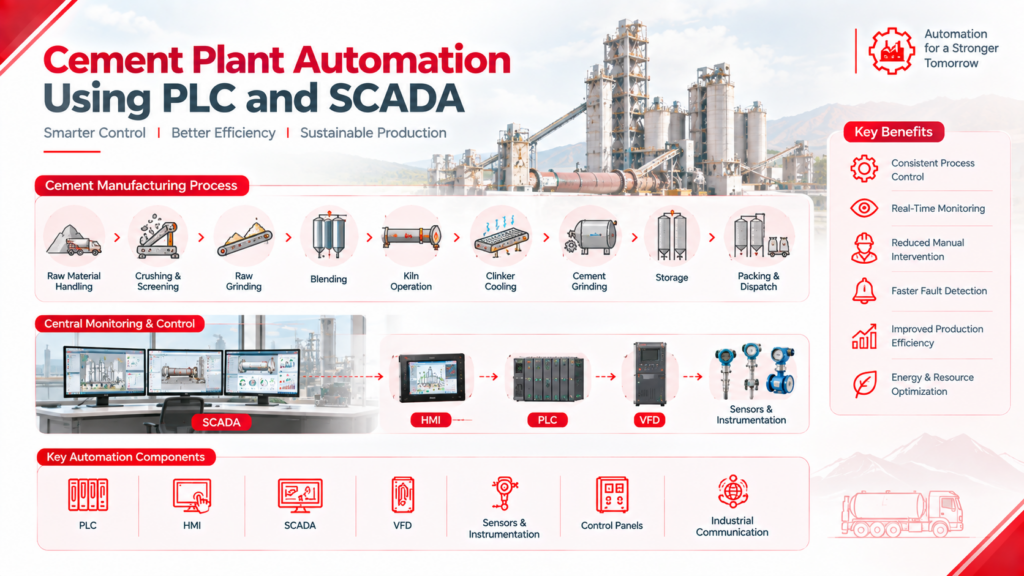
Cement manufacturing involves several continuous and energy-intensive processes such as raw material handling, crushing, grinding, blending, kiln operation, clinker cooling, cement grinding, storage, and packing. These processes require accurate control of temperature, pressure, flow, level, speed, and material movement.
Cement Plant Automation Solutions use technologies such as PLC, SCADA, HMI, VFD, sensors, instrumentation, industrial communication, and control panels to automate plant operations, improve process monitoring, and support consistent production.
Modern Cement Industry Automation can connect different sections of a cement plant through centralized control and real-time monitoring.
What is Cement Plant Automation?
Cement Plant Automation involves using industrial control systems to monitor and control different stages of cement manufacturing.
Automation can be applied to:
- Raw material handling
- Crushing and screening
- Conveyor systems
- Raw mill operation
- Material blending
- Kiln automation
- Clinker cooling
- Cement grinding
- Silo management
- Packing and dispatch
- Dust collection systems
- Plant utilities
A typical automated cement production process can follow:
Raw Materials → Crushing → Raw Grinding → Blending → Kiln → Clinker Cooling → Cement Grinding → Storage → Packing
Role of PLC in Cement Plant Automation
A PLC (Programmable Logic Controller) acts as a control unit for various machines and process sections.
The PLC receives signals from field instruments and sensors and controls motors, conveyors, valves, dampers, pumps, fans, and other equipment according to programmed logic.
PLC Programming for Cement Plants can include:
- Equipment sequence control
- Motor start/stop logic
- Conveyor interlocking
- Process monitoring
- Alarm generation
- Level control
- Temperature monitoring
- Pressure monitoring
- Equipment status
- Automatic and manual operation
For example, conveyor interlocking can ensure that downstream equipment is ready before upstream material feeding begins.
HMI for Cement Plant Monitoring
An HMI (Human Machine Interface) provides operators with a visual interface for monitoring and controlling plant equipment.
An HMI can display:
- Motor status
- Conveyor status
- Temperature
- Pressure
- Material level
- Fan status
- Pump status
- Equipment faults
- Alarm conditions
- Process values
- Operating modes
This allows operators to monitor important plant parameters and equipment conditions from a centralized interface.
SCADA for Cement Plant Automation
For large cement plants, SCADA Automation provides centralized monitoring and supervision of multiple process sections.
A SCADA System can monitor:
- Raw material handling
- Crushing
- Grinding
- Kiln operation
- Clinker cooling
- Cement mills
- Storage silos
- Packing systems
- Equipment alarms
- Process trends
- Production information
- Energy consumption
SCADA can also support historical data logging, alarm management, trend visualization, production reporting, and centralized plant monitoring.
Kiln Automation
The kiln is one of the most important sections of a cement manufacturing plant.
Automation can monitor and control parameters such as:
- Kiln temperature
- Pressure
- Fuel flow
- Air flow
- Fan operation
- Material feed
- Equipment status
PLC and SCADA systems can collect process information and provide operators with real-time visibility into kiln operation.
Process control should be designed according to the specific kiln configuration, operating requirements, instrumentation, and safety systems.
VFD Automation in Cement Plants
Cement plants contain many motors used for conveyors, fans, pumps, crushers, feeders, mills, and other equipment.
VFD Automation allows motor speed to be adjusted according to process requirements.
VFDs can be used for:
- Conveyor drives
- ID and process fans
- Pumps
- Feeders
- Blowers
- Material-handling equipment
A properly designed VFD Control Panel can provide speed control, motor protection, fault indication, and communication with the PLC or plant control system.
Sensors and Instrumentation
Instrumentation provides real-time information to the automation system.
Common devices used in cement plant automation include:
- Temperature sensors
- Pressure transmitters
- Level sensors
- Flow meters
- Vibration sensors
- Proximity sensors
- Speed sensors
- Weigh feeders
- Differential pressure sensors
These instruments provide feedback to the PLC and SCADA system for process monitoring and equipment control.
Control Panels for Cement Plant Automation
A reliable Industrial Control Panel provides centralized electrical control and protection for automated cement plant equipment.
A PLC Control Panel may include:
- PLC and I/O modules
- HMI
- VFDs
- Power supplies
- MCBs and MCCBs
- Contactors
- Relays
- Terminal blocks
- Communication modules
- Instrumentation interfaces
- Safety and protection devices
Proper Control Panel Manufacturing, electrical design, wiring, component selection, and testing are important for reliable plant operation.
Applications of Cement Plant Automation
Raw Material Handling
Automated conveyors, feeders, crushers, and sensors can coordinate the movement of limestone and other raw materials.
Crushing and Screening
PLC-based control can coordinate crushers, conveyors, feeders, and interlocking systems.
Raw Material Grinding
Automation can monitor and control mills, feeders, fans, temperature, pressure, and other process parameters.
Kiln and Clinker Production
PLC and SCADA systems can monitor equipment and process parameters associated with kiln operation and clinker production.
Clinker Cooling
Fans, conveyors, sensors, and control systems can be integrated for automated clinker cooling operations.
Cement Grinding
Automation can coordinate cement mills, feeders, separators, fans, and material-transfer equipment.
Packing and Dispatch
Automated systems can control bag filling, weighing, sealing, conveying, palletizing, and dispatch operations.
Benefits of Cement Plant Automation
Improved Process Control
Automation helps maintain consistent control of important plant parameters.
Real-Time Monitoring
HMI and SCADA systems provide real-time visibility into equipment and process conditions.
Reduced Manual Intervention
Automated sequences reduce repetitive manual operations across different plant sections.
Better Equipment Monitoring
PLC and SCADA systems can provide equipment status and fault information for troubleshooting.
Improved Alarm Management
Automation systems can generate alarms when configured process or equipment conditions move outside defined operating limits.
Production Data Collection
SCADA systems can collect historical process and equipment data for reporting and analysis.
Energy Monitoring
Connected automation systems can help monitor energy-related parameters and equipment operating conditions.
Industry 4.0 in Cement Manufacturing
Modern cement plants are increasingly adopting Industry 4.0 and IIoT technologies to connect equipment, instrumentation, control systems, and production data.
A connected cement plant automation architecture can follow:
Sensors & Instruments → PLC → HMI/SCADA → Industrial Network → Production Data → Monitoring & Analysis
This can support centralized plant monitoring, production reporting, equipment performance analysis, energy monitoring, and data-driven maintenance strategies.
As an Industrial Automation System Integrator in Pune, Automate Engineering works with technologies such as PLC Programming, SCADA Automation, HMI Programming, VFD Automation, industrial instrumentation, control panels, and process automation for industrial applications.
From raw material handling and grinding to kiln operation, clinker cooling, cement production, storage, and packing, Cement Plant Automation Solutions can provide centralized control, real-time monitoring, improved equipment visibility, and efficient plant operations.
#CementPlantAutomation #CementAutomation #CementIndustry #CementManufacturing #IndustrialAutomation #PLCAutomation #PLCProgramming #SCADA #SCADAAutomation #HMI #VFDAutomation #ProcessAutomation #KilnAutomation #CementPlant #IndustrialInstrumentation #ControlPanel #PLCControlPanel #FactoryAutomation #SmartManufacturing #Industry40 #IIoT #ManufacturingAutomation #IndustrialAutomationSolutions #PuneAutomation