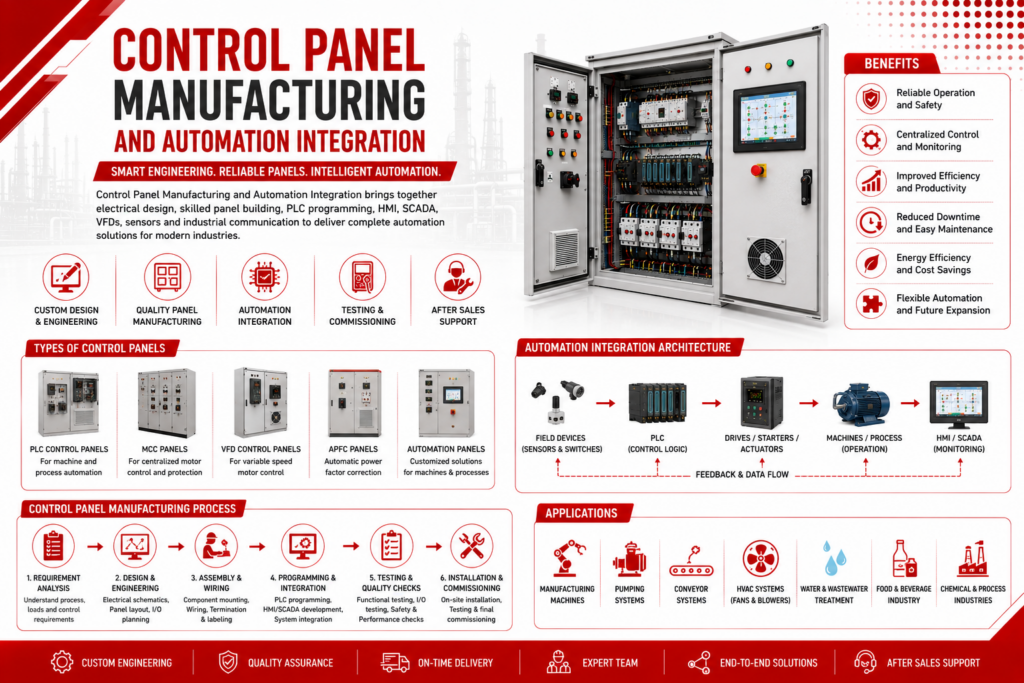
Modern industries require reliable electrical and automation systems to operate machines efficiently, safely, and with minimum downtime. Control Panel Manufacturing and Automation Integration brings together electrical engineering, PLC programming, motor control, HMI, SCADA, VFDs, sensors, and industrial communication to create complete automation solutions for manufacturing and process industries.
A well-designed Industrial Control Panel acts as the central point where power distribution, control logic, protection, and communication systems are integrated to operate industrial equipment and processes.
What is Control Panel Manufacturing?
Control Panel Manufacturing involves the design, assembly, wiring, testing, and integration of electrical and automation components inside a suitable panel enclosure.
Depending on the application, an industrial control panel may include:
- PLC and I/O modules
- HMI
- VFDs and soft starters
- MCCBs, MCBs, and fuses
- Contactors and overload relays
- Power supplies
- Relays and timers
- Terminal blocks
- Energy meters
- Industrial communication modules
- Sensors and field connections
- Safety and protection devices
The selection and arrangement of these components depend on the machine requirements, load ratings, control philosophy, and process conditions.
The Role of Automation Integration
Manufacturing a panel is only one part of an automation project. Automation Integration connects the control panel with machines, motors, sensors, actuators, and higher-level monitoring systems.
A typical integrated automation architecture may follow:
Field Devices → PLC → Control Logic → VFD/Starter/Actuator → Machine Operation → HMI/SCADA Monitoring
This integration allows machines and processes to operate automatically according to programmed conditions.
For example, sensors can provide real-time information to a PLC, the PLC can execute the required control logic, and the control panel can operate motors, pumps, valves, conveyors, or other equipment. At the same time, an HMI or SCADA system can provide operators with real-time monitoring, alarms, and control options.
Types of Industrial Control Panels
Different industrial applications require different types of control panels. Common examples include:
PLC Control Panels
Used for machine automation and process control through programmable logic controllers and I/O systems.
MCC Panels
Motor Control Center Panels are used to control and protect multiple industrial motors from a centralized location.
VFD Control Panels
Used for variable speed control of motors in applications such as pumps, fans, conveyors, and process machinery.
APFC Panels
Automatic Power Factor Correction Panels help manage reactive power and automatically control capacitor banks.
Automation and Machine Control Panels
Designed for customized machine applications requiring PLC, HMI, sensors, actuators, drives, and safety systems.
Key Stages in Control Panel Manufacturing
A reliable Control Panel Manufacturing Process involves proper engineering and systematic execution.
1. Requirement Analysis
The first step is understanding the machine, process, electrical load, control requirements, and automation scope.
2. Electrical and Automation Design
This stage includes component selection, electrical schematics, panel layout planning, I/O planning, power distribution, and protection design.
3. Panel Assembly and Wiring
Selected components are installed inside the enclosure according to the panel layout. Proper wiring, cable routing, terminal identification, and segregation of power and control circuits are important for reliable operation.
4. PLC, HMI and SCADA Integration
Automation software is developed and integrated with the control panel. PLC logic controls machine operation, while HMI and SCADA systems provide monitoring and operator control.
5. Testing and Quality Checks
The completed panel is tested to verify wiring, component operation, I/O signals, protection functions, communication, and automation logic.
6. Installation and Commissioning
The control panel is installed and connected to field equipment. The automation system is then tested under actual operating conditions.
Benefits of Integrated Control Panel Solutions
A professionally manufactured and integrated Industrial Automation Control Panel provides several advantages.
Reliable Operation: Proper component selection, wiring, and testing support stable machine operation.
Centralized Control: Multiple machines and equipment can be controlled through organized automation systems.
Improved Safety: Protection devices, interlocks, and safety circuits can be integrated according to application requirements.
Easy Monitoring: HMI and SCADA systems provide visibility of machine status, alarms, process parameters, and operating conditions.
Reduced Downtime: Organized control systems and fault monitoring can help maintenance teams identify issues faster.
Flexible Automation: PLC programming allows automation logic to be modified according to changing process requirements.
Future Expansion: Proper panel design can allow space and I/O capacity for future automation requirements.
Control Panels for Smart Manufacturing
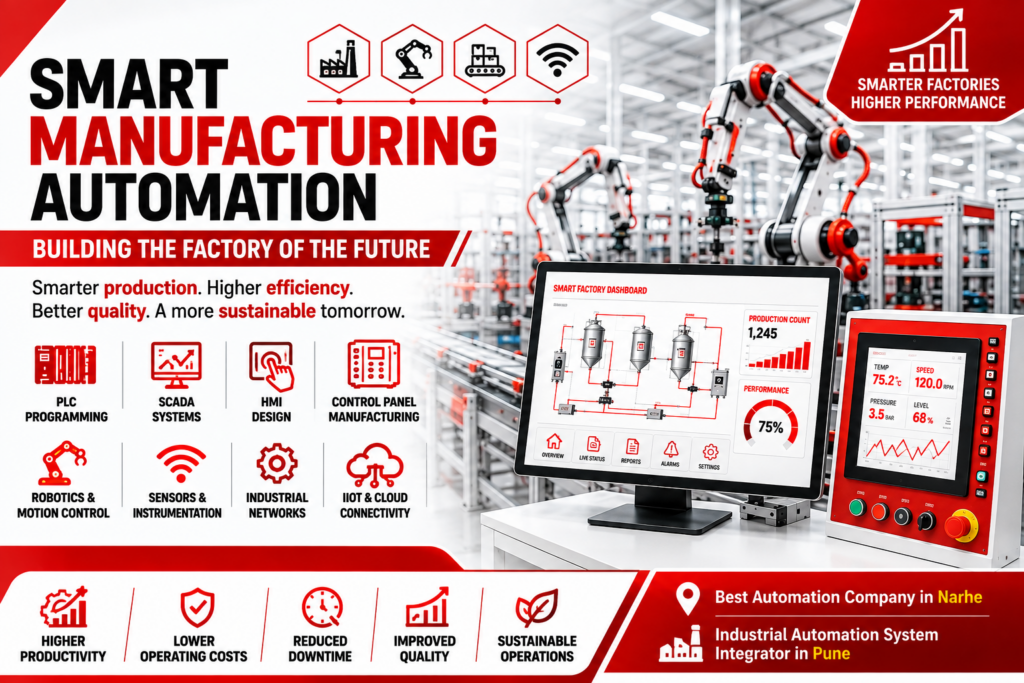
As industries move toward Smart Manufacturing and Industry 4.0, control panels are becoming more connected and intelligent.
Modern panels can integrate with IIoT systems, remote monitoring platforms, energy meters, SCADA software, industrial Ethernet, and data collection systems. This allows industries to monitor production, machine performance, energy consumption, alarms, and operational data.
The combination of Control Panel Manufacturing, PLC Automation, HMI, SCADA, VFDs, and Industrial Communication creates a strong foundation for connected and efficient manufacturing operations.
As an Industrial Automation System Integrator in Pune, Automate Engineering provides solutions involving Control Panel Manufacturing, PLC Control Panels, MCC Panels, VFD Panels, APFC Panels, PLC Programming, HMI Programming, SCADA Automation, Machine Automation, and Industrial Automation Integration.
A properly engineered control panel combined with effective automation integration helps industries achieve safer operation, better machine control, improved productivity, and reliable long-term performance.
Automate Engineering – Complete Control Panel Manufacturing and Industrial Automation Solutions for smarter, connected, and efficient manufacturing.
#ControlPanelManufacturing #IndustrialControlPanel #AutomationIntegration #IndustrialAutomation #PLCPanel #MCCPanel #VFDPanel #APFCPanel #PLCAutomation #PLCProgramming #HMI #SCADA #VFDAutomation #MachineAutomation #FactoryAutomation #IndustrialAutomationSolutions #SmartManufacturing #Industry40 #ControlPanelDesign #AutomationEngineering #PuneAutomation