Industrial automation depends on proper control panel wiring, PLC programming, and testing. A well-designed control panel helps machines operate safely, reliably, and efficiently. For students, electricians, technicians, and automation engineers, practical training in these areas is very useful for building real industrial skills.
What is Control Panel Wiring?
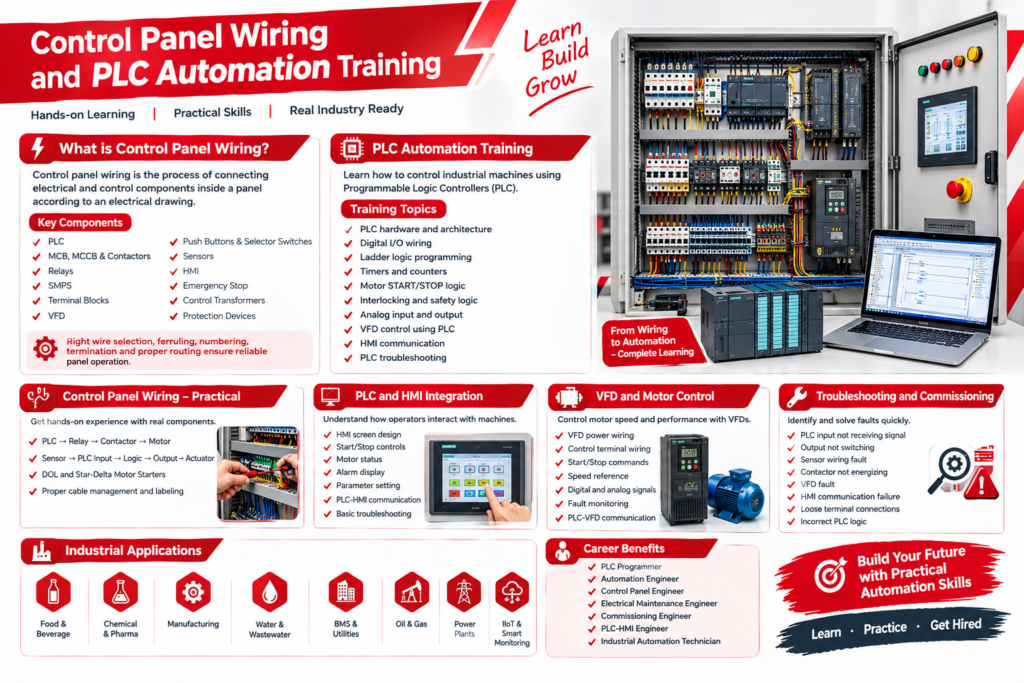
Control panel wiring is the process of connecting electrical and control components inside a panel according to an electrical drawing. A typical automation panel may include:
- PLC
- MCB, MCCB and contactors
- Relays
- SMPS
- Terminal blocks
- VFD
- Push buttons and selector switches
- Sensors
- HMI
- Emergency stop
- Control transformers and other protection devices
Correct wire selection, ferruling, numbering, termination, and proper routing are important for reliable panel operation.
PLC Automation Training
PLC training teaches how to control industrial machines using programmable logic controllers. During practical training, learners can work with PLC hardware and understand how inputs, outputs, timers, counters, analog signals, and communication are used in automation.
Important PLC training topics include:
- PLC hardware and architecture
- Digital input and output wiring
- Ladder logic programming
- Timers and counters
- Motor START/STOP logic
- Interlocking and safety logic
- Analog input and output
- VFD control using PLC
- HMI communication
- PLC troubleshooting
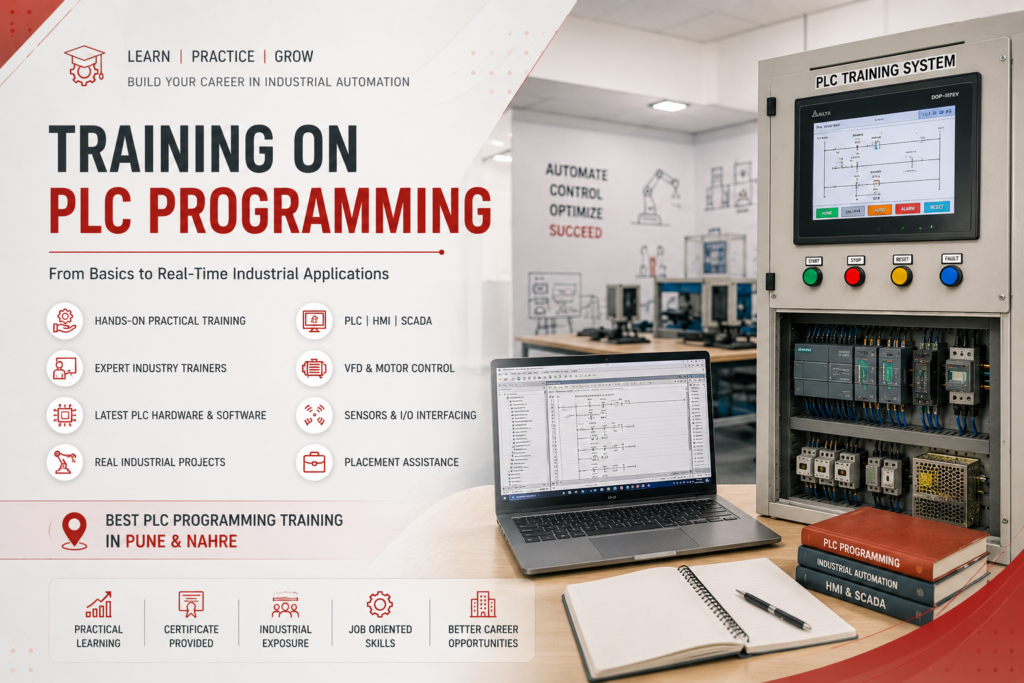
For learners searching for best plc programming pune & nahre, practical training should focus not only on programming but also on actual panel wiring, commissioning, and troubleshooting.
Control Panel Wiring Practical
A good training program should provide hands-on practice with real components. Students can learn how to wire:
PLC → Relay → Contactor → Motor
and
Sensor → PLC Input → PLC Logic → PLC Output → Actuator
They can also practice motor control circuits such as DOL and Star-Delta starters.
PLC and HMI Integration
Modern machines commonly use an HMI along with a PLC. Training can cover:
- HMI screen design
- Start/Stop controls
- Motor status
- Alarm display
- Parameter setting
- PLC-HMI communication
- Basic troubleshooting
This helps learners understand how an operator interacts with an automated machine.
VFD and Motor Control
VFDs are widely used for controlling motor speed. PLC automation training can include:
- VFD power wiring
- Control terminal wiring
- Start/Stop commands
- Speed reference
- Digital and analog signals
- Fault monitoring
- PLC-VFD communication
Practical exercises help learners understand the complete sequence from PLC programming to motor operation.
Troubleshooting and Commissioning
Automation training should also cover troubleshooting because industrial engineers often need to identify faults quickly.
Common practical troubleshooting exercises include:
- PLC input not receiving a signal
- Output not switching
- Sensor wiring fault
- Contactor not energizing
- VFD fault
- HMI communication failure
- Loose terminal connections
- Incorrect PLC logic
Learners can use electrical drawings, multimeters, PLC diagnostics, and online monitoring to locate problems.
Career Benefits
Practical control panel and PLC training can help learners develop skills for roles such as:
- PLC Programmer
- Automation Engineer
- Control Panel Engineer
- Electrical Maintenance Engineer
- Commissioning Engineer
- PLC-HMI Engineer
- Industrial Automation Technician
Conclusion
Control Panel Wiring and PLC Automation Training combines electrical knowledge with practical automation skills. Learning panel wiring, PLC programming, HMI, VFD, sensors, and troubleshooting together gives learners a better understanding of complete industrial automation systems.
For students and working professionals looking for best plc programming pune & nahre, a hands-on training approach with real PLC panels and industrial components can provide valuable practical exposure.
#PLCProgramming #ControlPanelWiring #IndustrialAutomation #PLCTraining #AutomationTraining #PLC #HMI #VFD #ElectricalPanel #IndustrialTraining