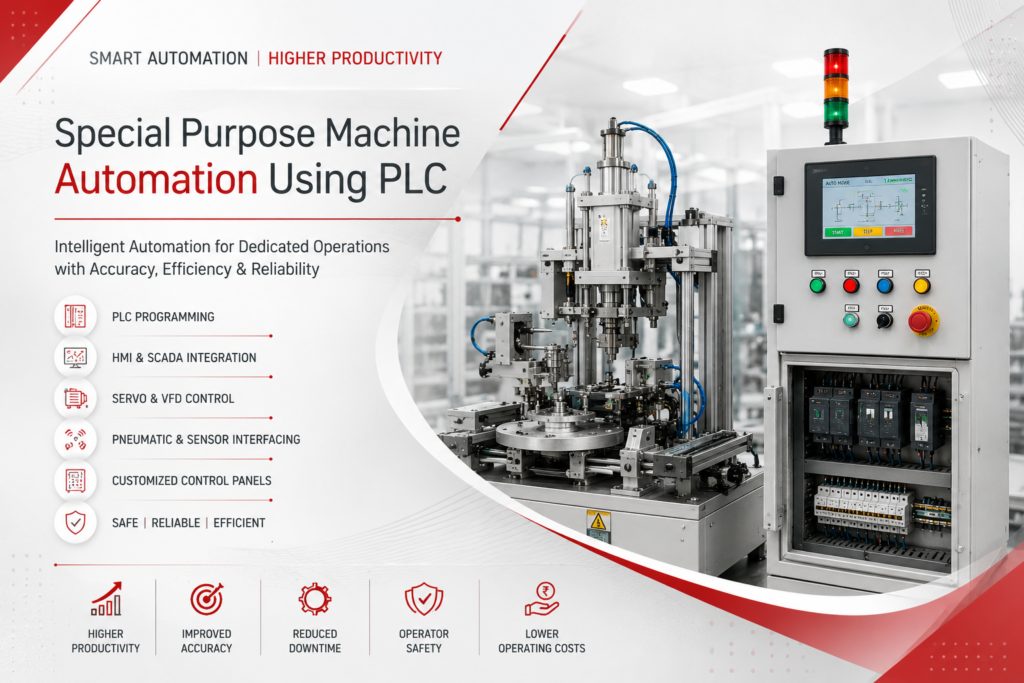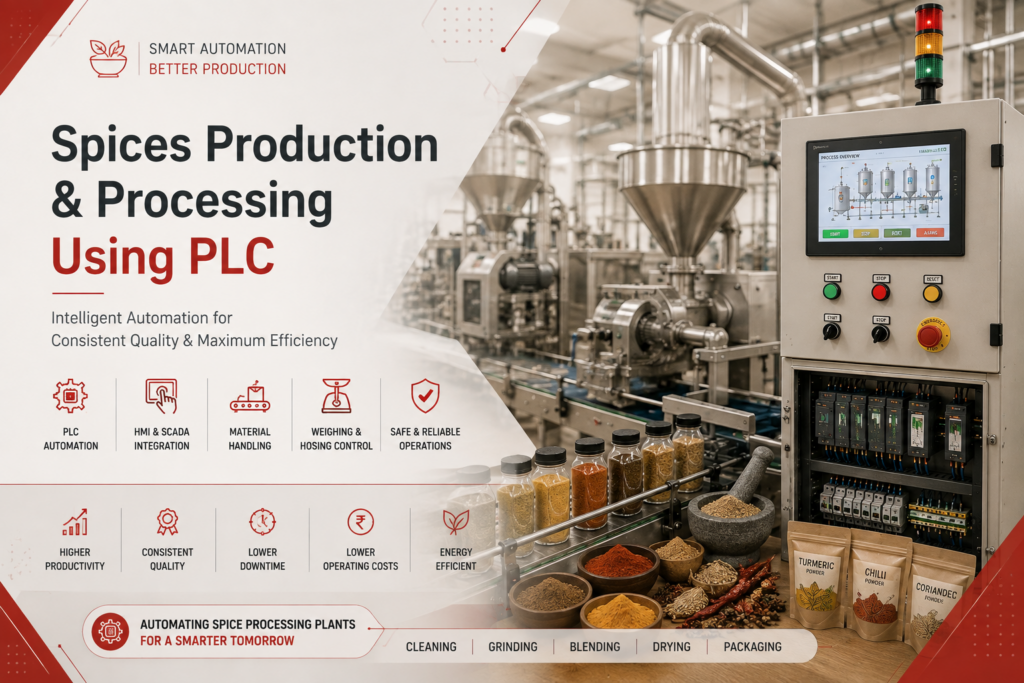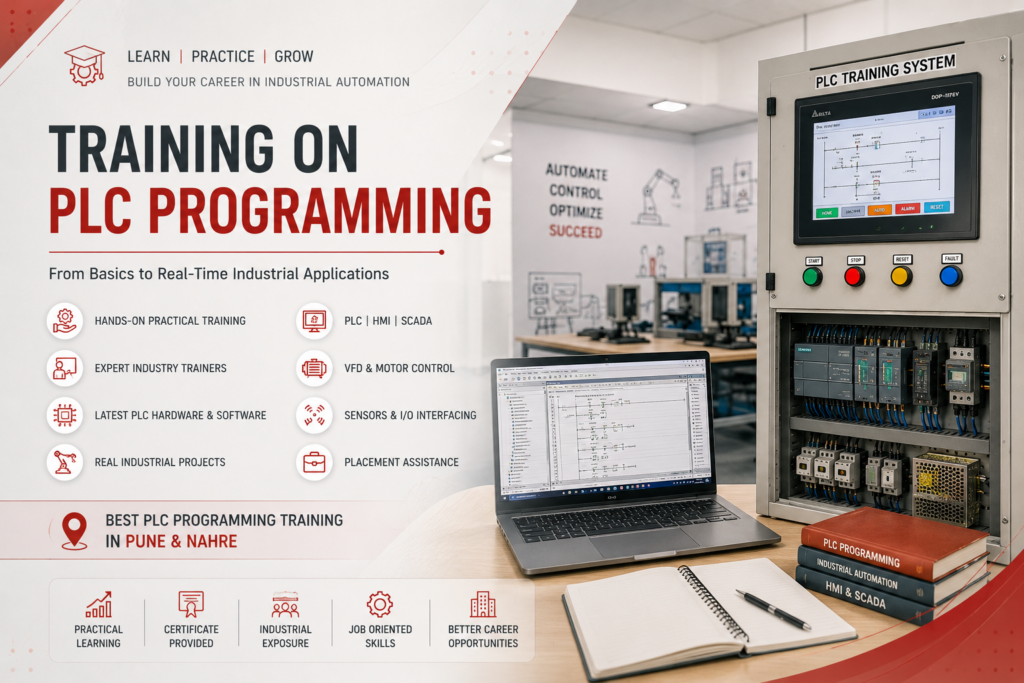
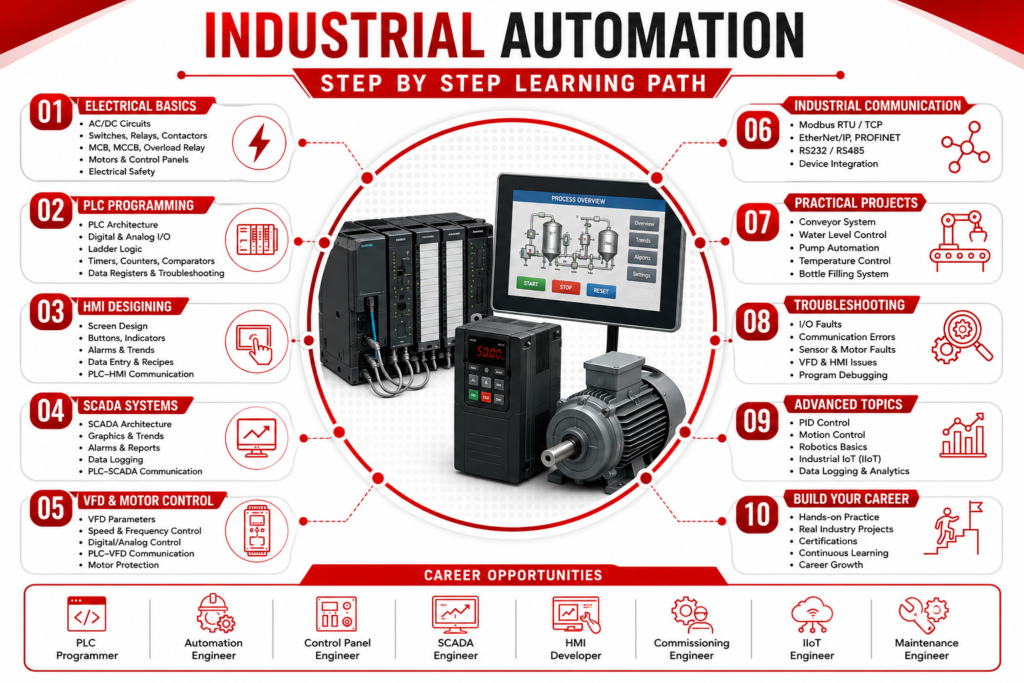
Industrial Automation is one of the most important technologies used in modern manufacturing industries. It combines PLC, SCADA, HMI, VFD, sensors, instrumentation, robotics, and industrial communication to automate machines and production processes.
If you want to build a career in Industrial Automation, learning the concepts step by step is the best approach.
1. Start with Electrical Basics
Before learning PLC programming, understand the fundamentals of electrical systems:
- AC and DC circuits
- Relays and contactors
- MCB, MCCB and overload relays
- Sensors and switches
- Motors
- Control panels
- Wiring and electrical safety
A strong electrical foundation makes PLC programming much easier to understand.
2. Learn PLC Programming
PLC is the heart of many industrial automation systems. Start with basic PLC concepts such as:
- PLC architecture
- Digital Input and Output
- Analog Input and Output
- Ladder Logic
- Timers and Counters
- Comparators
- Data registers
- Program troubleshooting
Then practice PLC programming using platforms such as Siemens, Allen-Bradley, Mitsubishi and Delta.
For students and working professionals looking for practical training, choosing the best PLC programming Pune course can help you gain hands-on experience with real industrial applications.
3. Learn HMI Designing
After PLC programming, learn how to design an HMI (Human Machine Interface).
You should understand:
- HMI screen design
- Start/Stop controls
- Alarms
- Status indicators
- Data entry
- Trends
- Recipe management
- PLC-HMI communication
Practical HMI projects will help you understand how operators control machines in real industries.
4. Learn SCADA
SCADA is widely used for monitoring and controlling industrial processes.
Learn:
- SCADA architecture
- Tags
- Graphics
- Alarms
- Trends
- Reports
- Data logging
- PLC-SCADA communication
Popular SCADA platforms include Siemens WinCC and other industrial SCADA solutions.
5. Understand VFD and Motor Control
Variable Frequency Drives (VFDs) are commonly used to control the speed of industrial motors.
Learn:
- VFD parameters
- Speed control
- Frequency settings
- Digital and analog control
- VFD fault handling
- PLC-VFD communication
- Motor protection
Try practical projects involving conveyors, pumps and fans.
6. Learn Industrial Communication
Modern automation systems require different devices to communicate with each other.
Important protocols include:
- Modbus RTU
- Modbus TCP
- Ethernet/IP
- PROFINET
- RS232
- RS485
Understanding industrial communication will help you connect PLCs, HMIs, SCADA systems, VFDs and other devices.
7. Practice with Real Industrial Projects
Theory alone is not enough. Build practical projects such as:
- Automatic conveyor system
- Water-level control
- Pump automation
- Motor control system
- Bottle filling system
- Traffic light automation
- Temperature control
- PLC-based machine automation
Projects improve your programming, troubleshooting and commissioning skills.
8. Learn Troubleshooting
A good automation engineer should know how to find and solve problems.
Practice troubleshooting:
- PLC input/output faults
- Sensor problems
- Communication errors
- Motor faults
- VFD faults
- HMI communication issues
- Wiring problems
- PLC program errors
Hands-on troubleshooting is one of the most valuable skills for an industrial automation career.
9. Choose Practical Industrial Automation Training
If you are searching for best PLC programming Nahre, focus on training that provides practical PLC programming, HMI, SCADA, VFD, electrical panel and industrial communication experience rather than only theoretical classes.
Look for a course that provides:
- Real PLC hardware
- Industrial automation projects
- Practical programming
- HMI and SCADA training
- VFD training
- Troubleshooting practice
- Industrial communication
- Project-based learning
10. Build Your Career in Industrial Automation
After learning the fundamentals, you can explore career opportunities such as:
- PLC Programmer
- Automation Engineer
- Control Panel Engineer
- SCADA Engineer
- HMI Developer
- Commissioning Engineer
- Maintenance Automation Engineer
- Industrial IoT Engineer
Final Thoughts
Learning Industrial Automation step by step makes it easier to develop strong technical skills. Start with electrical basics, then learn PLC programming, followed by HMI, SCADA, VFD, industrial communication and troubleshooting. Most importantly, keep working on real-world projects.
With consistent practice and practical training, you can develop the skills required to start or advance your career as an Industrial Automation Engineer.
#IndustrialAutomation #PLCProgramming #BestPLCProgrammingPune #BestPLCProgrammingNahre #PLCTraining #PLCProgrammingPune #AutomationTraining #SCADA #HMI #VFD #IndustrialAutomationTraining #AutomationEngineer #PLCTrainer #IndustrialAutomationCourse