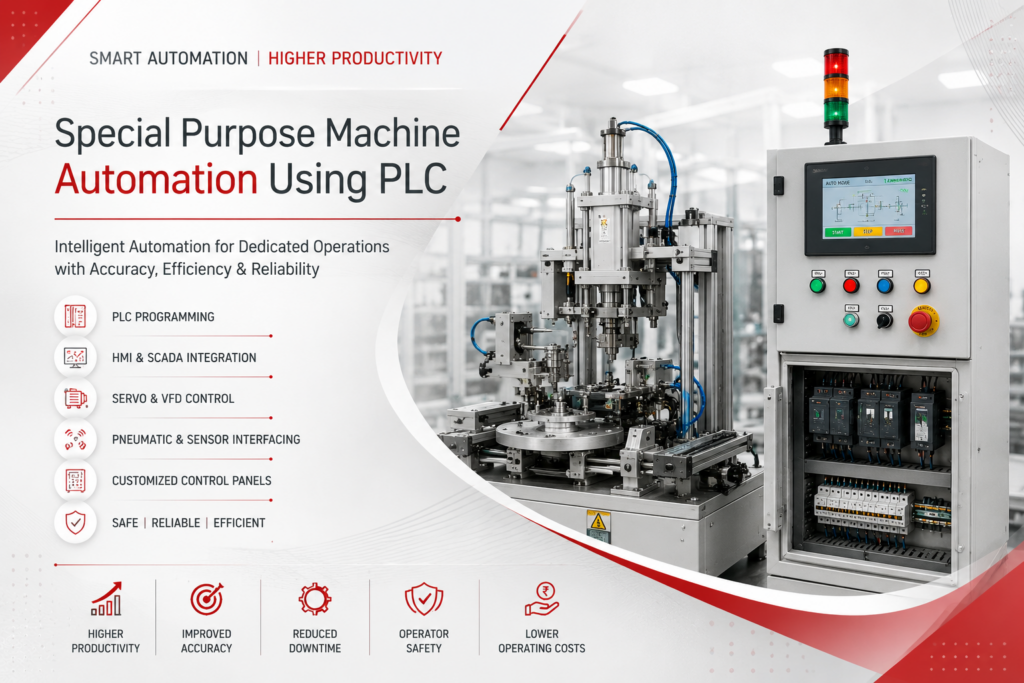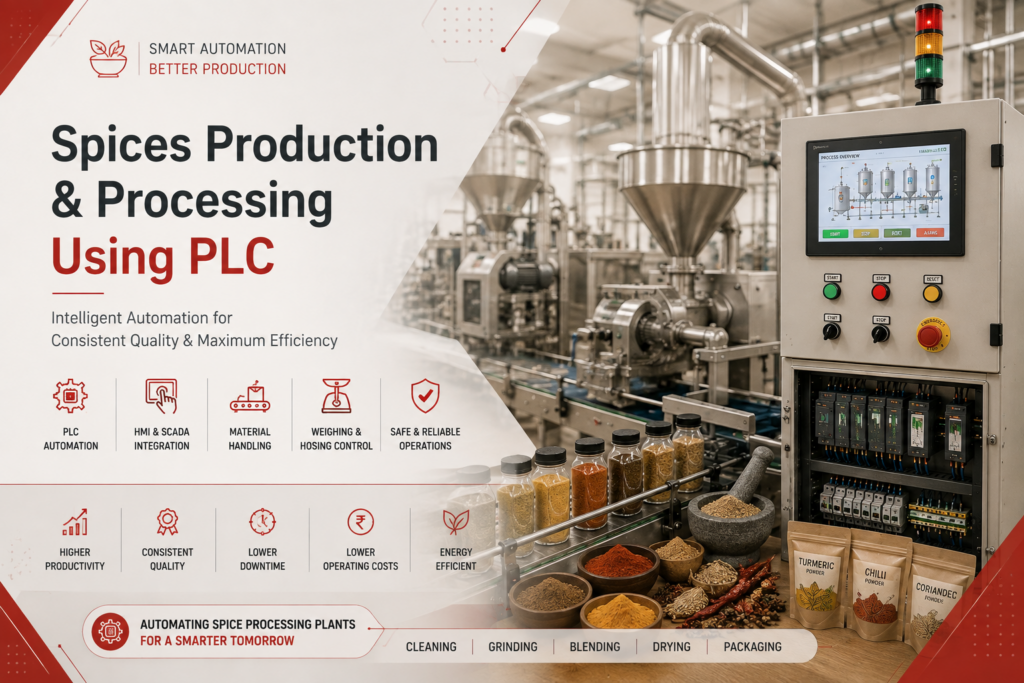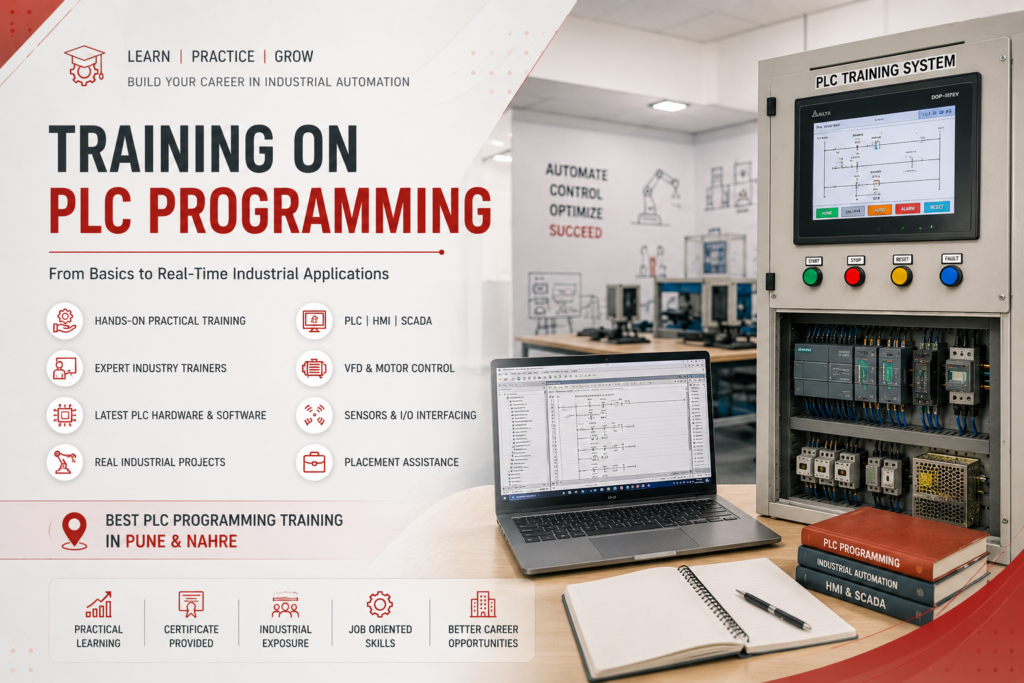
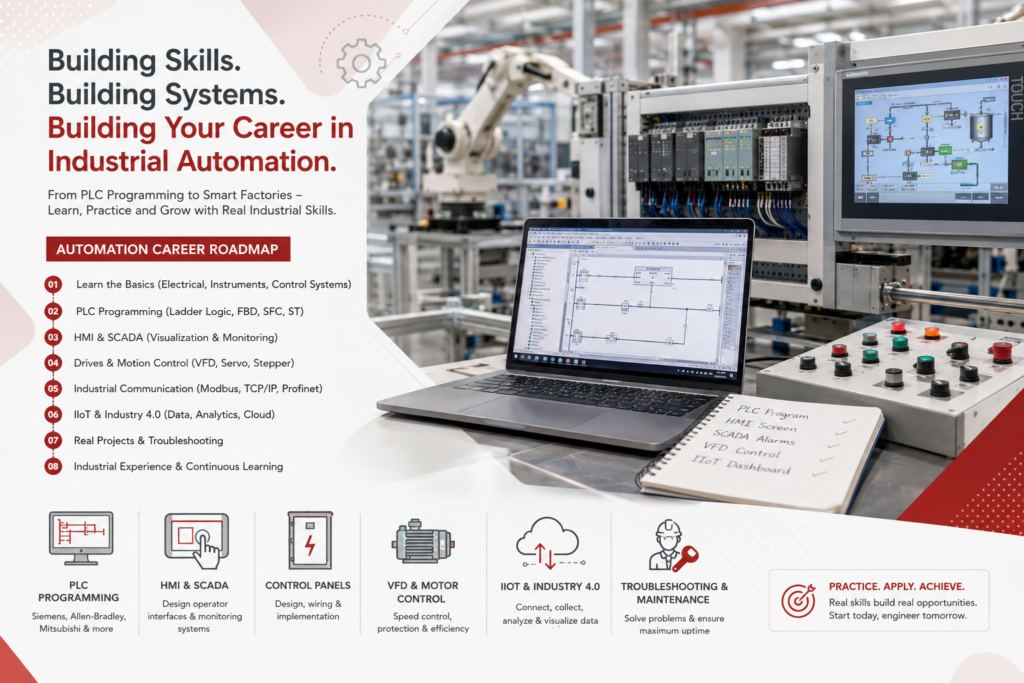
Industrial automation is one of the fastest-growing career fields for students and professionals from Electrical, Electronics, Instrumentation, Mechatronics, and related engineering backgrounds. Modern manufacturing industries depend on PLC, HMI, SCADA, VFD, servo systems, industrial networking, robotics, and IIoT to improve productivity, quality, safety, and efficiency.
If you are planning to build a career in automation, developing practical skills—not just theoretical knowledge—is essential. This guide explains the important skills, software, projects, and training required to start a successful career in industrial automation.
1. Understand the Basics of Industrial Automation
Before learning advanced automation technologies, understand the fundamentals of:
- Electrical control systems
- Sensors and actuators
- Relays and contactors
- Motors and starters
- VFDs and soft starters
- Control panels
- Industrial instrumentation
- Pneumatics and hydraulics
- Industrial communication
A strong understanding of electrical systems makes it much easier to troubleshoot and program industrial automation systems.
2. Learn PLC Programming
PLC programming is one of the most important skills for an automation engineer.
Start with PLC programming concepts such as:
- Digital Input and Digital Output
- Analog Input and Analog Output
- Ladder Logic
- Function Block Diagram
- Timers and counters
- Comparators
- Data registers
- PID control
- Alarms and interlocks
- Motor control
- Sequence control
You can learn PLC platforms from major manufacturers such as Siemens, Allen-Bradley, Mitsubishi, Delta, and Schneider.
For students and working professionals in Maharashtra, searching for best PLC programming Pune or best PLC programming Narhe can help identify practical training options that focus on industrial applications rather than only classroom theory.
3. Learn HMI and SCADA
PLC programming alone is not enough for many industrial automation jobs. You should also learn how operators monitor and control machines.
HMI
Learn how to create:
- Motor control screens
- Auto/manual operation
- Alarm pages
- Set-point screens
- Status indicators
- Recipe screens
- Production counters
SCADA
SCADA systems are widely used for plant monitoring and process automation.
Important SCADA skills include:
- Tag configuration
- Graphics development
- Alarm management
- Trends
- Historical data
- User management
- Reports
- Data logging
- PLC-SCADA communication
Popular platforms include Siemens WinCC, Rockwell FactoryTalk View, AVEVA/Wonderware, and other industrial SCADA platforms.
4. Develop Electrical Panel Knowledge
An automation engineer should understand how PLC-based control panels are designed and wired.
Learn about:
- MCC panels
- PLC panels
- VFD panels
- Control panels
- SMPS
- MCB/MCCB
- Contactors
- Relays
- Terminal blocks
- Safety relays
- Panel wiring
- Earthing
- Cable selection
Learning electrical design software such as AutoCAD Electrical can also improve your employability.
5. Learn Industrial Communication
Modern automation systems contain multiple devices that need to communicate with each other.
Important protocols include:
- Modbus RTU
- Modbus TCP/IP
- Ethernet/IP
- PROFINET
- PROFIBUS
- RS-232
- RS-485
- OPC UA
Understanding IP addressing, Ethernet networking, PLC communication, and troubleshooting communication faults is highly valuable for automation engineers.
6. Learn VFD and Motor Control
Motors are fundamental to manufacturing automation.
You should understand:
- DOL starters
- Star-delta starters
- VFD operation
- Speed control
- Frequency and RPM
- Acceleration/deceleration
- VFD fault diagnosis
- Forward/reverse control
- Analog speed reference
- PLC-VFD communication
For advanced applications, learn servo motors and motion control as well.
7. Practice Real Industrial Projects
One of the biggest differences between a beginner and a job-ready automation engineer is hands-on project experience.
Instead of learning PLC instructions individually, build complete projects such as:
Conveyor Automation
Create a conveyor system with:
- Start/stop control
- Emergency stop
- Sensors
- Motor control
- Product counting
- Automatic sequence
- HMI monitoring
Tank Level Control
Build a PLC-based system containing:
- Level sensors
- Pump control
- Auto/manual mode
- High-level and low-level alarms
- HMI display
Motor Control System
Develop a project using:
- PLC
- VFD
- Motor
- HMI
- Start/stop commands
- Speed reference
- Fault monitoring
These projects help demonstrate your practical knowledge during interviews.
8. Learn Troubleshooting
Industrial companies need engineers who can solve problems quickly.
Practice troubleshooting:
- PLC input/output faults
- Sensor failures
- Motor faults
- VFD trips
- Communication errors
- HMI communication problems
- Wiring faults
- Power supply problems
- PLC program errors
Always learn to troubleshoot systematically—from power supply and wiring to field devices, PLC logic, communication, and HMI.
9. Add IIoT and Industry 4.0 Skills
Industrial automation is increasingly connected with Industrial IoT (IIoT), data analytics, cloud platforms, and Industry 4.0.
Consider learning:
- MQTT
- OPC UA
- Industrial IoT gateways
- PLC data acquisition
- Database connectivity
- Grafana
- InfluxDB
- Python basics
- Remote monitoring
- Energy monitoring
- Production dashboards
Combining PLC programming with IIoT can open opportunities in smart manufacturing and digital transformation projects.
10. Choose the Right Industrial Automation Training
A good training program should provide more than PLC theory.
Look for training that includes:
- Real PLC hardware
- HMI hardware
- VFD
- Sensors
- Industrial control panels
- SCADA software
- Industrial communication
- Electrical wiring
- Troubleshooting
- Real-time projects
- Industrial case studies
If you are looking for PLC training in Pune or Narhe, compare institutes based on practical lab facilities, trainer experience, industrial projects, and placement assistance rather than choosing only on the basis of course fees.
11. Build an Automation Portfolio
Your resume becomes much stronger when you can demonstrate actual projects.
Create a portfolio containing:
- PLC programming projects
- HMI screens
- SCADA projects
- VFD applications
- Electrical panel drawings
- Industrial communication projects
- IIoT dashboards
- Project documentation
- PLC source programs
- Videos of working projects
A candidate who can explain a complete automation project from electrical wiring → PLC programming → HMI → VFD → communication → troubleshooting has a significant advantage during interviews.
12. Career Opportunities in Industrial Automation
After developing these skills, you can explore roles such as:
- PLC Programmer
- Automation Engineer
- Control Engineer
- PLC-SCADA Engineer
- HMI Engineer
- Electrical Automation Engineer
- Commissioning Engineer
- Maintenance Automation Engineer
- Process Automation Engineer
- Instrumentation Engineer
- Robotics Engineer
- IIoT Engineer
Industries hiring automation professionals include manufacturing, pharmaceuticals, food and beverage, chemicals, automotive, water treatment, packaging, process industries, energy, and machine building.
13. A Simple Learning Roadmap
A practical learning sequence can be:
Electrical Fundamentals → PLC Programming → HMI → VFD → SCADA → Industrial Networking → Control Panel Design → Troubleshooting → Industrial Projects → IIoT
Do not try to learn everything simultaneously. Build your skills step by step and continuously apply what you learn through projects.
Conclusion
Starting a career in industrial automation requires a combination of technical knowledge, programming skills, electrical understanding, practical experience, and troubleshooting ability. PLC programming should be your foundation, followed by HMI, SCADA, VFD, industrial communication, panel design, and IIoT.
If you are searching for best PLC programming Pune, best PLC programming Narhe, or practical industrial automation training, focus on programs that provide real hardware practice and project-based learning.
With consistent practice and a strong project portfolio, students and professionals can build rewarding careers in PLC programming, industrial automation, control systems, SCADA, robotics, and Industry 4.0.