
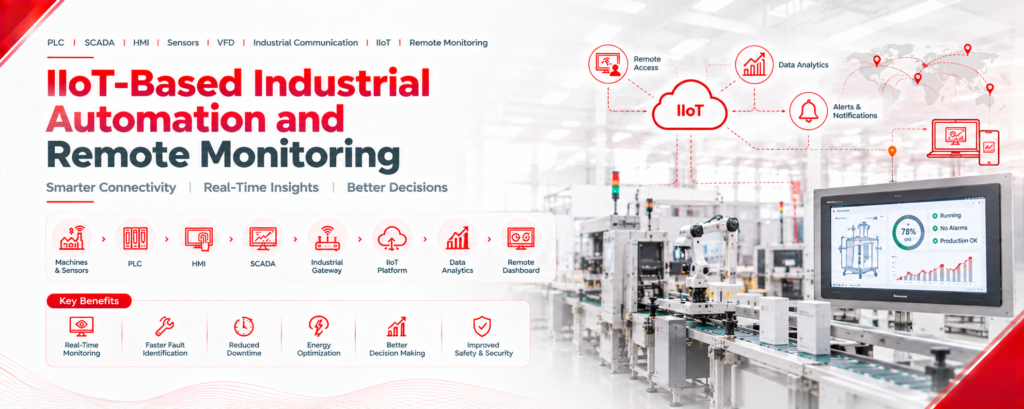
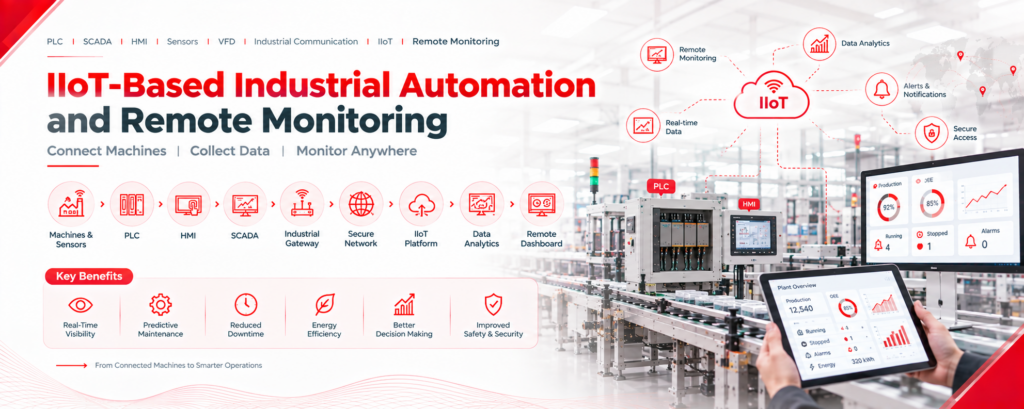
Modern industries are increasingly connecting machines, sensors, and automation systems to monitor plant operations from centralized locations. This connectivity helps production and maintenance teams access real-time equipment information, identify faults, analyze performance, and make informed decisions.
IIoT-Based Industrial Automation and Remote Monitoring combines the Industrial Internet of Things (IIoT), PLC, SCADA, HMI, industrial communication, sensors, gateways, and data analytics to connect industrial equipment with digital monitoring platforms.
What is IIoT-Based Industrial Automation?
The Industrial Internet of Things (IIoT) connects industrial machines and devices to communication networks and data platforms. It allows selected operating information to be collected, transferred, and analyzed beyond the local machine control system.
A typical IIoT architecture is:
Sensors & Machines → PLC → Industrial Gateway → Secure Network → IIoT Platform → Dashboard & Analytics
This architecture can be adapted to manufacturing plants, process industries, utilities, water treatment plants, and energy systems.
Role of PLC in IIoT Integration
A PLC (Programmable Logic Controller) controls industrial machines and processes using programmed logic. In an IIoT system, the PLC can also provide operating data to authorized monitoring platforms.
PLC applications include:
- Machine start/stop control
- Motor and pump control
- Sensor monitoring
- Temperature and pressure control
- Production counting
- Equipment status monitoring
- Alarm generation
- Process sequencing
- Communication with SCADA and gateways
The PLC generally continues performing its control functions locally, while the IIoT platform collects and analyzes selected data.
SCADA and IIoT: How They Work Together
SCADA (Supervisory Control and Data Acquisition) provides supervisory monitoring, visualization, alarm management, and historical data collection.
IIoT can extend this information to remote dashboards, analytics platforms, or enterprise applications.
| SCADA | IIoT |
|---|---|
| Supervisory monitoring and control | Connected data collection and analysis |
| Often used in a plant control room | Can support remote access across locations |
| Displays process parameters and alarms | Can combine data from multiple assets |
| Stores historical process information | Can support broader analytics and reporting |
| Works with PLCs, RTUs, and instruments | Works with gateways, networks, and data platforms |
SCADA and IIoT are complementary technologies. The right architecture depends on plant requirements, existing equipment, and security considerations.
Remote Industrial Monitoring
Remote monitoring allows authorized personnel to view selected plant information without being physically present at the machine or control room.
A remote monitoring dashboard may display:
- Machine running and stopped status
- Production count
- Motor speed and current
- Temperature and pressure
- Tank levels
- Pump and valve status
- Energy consumption
- Active alarms
- Downtime information
- Historical trends
For example, a maintenance engineer can review a pump’s operating status remotely and determine whether an inspection is required.
Sensors and Instrumentation in IIoT
Sensors collect information from industrial equipment and processes. This information can be transferred through a PLC, remote I/O, smart instrument, or industrial gateway.
| Device | Typical Monitoring Application |
|---|---|
| Temperature Sensor | Process and equipment temperature |
| Pressure Transmitter | Pipeline and vessel pressure |
| Flow Meter | Liquid or gas flow |
| Level Transmitter | Tank and vessel level |
| Vibration Sensor | Rotating equipment condition |
| Energy Meter | Electrical consumption |
| Proximity Sensor | Position and object detection |
| Current Sensor | Motor load monitoring |
Accurate sensor data is essential for meaningful remote monitoring and analysis.
Industrial Gateways and Communication Protocols
An industrial gateway connects equipment and control systems to monitoring or data platforms. It may collect data from multiple devices, convert protocols, and transmit selected information.
Common industrial communication technologies include:
- Modbus TCP/IP
- Modbus RTU
- PROFINET
- EtherNet/IP
- OPC UA
- MQTT
The appropriate protocol depends on the devices, network design, data requirements, and compatibility of the monitoring platform.
IIoT for Predictive Maintenance
IIoT can support condition monitoring and predictive maintenance by collecting operating data over time.
Important parameters include:
- Motor temperature
- Vibration levels
- Motor current
- Operating hours
- Pressure changes
- Equipment fault history
For example, unusual vibration combined with increasing motor temperature may indicate a developing mechanical problem. Maintenance teams can investigate the condition before it causes a major interruption.
Predictive maintenance requires suitable data, appropriate analysis, and validation against actual equipment conditions.
Energy Monitoring Using IIoT
Energy monitoring helps industries understand how electricity is being consumed across machines, production lines, and utilities.
An IIoT-based energy monitoring system can collect:
- Voltage and current
- Active power
- Power factor
- Energy consumption
- Maximum demand
- Machine-wise energy usage
The data can be displayed on centralized dashboards, helping teams identify high energy consumption and opportunities for improvement.
IIoT Applications Across Industries
1. Manufacturing Plants
- Machine status monitoring
- Production count tracking
- Downtime analysis
- Line performance monitoring
- Automated production reporting
2. Water and Wastewater Treatment
- Pump and blower monitoring
- Tank level monitoring
- Flow and pressure tracking
- Water quality data collection
- Remote station monitoring
3. Oil and Gas
- Pipeline pressure and flow monitoring
- Pump and compressor status
- Tank level monitoring
- Remote equipment diagnostics
- Alarm and event reporting
4. Solar Power Plants
- Inverter performance monitoring
- Energy generation tracking
- Weather data collection
- Equipment alarm monitoring
- Remote plant dashboards
5. Pharmaceutical and Food Processing
- Equipment status monitoring
- Process parameter recording
- Production data collection
- Alarm history
- Support for batch traceability where appropriately integrated and validated
HMI and Remote Dashboards
An HMI (Human Machine Interface) is commonly used for local machine operation, while remote dashboards can provide broader visibility across production lines or facilities.
A dashboard may display:
- Overall plant status
- Machine-wise performance
- Active alarms
- Production trends
- Energy consumption
- Equipment availability
- Maintenance indicators
Remote dashboards should use appropriate access permissions and should not replace validated local control and safety systems.
Cybersecurity in IIoT-Based Automation
Connecting industrial systems to external networks introduces cybersecurity risks. Remote monitoring should therefore be designed with security from the beginning.
Important practices include:
- Network segmentation
- Firewalls and secure gateways
- Encrypted communication where supported
- Role-based access control
- Multi-factor authentication where available
- Regular software and firmware updates
- Secure remote-access methods
- Logging and monitoring of access
- Keeping safety and control functions independent of cloud availability
Remote access should be limited to authorized users and implemented according to the plant’s cybersecurity requirements.
Benefits of IIoT-Based Industrial Automation
IIoT integration can help industries achieve:
- Real-time remote monitoring
- Improved equipment visibility
- Faster fault identification
- Centralized data collection
- Better downtime analysis
- Energy consumption tracking
- Improved maintenance planning
- Historical data analysis
- Multi-site monitoring
- Data-driven operational decisions
Actual results depend on system design, data quality, connectivity, and how effectively the collected information is used.
Industry 4.0 and IIoT Integration
IIoT is an important part of Industry 4.0 and smart manufacturing because it connects physical equipment with digital monitoring and analytics systems.
A typical architecture is:
Field Devices → PLC / SCADA → Industrial Gateway → Secure Network → IIoT Platform → Analytics & Reports
This enables manufacturers to combine automation data with production and maintenance information to improve operational visibility.
Conclusion
IIoT-Based Industrial Automation and Remote Monitoring connects industrial equipment, PLCs, SCADA systems, sensors, gateways, and digital platforms to make plant information more accessible and useful.
From machine monitoring and energy management to equipment diagnostics and multi-site dashboards, IIoT can support better industrial decision-making when implemented with reliable communication and strong cybersecurity.
For companies looking for an Industrial Automation System Integrator in Pune, solutions involving PLC Programming, SCADA Automation, HMI Programming, Industrial Communication, IIoT Integration, Remote Monitoring, Energy Monitoring, Control Panel Manufacturing, and Process Automation can be designed according to specific plant requirements.
#IIoT #IndustrialIoT #RemoteMonitoring #IndustrialAutomation #IIoTAutomation #PLCAutomation #PLCProgramming #SCADA #SCADAAutomation #HMI #IndustrialCommunication #PredictiveMaintenance #EnergyMonitoring #MachineMonitoring #ProcessAutomation #SmartManufacturing #Industry40 #ControlPanel #PLCControlPanel #IndustrialInstrumentation #FactoryAutomation #DigitalManufacturing #IndustrialAutomationSolutions #PuneAutomation