Completing an engineering degree is an important achievement, but practical technical skills are equally important for starting a successful career. Today, manufacturing industries are adopting automation technologies to improve productivity, quality, safety, and efficiency.
Industrial Automation offers exciting career opportunities for fresh graduates from Electrical, Electronics, Mechanical, Instrumentation, Mechatronics, and related engineering branches.
Learning technologies such as PLC Programming, HMI Designing, SCADA, VFD, Industrial IoT, and Electrical Control Panel Designing can help fresh engineers develop the practical knowledge required in modern industries.
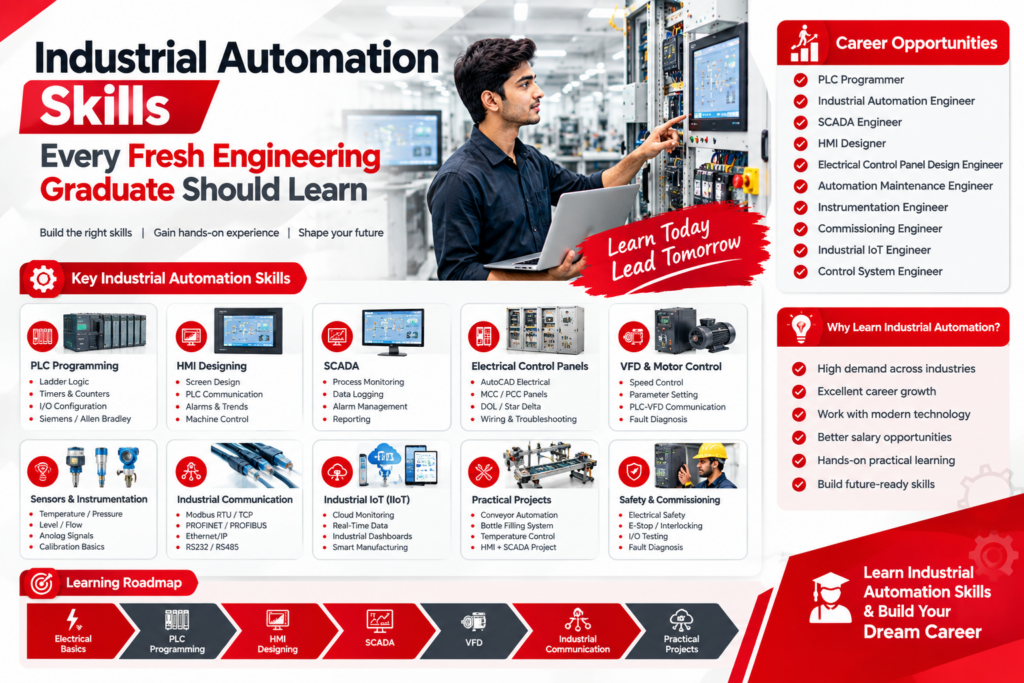
Let’s explore the important industrial automation skills every fresh engineering graduate should learn.
1. PLC Programming – The Foundation of Industrial Automation
PLC (Programmable Logic Controller) programming is one of the most important skills for an automation engineer.
PLCs are widely used to control industrial machines, conveyors, packaging systems, motors, and manufacturing processes.
Important PLC Programming Skills:
- PLC hardware and software fundamentals
- Ladder Logic Programming
- Timers, Counters, and Comparators
- Digital and Analog Input/Output
- Siemens, Allen Bradley, and Mitsubishi PLC
- PLC Communication and Troubleshooting
- Industrial Machine Sequence Programming
Practical PLC programming knowledge helps graduates understand how industrial machines operate automatically.
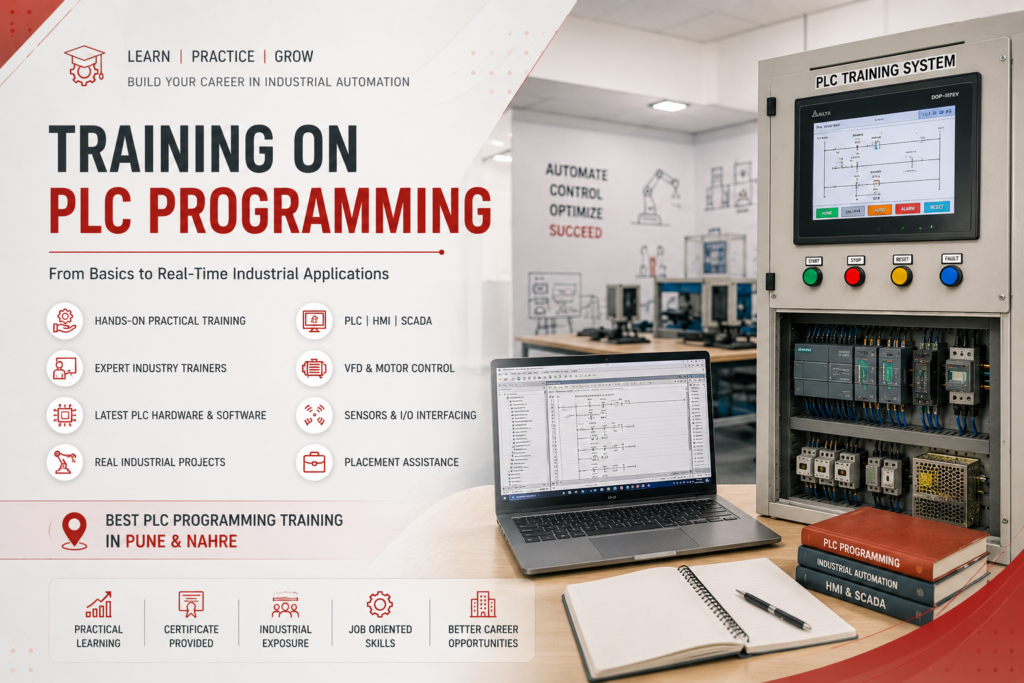
Students searching for best plc programming pune & nahre should focus on hands-on PLC training, real industrial hardware, practical projects, and troubleshooting skills.
2. HMI Designing – Machine Monitoring and Control
HMI (Human Machine Interface) allows machine operators to monitor and control industrial equipment through graphical screens.
HMI designing is an essential skill for engineers interested in machine automation and control systems.
Important HMI Skills:
- HMI Screen Designing
- PLC and HMI Communication
- Alarm and Event Configuration
- Real-Time Data Monitoring
- Trends and Graphical Displays
- Machine Start/Stop Control
- Parameter Setting and Monitoring
Learning HMI designing helps engineers develop user-friendly industrial machine control systems.
3. SCADA – Industrial Process Monitoring
SCADA (Supervisory Control and Data Acquisition) is used to monitor and control industrial processes from centralized systems.
SCADA systems are commonly used in manufacturing plants, water treatment plants, pharmaceutical industries, power plants, and process industries.
Important SCADA Skills:
- SCADA Software Fundamentals
- PLC-SCADA Communication
- Tag Configuration
- Alarm Management
- Data Logging and Trending
- Industrial Process Visualization
- Reporting and Monitoring
Knowledge of SCADA systems can help fresh graduates explore careers in industrial process automation and plant monitoring.
4. Electrical Control Panel Designing and Wiring
Electrical control panels are an important part of industrial automation systems.
Automation engineers should understand how electrical components are selected, connected, and integrated with PLC systems.
Important Control Panel Skills:
- Electrical Drawing Reading
- AutoCAD Electrical Basics
- PLC Control Panel Designing
- MCC and PCC Panel Fundamentals
- DOL and Star-Delta Starter Circuits
- Switchgear and Protection Devices
- Power and Control Wiring
- Electrical Panel Troubleshooting
Practical knowledge of control panel wiring helps engineers understand real industrial electrical systems.
5. VFD and Motor Control
Electric motors are widely used in industrial machines, pumps, fans, conveyors, and manufacturing equipment.
VFD (Variable Frequency Drive) technology helps control motor speed and improve process performance.
Important VFD Skills:
- VFD Working Principles
- Motor Speed Control
- VFD Parameter Configuration
- PLC and VFD Communication
- Motor Starting and Stopping
- Fault Identification
- Industrial Motor Control Applications
Understanding VFDs and motor control systems is useful for automation, electrical maintenance, and commissioning engineers.
6. Industrial Sensors and Instrumentation
Sensors are essential components of industrial automation systems. They collect information from machines and processes and send signals to control systems.
Important Instrumentation Skills:
- Proximity and Photoelectric Sensors
- Temperature Sensors
- Pressure Transmitters
- Level Measurement
- Flow Measurement
- Analog Signals (4–20 mA and 0–10 V)
- Sensor Calibration Basics
- PLC and Sensor Interfacing
Instrumentation knowledge helps engineers work with process control and automated manufacturing systems.
7. Industrial Communication Protocols
Modern industrial machines communicate through different industrial networks.
Fresh engineers should understand how PLCs, HMIs, SCADA systems, VFDs, and other devices exchange data.
Important Communication Technologies:
- Modbus RTU
- Modbus TCP/IP
- PROFINET
- PROFIBUS
- Ethernet/IP
- RS232 and RS485
- OPC UA Basics
Industrial communication skills are useful for machine integration, troubleshooting, and automation system development.
8. Industrial IoT and Industry 4.0
Industrial IoT (IIoT) connects industrial machines and equipment to digital monitoring platforms.
With Industry 4.0 technologies, manufacturers can monitor production data, machine performance, and operating conditions.
Important IIoT Skills:
- Industrial IoT Fundamentals
- PLC and IoT Gateway Communication
- Cloud-Based Machine Monitoring
- Real-Time Data Collection
- Industrial Dashboards
- Remote Machine Monitoring
- Smart Manufacturing Concepts
Learning IIoT can help fresh graduates prepare for emerging opportunities in connected manufacturing and industrial digitalization.
9. Practical Automation Projects and Troubleshooting
Theoretical knowledge alone is not sufficient to become a skilled automation engineer.
Fresh graduates should work on practical automation projects to understand real industrial applications.
Recommended Industrial Automation Projects:
- PLC-Based Conveyor Automation
- Automatic Bottle Filling System
- Water Level Control Using PLC
- Motor Control Using VFD
- PLC and HMI-Based Machine Control
- Temperature Monitoring Using SCADA
- Industrial IoT-Based Machine Monitoring
Practical projects improve programming, wiring, troubleshooting, and problem-solving skills.
10. Industrial Safety and Commissioning Skills
Industrial automation engineers must also understand basic machine safety and commissioning procedures.
Important skills include electrical safety, emergency-stop systems, interlocking, safe isolation procedures, input/output testing, and systematic fault diagnosis.
Understanding these concepts helps engineers work more safely and effectively during machine installation, testing, and maintenance.
Career Opportunities After Learning Industrial Automation
After developing practical industrial automation skills, fresh engineering graduates can explore different technical job opportunities.
Popular Career Options:
- PLC Programmer
- Industrial Automation Engineer
- SCADA Engineer
- HMI Designer
- Electrical Control Panel Design Engineer
- Automation Maintenance Engineer
- Instrumentation Engineer
- Commissioning Engineer
- Industrial IoT Engineer
- Control System Engineer
These roles are available across industries such as Automotive, Manufacturing, Pharmaceuticals, Food and Beverage, Chemical Processing, Packaging, Water Treatment, and Special Purpose Machine Manufacturing.
How to Start Learning Industrial Automation?
Fresh engineering graduates should begin with electrical fundamentals and PLC programming before moving toward advanced automation technologies.
A practical learning roadmap is:
Electrical Basics → PLC Programming → HMI Designing → SCADA → VFD → Industrial Communication → Industrial IoT → Practical Projects
Students looking for best plc programming pune & nahre should select training that provides practical experience with PLC hardware, industrial control panels, HMI systems, and real automation applications.
Hands-on training and project experience can help bridge the gap between academic education and industrial requirements.
Conclusion
Industrial Automation is an excellent technical career option for fresh engineering graduates who want to work with modern manufacturing technologies.
Skills such as PLC Programming, HMI Designing, SCADA, Electrical Control Panel Designing, VFD, Industrial Instrumentation, and Industrial IoT provide a strong foundation for entering the automation industry.
At Automate Engineering, we focus on developing practical industrial automation skills through technical training, hands-on learning, and industrial applications.
Start building your automation skills today and prepare yourself for a successful engineering career.
Website: www.automateengg.com
Industrial Automation Training, PLC Programming Training, Best PLC Programming Pune & Nahre, PLC SCADA Training, Industrial Automation Course, HMI Designing, Electrical Control Panel Training, VFD Training, Industrial IoT Training, Automation Engineering Jobs, PLC Programming for Freshers, Industrial Automation Skills.
#IndustrialAutomation #PLCProgramming #SCADATraining #AutomationEngineering #AutomateEngineering