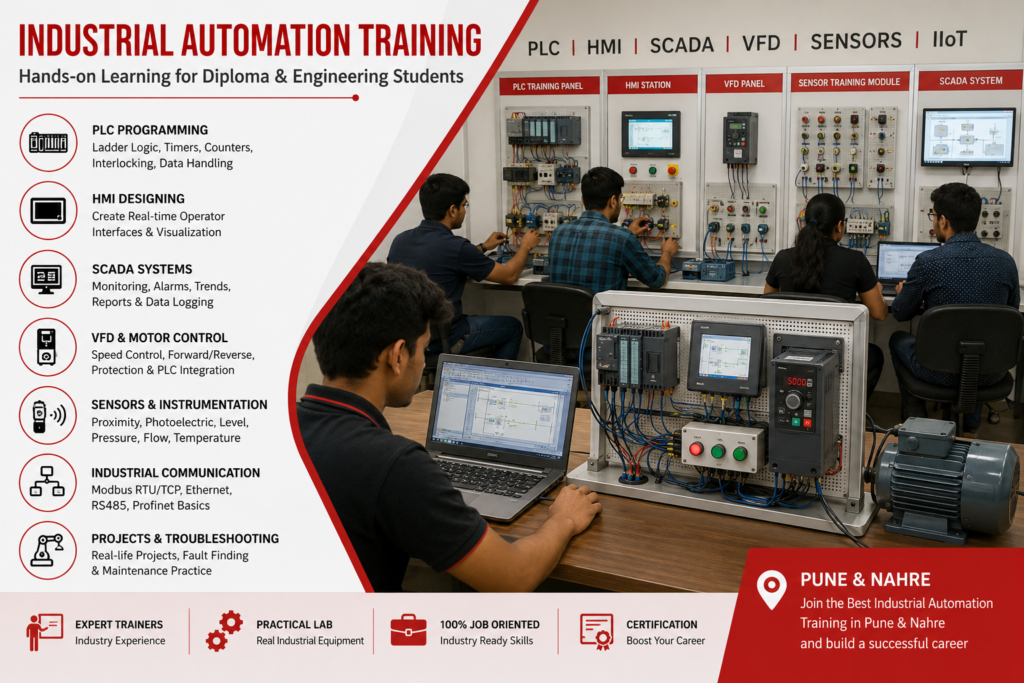
Industrial automation is one of the fastest-growing technology fields in modern manufacturing. With industries adopting PLCs, HMI, SCADA, VFDs, robotics, industrial communication, and IIoT, there is increasing demand for skilled automation professionals.
For Diploma and Engineering students, Industrial Automation Training is an excellent way to gain practical knowledge and become industry-ready. Students from Electrical, Electronics, E&TC, Instrumentation, Mechanical, and Mechatronics backgrounds can develop valuable technical skills through hands-on automation training.
Why Industrial Automation Training Is Important for Students
Engineering colleges provide students with theoretical knowledge, but industrial automation requires practical understanding of machines, control systems, PLC programming, sensors, drives, and industrial communication.
A practical Industrial Automation Training program helps students learn:
- PLC programming
- HMI designing
- SCADA development
- VFD and motor control
- Industrial sensors
- Electrical control panels
- Industrial communication
- Instrumentation
- Pneumatics and hydraulics
- Industrial IoT
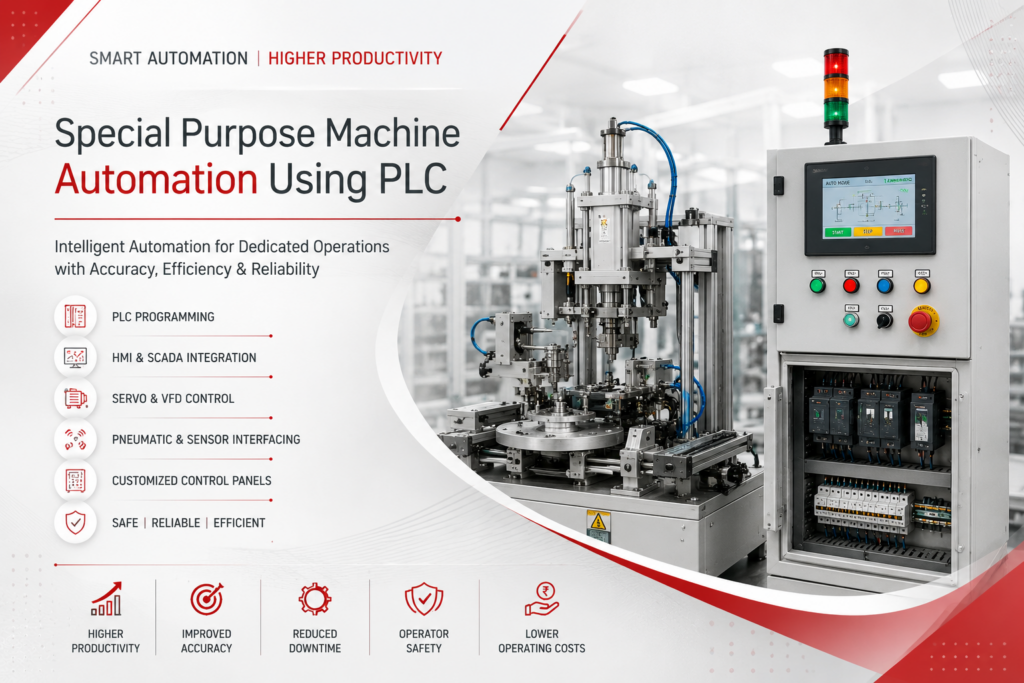
- Machine automation
- Troubleshooting
These skills can help Diploma and Engineering students prepare for technical interviews and entry-level automation jobs.
What Do Students Learn in Industrial Automation Training?
1. PLC Programming
PLC programming is one of the most important skills required in industrial automation.
Students can learn:
- PLC hardware and architecture
- Digital and analog I/O
- Ladder Logic programming
- Timers and counters
- Data handling
- Interlocking
- Sequencing
- Alarms and fault handling
- PLC troubleshooting
- Industrial automation applications
Students can get exposure to popular PLC platforms such as Siemens, Allen-Bradley, Mitsubishi, Delta, and other industrial PLCs.
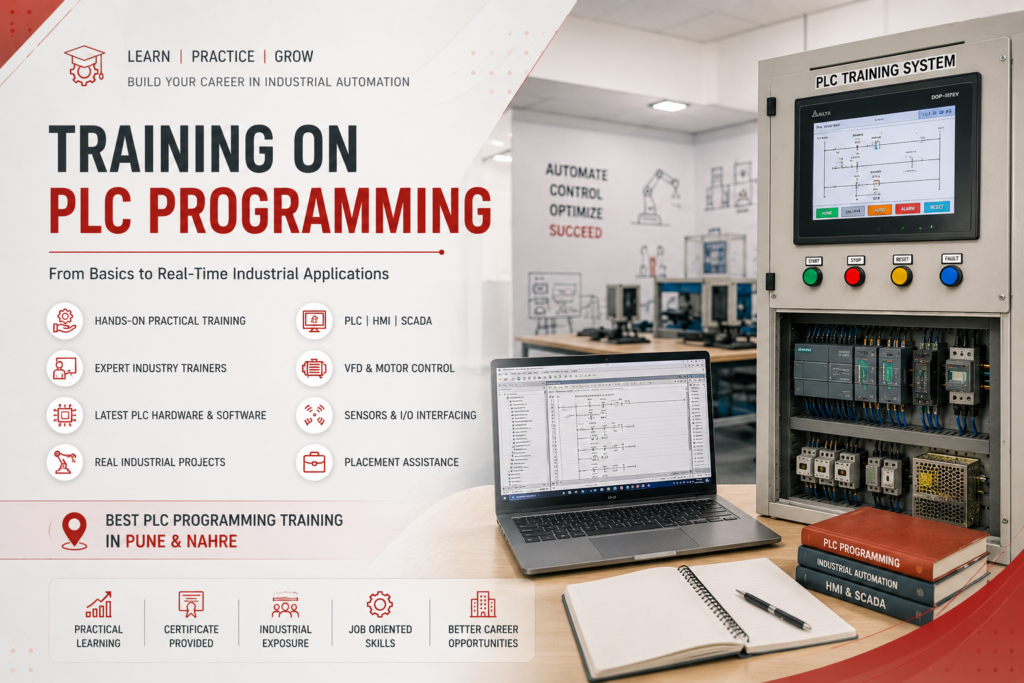
Best PLC Programming Pune Training for Students
Students searching for best PLC programming Pune should look for training that provides practical exposure instead of only theoretical PLC programming.
A good PLC training program should include:
- Real PLC hardware
- Ladder Logic programming
- HMI integration
- VFD integration
- Sensors and actuators
- Industrial communication
- Machine automation projects
- PLC troubleshooting
- Industry-oriented practical assignments
For students searching for best PLC programming Pune, practical experience with PLC-HMI-VFD systems can be especially valuable when preparing for automation engineering jobs.
Industrial Automation Training in Nahre
Students located in Nahre, Pune, and nearby areas can benefit from Industrial Automation Training that provides hands-on laboratory practice.
Industrial Automation Training in Nahre can help students understand how PLCs, HMIs, VFDs, sensors, control panels, and SCADA systems work together in real industrial applications.
When selecting automation training in Nahre, students should consider practical laboratory facilities, industrial projects, experienced trainers, and exposure to multiple automation platforms.
HMI Designing
HMI is used by machine operators to monitor and control industrial equipment.
Students can learn to develop HMI screens for:
- Machine Start/Stop
- Motor control
- Production counters
- Alarm indication
- Parameter settings
- Fault monitoring
- Process status
- Data visualization
PLC-HMI integration is an important skill for students planning to work as PLC or Automation Engineers.
SCADA Training
SCADA systems are widely used for industrial monitoring and process control.
Students can learn:
- SCADA architecture
- Tag configuration
- PLC-SCADA communication
- Alarm management
- Trends
- Data logging
- Reports
- Process visualization
Practical SCADA training allows students to understand how industrial processes are monitored from a centralized system.
VFD and Motor Control
Motors are used extensively in manufacturing machines, conveyors, pumps, compressors, and other industrial equipment.
Industrial Automation Training introduces students to:
- VFD fundamentals
- Motor speed control
- Forward/reverse control
- Acceleration and deceleration
- VFD parameter settings
- PLC-VFD integration
- Motor protection
- Basic troubleshooting
Sensors and Instrumentation
Students also need to understand field-level devices used in automation systems.
Training can include:
- Proximity sensors
- Photoelectric sensors
- Limit switches
- Temperature sensors
- Pressure sensors
- Level sensors
- Flow sensors
- Encoders
- 4–20 mA signals
Understanding sensors helps students troubleshoot automation systems and develop complete machine-control applications.
Industrial Communication
Modern automation systems use industrial communication networks to exchange data between PLCs, HMIs, SCADA systems, VFDs, and other devices.
Students can learn the basics of:
- Modbus RTU
- Modbus TCP/IP
- RS232
- RS485
- Ethernet
- Profinet
- Industrial Ethernet
Communication knowledge is becoming increasingly important for automation and IIoT applications.
Practical Industrial Automation Projects
Project-based learning can make Industrial Automation Training more effective.
Diploma and Engineering students can work on projects such as:
- Conveyor belt automation
- Automatic bottle filling system
- Tank level control
- Motor control using PLC and VFD
- Automatic sorting machine
- Pump automation
- Temperature control
- PLC-HMI based machine automation
- SCADA-based process monitoring
- Industrial IoT monitoring
These projects can help students understand how individual automation components work together as a complete system.
Career Opportunities After Industrial Automation Training
After completing practical Industrial Automation Training, students can explore roles such as:
- PLC Programmer
- Automation Engineer
- PLC-SCADA Engineer
- HMI Engineer
- Control Panel Design Engineer
- Commissioning Engineer
- Maintenance Engineer
- Instrumentation Engineer
- Electrical Automation Engineer
- Industrial IoT Engineer
Industries hiring automation professionals include manufacturing, automotive, pharmaceuticals, food and beverage, chemicals, packaging, water treatment, power, and process industries.
How to Select the Right Automation Training Course
Before joining an automation course, students should check whether the institute provides:
- Hands-on PLC training
- Real industrial hardware
- HMI and SCADA practice
- VFD training
- Industrial sensor training
- Control panel fundamentals
- Industrial communication
- Troubleshooting practice
- Industry-oriented projects
- Technical interview preparation
The combination of PLC + HMI + SCADA + VFD + Sensors + Industrial Communication + Projects can provide students with a strong foundation for an automation career.
Why Practical Skills Matter
Companies generally look for candidates who can understand and troubleshoot real industrial systems. Simply knowing PLC programming concepts may not be enough.
Students should therefore practice:
PLC Programming → HMI → VFD → Sensors → Communication → SCADA → Troubleshooting → Industrial Project
This learning approach helps Diploma and Engineering students connect their academic knowledge with real industrial applications.
Conclusion
Industrial Automation Training for Diploma and Engineering Students can provide an important bridge between classroom education and industrial requirements.
Students searching for best PLC programming Pune, PLC training in Pune, or Industrial Automation Training in Nahre should prioritize practical, project-based training with real automation hardware.
By developing skills in PLC programming, HMI, SCADA, VFD, instrumentation, industrial communication, and IIoT, students can build a strong technical foundation and prepare themselves for exciting career opportunities in the industrial automation sector.
Keywords: Industrial Automation Training, Industrial Automation Training Pune, PLC Training Pune, Best PLC Programming Pune, PLC Programming Training, PLC Training in Nahre, Industrial Automation Training in Nahre, HMI Training, SCADA Training, VFD Training, Automation Engineer Training, Industrial Automation Course Pune, PLC Programming Course Pune.