The oil and gas industry involves complex processes such as crude oil handling, separation, refining, storage, transportation, gas processing, and distribution. These processes require accurate control of temperature, pressure, flow, level, and equipment operation.
Oil and Gas Process Automation uses technologies such as PLC, SCADA, HMI, DCS, VFD, industrial instrumentation, control valves, safety systems, and industrial communication to improve process control, monitoring, reliability, and operational efficiency.
What is Oil and Gas Process Automation?
Oil and Gas Process Automation refers to the use of industrial control systems and instrumentation to monitor and control processes throughout oil and gas facilities.
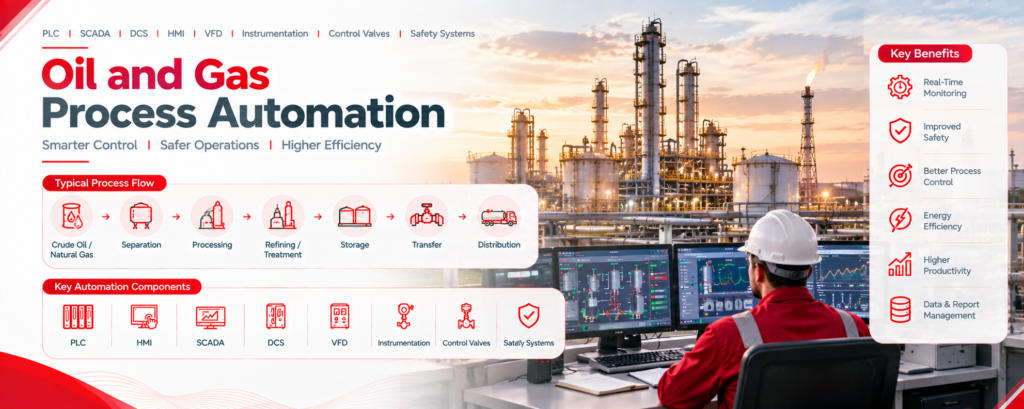
Typical process flow:
Crude Oil / Natural Gas → Separation → Processing → Refining / Treatment → Storage → Transfer → Distribution
Automation helps operators monitor process conditions and control equipment from centralized control systems.
Role of PLC in Oil and Gas Automation
A PLC (Programmable Logic Controller) is used for controlling machines, equipment, and process sequences.
PLC automation applications include:
- Pump and motor control
- Valve operation
- Tank level control
- Conveyor and material handling
- Interlocking systems
- Equipment sequencing
- Alarm generation
- Emergency shutdown logic
- Monitoring field sensors
- Automatic start/stop operations
PLC systems can communicate with HMI, SCADA, VFDs, remote I/O, and other industrial devices.
HMI for Oil and Gas Process Monitoring
An HMI (Human Machine Interface) provides operators with a visual interface for monitoring and controlling industrial processes.
An HMI can display:
- Pressure
- Temperature
- Flow rate
- Tank level
- Pump status
- Valve position
- Motor status
- Equipment alarms
- Process setpoints
- Fault conditions
- Production parameters
This allows operators to monitor plant conditions and control equipment from a centralized interface.
SCADA in Oil and Gas Automation
SCADA (Supervisory Control and Data Acquisition) is used for centralized monitoring, data collection, alarm management, and process visualization.
SCADA automation can monitor:
- Oil and gas pipelines
- Pumping stations
- Storage tanks
- Compressor stations
- Processing units
- Flow stations
- Pressure systems
- Utility systems
SCADA systems also support historical data logging, trends, alarm management, production reports, and remote monitoring.
DCS for Continuous Process Control
A Distributed Control System (DCS) is commonly used for large continuous-process applications where many process parameters need to be controlled simultaneously.
DCS can be used for:
- Refinery processes
- Gas processing
- Distillation
- Heating and cooling
- Pressure control
- Flow control
- Temperature control
- Process optimization
DCS provides centralized process visualization while distributing control functions across the plant.
VFD Automation in Oil and Gas Plants
VFD (Variable Frequency Drive) technology is used to control the speed of motors according to process requirements.
Typical applications include:
- Pumps
- Fans
- Blowers
- Compressors
- Cooling systems
- Material handling equipment
VFD automation can help provide controlled motor operation and support energy-efficient process operation.
Industrial Instrumentation
Instrumentation is an important part of oil and gas process automation.
Common instruments include:
| Instrument | Typical Measurement |
|---|---|
| Pressure Transmitter | Pressure |
| Temperature Transmitter | Temperature |
| Flow Transmitter | Flow |
| Level Transmitter | Tank/Vessel Level |
| Control Valve | Flow/Pressure Control |
| Gas Detector | Gas Leakage |
| Proximity Sensor | Equipment Position |
| Vibration Sensor | Equipment Condition |
These field devices send process information to PLC, DCS, or SCADA systems for monitoring and control.
Oil and Gas Automation Applications
1. Crude Oil Handling
Automation can monitor and control:
- Crude oil transfer pumps
- Tank levels
- Flow rates
- Pressure
- Valves
- Transfer pipelines
2. Oil Separation
Automation systems can control process parameters during separation of oil, gas, and water.
3. Gas Processing
Automation is used for monitoring:
- Gas pressure
- Flow
- Temperature
- Gas composition
- Compressor operation
- Valves and pipelines
4. Refinery Automation
Refinery automation can support processes such as:
- Distillation
- Heating
- Cooling
- Pumping
- Separation
- Product transfer
- Storage
5. Storage Tank Automation
Tank automation can monitor:
- Tank level
- Temperature
- Pressure
- Inlet/outlet valves
- Pump operation
- High-level and low-level alarms
6. Pipeline Automation
Pipeline systems can use automation for:
- Pressure monitoring
- Flow measurement
- Valve control
- Pump station monitoring
- Leak detection
- Remote monitoring
Safety and Alarm Monitoring
Safety is a critical requirement in oil and gas facilities because many processes involve flammable materials and high-pressure systems.
Automation systems can support:
- High-pressure alarms
- Low-pressure alarms
- High-temperature alarms
- High-level alarms
- Gas detection
- Emergency shutdown systems
- Equipment interlocking
- Fire and gas monitoring
Safety Instrumented Systems (SIS) and Emergency Shutdown Systems (ESD) may be used for dedicated safety functions depending on the plant design and applicable standards.
Oil and Gas Control Panels
Industrial control panels provide the electrical and control interface for automation equipment.
A typical automation control panel may include:
- PLC
- Remote I/O
- HMI
- VFD
- Power supplies
- MCB/MCCB
- Contactors
- Relays
- Terminal blocks
- Communication modules
- Industrial networking components
Proper control panel design and manufacturing is important for reliable industrial automation systems.
Benefits of Oil and Gas Process Automation
Oil and gas automation can provide:
- Real-time process monitoring
- Accurate process control
- Faster fault detection
- Improved equipment control
- Reduced manual intervention
- Centralized data monitoring
- Alarm and event management
- Production data collection
- Better operational visibility
- Improved energy monitoring
- Support for remote monitoring
Industry 4.0 and IIoT in Oil and Gas
Modern oil and gas facilities are increasingly integrating Industry 4.0 and IIoT technologies with conventional automation systems.
A typical architecture can be represented as:
Field Sensors → PLC / DCS → HMI / SCADA → Industrial Network → Data Collection → Monitoring & Analysis
IIoT solutions can support:
- Remote equipment monitoring
- Energy monitoring
- Equipment performance tracking
- Predictive maintenance
- Historical data analysis
- Production reporting
- Centralized dashboards
Conclusion
Oil and Gas Process Automation combines PLC, DCS, SCADA, HMI, VFD, instrumentation, control valves, industrial networks, and safety systems to monitor and control complex industrial processes.
From crude oil handling and gas processing to refining, storage, and pipeline operations, automation helps create better visibility and more controlled plant operations.
For companies looking for an Industrial Automation System Integrator in Pune, solutions involving PLC Programming, SCADA Automation, HMI Programming, VFD Automation, Industrial Instrumentation, Control Panel Manufacturing, Process Automation, and IIoT can be designed according to specific industrial requirements.
#OilAndGasAutomation #OilAndGasIndustry #ProcessAutomation #IndustrialAutomation #PLCAutomation #PLCProgramming #SCADA #SCADAAutomation #HMI #VFDAutomation #DCS #IndustrialInstrumentation #ControlPanel #ProcessControl #PipelineAutomation #RefineryAutomation #GasProcessing #Industry40 #IIoT #SmartManufacturing #FactoryAutomation #ManufacturingAutomation #IndustrialAutomationSolutions #PuneAutomation