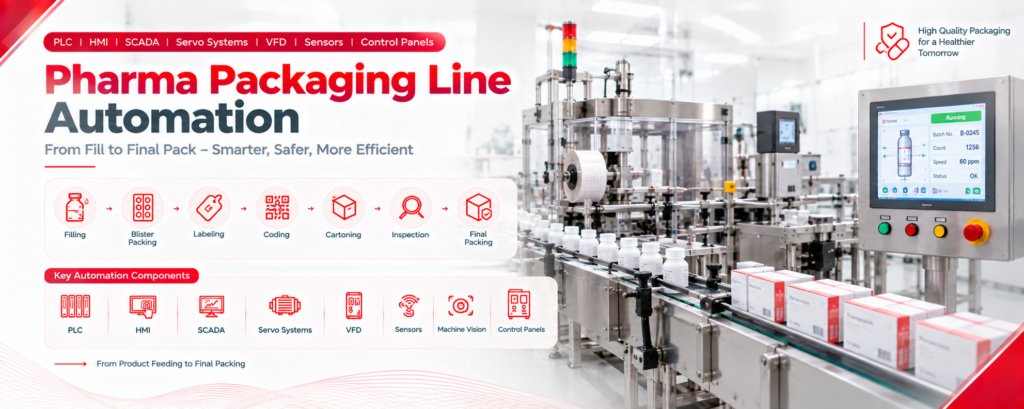
Pharmaceutical packaging requires accurate, consistent, and controlled operations to protect medicines and maintain product quality. Packaging lines may include bottle filling, blister packing, labeling, cartoning, coding, inspection, serialization, and final packing.
Pharma Packaging Line Automation uses PLC, HMI, SCADA, VFD, servo systems, sensors, machine vision, industrial communication, and control panels to automate and monitor these operations.
Automation helps pharmaceutical manufacturers achieve repeatable machine operation, accurate counting, better production monitoring, and faster detection of packaging faults.
What is Pharma Packaging Line Automation?
Pharma packaging line automation refers to the use of industrial automation systems to control and monitor different stages of pharmaceutical packaging.
A typical packaging flow can be:
Product Feeding → Filling / Blister Formation → Sealing → Inspection → Labeling → Coding → Cartoning → Serialization → Final Packing
The exact sequence depends on the type of pharmaceutical product and packaging machine.
Role of PLC in Pharma Packaging
A PLC (Programmable Logic Controller) acts as the main control system for many automated packaging machines.
PLC applications include:
- Machine sequencing
- Conveyor control
- Product counting
- Filling control
- Sensor monitoring
- Blister machine control
- Labeling sequence
- Carton handling
- Reject mechanism control
- Interlocking
- Alarm generation
- Automatic/manual operation
PLC programming coordinates different machine operations according to the required packaging sequence.
HMI for Pharma Packaging Machines
An HMI (Human Machine Interface) allows operators to monitor and control the packaging machine.
An HMI can display:
- Machine status
- Production count
- Batch number
- Machine speed
- Sensor status
- Conveyor status
- Temperature
- Alarm messages
- Fault conditions
- Recipe parameters
- Reject count
- Running time
Operators can also use HMI screens for suitable machine settings, recipe selection, and manual operation.
SCADA for Packaging Line Monitoring
SCADA (Supervisory Control and Data Acquisition) can provide centralized monitoring of pharmaceutical packaging operations.
SCADA can help monitor:
- Packaging line status
- Production quantity
- Machine performance
- Downtime
- Alarm history
- Reject information
- Energy consumption
- Batch-related data
- Equipment status
Historical trends and reports can help production and maintenance teams analyze line performance.
Sensors in Pharma Packaging Automation
Sensors are essential for detecting products, positions, packaging materials, and machine conditions.
Common sensors include:
| Sensor | Typical Application |
|---|---|
| Photoelectric Sensor | Product detection |
| Proximity Sensor | Position detection |
| Encoder | Speed and position feedback |
| Temperature Sensor | Sealing/heating control |
| Pressure Sensor | Pneumatic monitoring |
| Level Sensor | Hopper or liquid level |
| Vision Sensor | Product/packaging inspection |
| Limit Switch | Mechanical position detection |
Accurate sensor feedback helps the PLC make decisions during different packaging operations.
Servo Automation in Pharma Packaging
Servo motors are widely used where accurate positioning and synchronization are required.
Servo systems can be used for:
- Film feeding
- Cutting
- Product positioning
- Label dispensing
- Carton handling
- Rotary mechanisms
- Indexing systems
- Pick-and-place operations
Servo control allows precise speed, position, and movement according to machine requirements.
VFD Automation
VFDs (Variable Frequency Drives) can be used to control motors in pharmaceutical packaging lines.
Applications include:
- Conveyors
- Pumps
- Fans
- Blowers
- Feeding systems
- Material handling
VFD automation allows controlled motor speed and smooth machine operation.
Machine Vision for Pharma Packaging
Machine vision systems can be integrated with packaging automation for inspection and quality checking.
Vision systems can help identify:
- Missing products
- Incorrect labels
- Damaged packaging
- Incorrect print
- Missing caps
- Incorrect orientation
- Barcode or code quality issues
- Packaging defects
When an abnormal product is detected, the PLC can activate a rejection mechanism.
Pharmaceutical Packaging Applications
1. Bottle Filling and Capping
Automation can control:
- Bottle feeding
- Liquid filling
- Cap feeding
- Capping
- Bottle counting
- Conveyor movement
2. Blister Packaging
PLC and servo systems can coordinate:
- Product feeding
- Film movement
- Forming
- Filling
- Sealing
- Cutting
- Blister inspection
3. Labeling
Automated labeling systems can control:
- Label feeding
- Product detection
- Label positioning
- Label application
- Label inspection
4. Cartoning
Cartoning automation can coordinate:
- Product feeding
- Carton forming
- Product insertion
- Leaflet insertion
- Carton closing
- Coding
- Rejection
5. Serialization and Coding
Automated systems can support the printing and verification of product identification information such as:
- Batch number
- Manufacturing date
- Expiry date
- Product code
- Barcode
- Serialization information
Pneumatics in Pharma Packaging Automation
Pneumatic systems are commonly used for fast mechanical movements in packaging machines.
Applications include:
- Product pushing
- Clamping
- Gripping
- Cutting
- Carton handling
- Reject mechanisms
- Cylinder-based positioning
Solenoid valves controlled through the PLC can operate pneumatic cylinders according to the machine sequence.
Control Panels for Pharma Packaging Lines
The automation control panel provides the interface between the machine’s electrical equipment and control system.
A typical panel may include:
- PLC
- HMI
- Servo drives
- VFDs
- Remote I/O
- Power supplies
- MCB/MCCB
- Contactors
- Relays
- Terminal blocks
- Communication modules
- Safety components
Proper control panel design and manufacturing helps maintain organized wiring, reliable operation, and easier maintenance.
Interlocking and Safety
Packaging machines use interlocks to prevent incorrect or unsafe machine operation.
Examples include:
- Machine cannot start when a safety door is open.
- Conveyor cannot operate if a critical downstream machine is unavailable.
- Filling cannot start without product detection.
- Sealing cannot operate outside the required process conditions.
- Reject mechanism operates only when a defective product is detected.
- Emergency stop immediately brings the relevant machine section to a safe state.
Safety functions should be designed according to the machine’s risk assessment and applicable standards.
Alarm and Fault Monitoring
The PLC and HMI can provide alarms for:
- Sensor failure
- Motor overload
- Conveyor fault
- Low material level
- Temperature abnormality
- Pneumatic pressure fault
- Servo fault
- VFD fault
- Communication failure
- Safety-door opening
- Emergency stop
Clear alarm messages help operators identify faults and reduce troubleshooting time.
Benefits of Pharma Packaging Line Automation
Automation can provide:
- Consistent packaging operations
- Accurate product counting
- Precise machine synchronization
- Reduced manual intervention
- Faster fault detection
- Improved production monitoring
- Better reject handling
- Production data collection
- Improved machine efficiency
- Easier maintenance and troubleshooting
Industry 4.0 in Pharma Packaging
Modern pharmaceutical packaging lines can integrate PLC, HMI, SCADA, industrial communication, machine vision, and production data systems.
A typical architecture can be represented as:
Sensors & Machines → PLC → HMI/SCADA → Industrial Network → Production Data → Monitoring & Analysis
Industry 4.0 solutions can support:
- Production monitoring
- Batch tracking
- Machine performance analysis
- Downtime monitoring
- Alarm history
- Energy monitoring
- Remote diagnostics
- Data-based maintenance
Conclusion
Pharma Packaging Line Automation combines PLC Programming, HMI, SCADA, servo systems, VFDs, sensors, machine vision, pneumatics, industrial communication, and control panels to automate pharmaceutical packaging operations.
From filling and blister packaging to labeling, coding, inspection, cartoning, and final packing, automation helps improve process consistency, machine coordination, monitoring, and production efficiency.
For companies looking for an Industrial Automation System Integrator in Pune, solutions involving PLC Programming, SCADA Automation, HMI Programming, VFD Automation, Servo Automation, Machine Vision, Industrial Instrumentation, Control Panel Manufacturing, and Packaging Machine Automation can be developed according to specific production requirements.
#PharmaPackagingAutomation #PharmaceuticalAutomation #PharmaPackaging #PackagingAutomation #IndustrialAutomation #PLCAutomation #PLCProgramming #SCADA #SCADAAutomation #HMI #ServoAutomation #VFDAutomation #MachineVision #PackagingMachine #ProcessAutomation #ControlPanel #PLCControlPanel #IndustrialInstrumentation #Pneumatics #FactoryAutomation #SmartManufacturing #Industry40 #IIoT #IndustrialAutomationSolutions #PuneAutomation