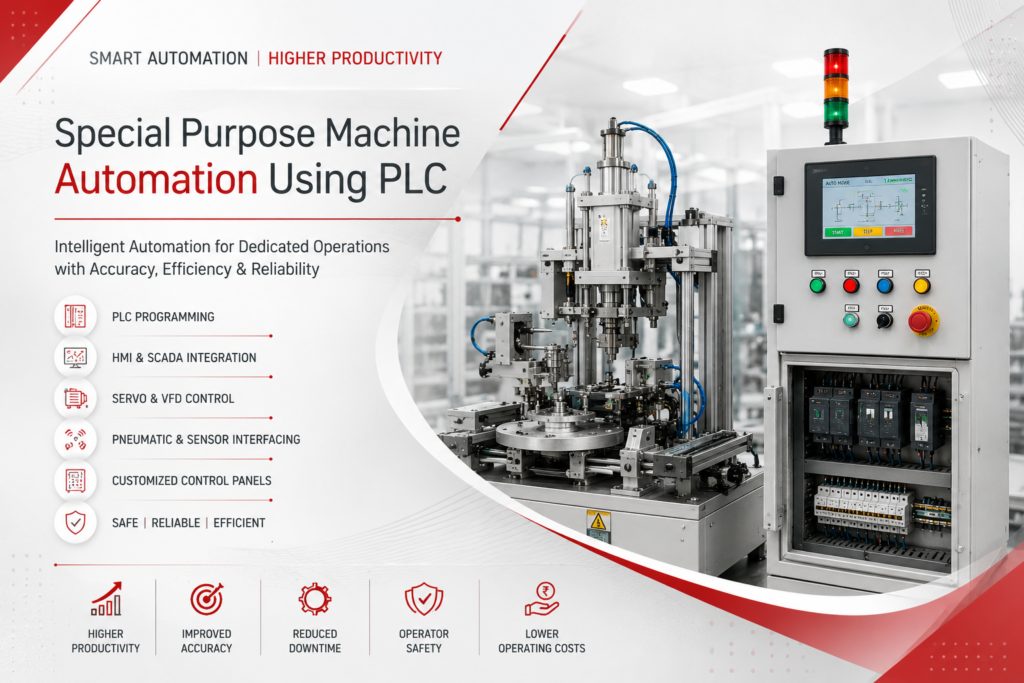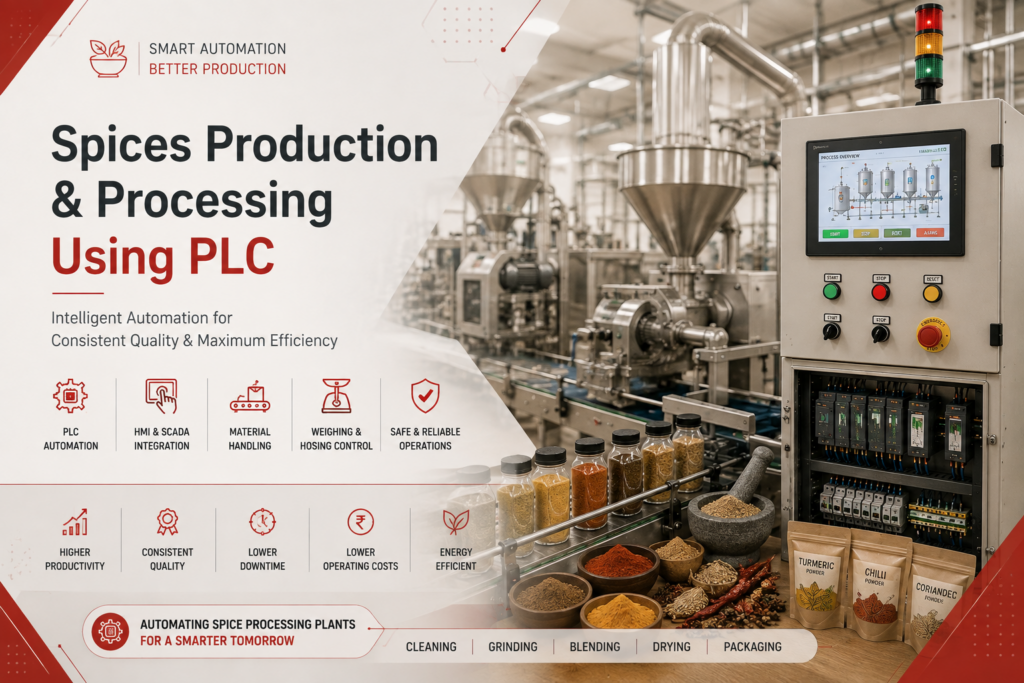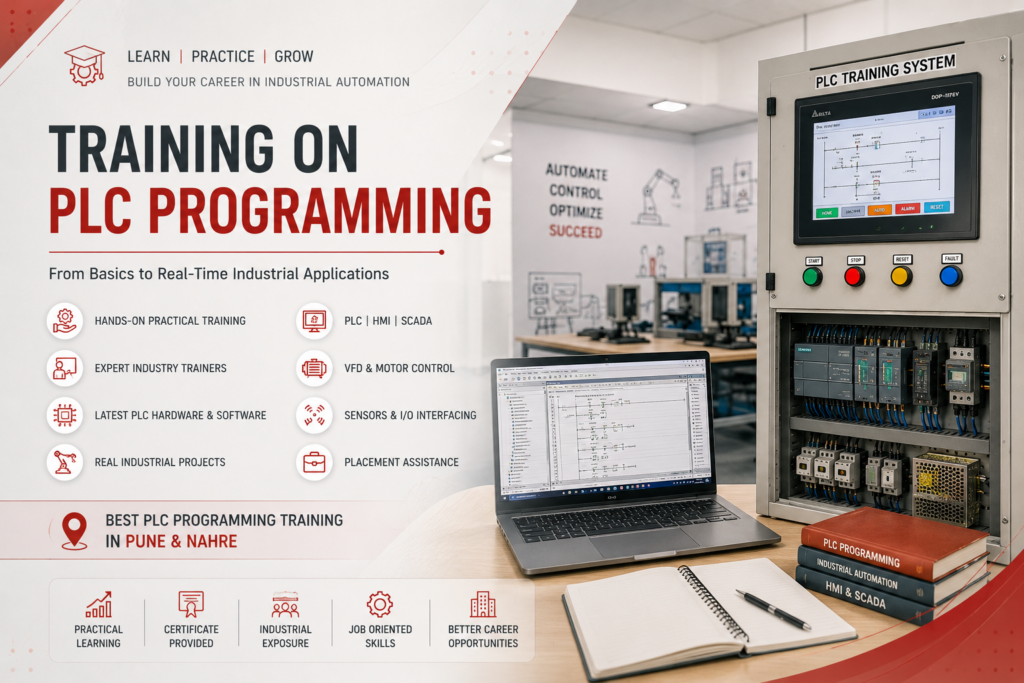
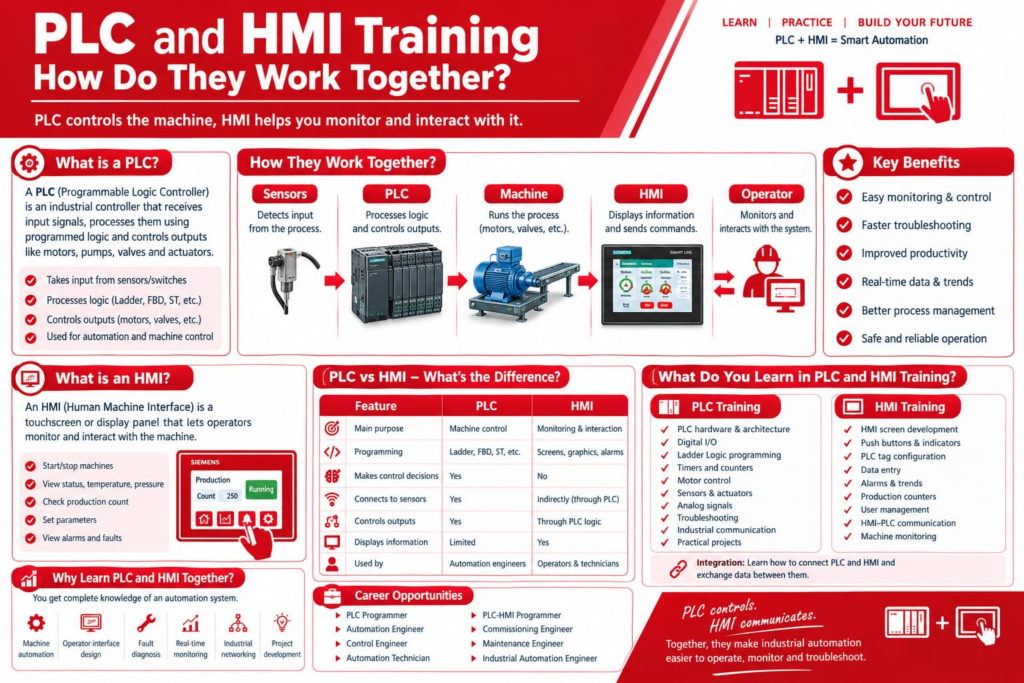
Industrial automation has transformed the way modern factories operate. Machines can now perform repetitive operations, monitor processes, detect faults, and provide real-time information with minimal human intervention. Two of the most important technologies behind this automation are PLC (Programmable Logic Controller) and HMI (Human Machine Interface).
Understanding how PLC and HMI work together is essential for students, engineers, technicians, and professionals looking to build a career in industrial automation. Practical PLC and HMI training helps learners understand not only programming but also how real industrial machines are controlled and monitored.
For students looking for best PLC programming Pune, practical training in PLC programming, HMI designing, troubleshooting, and industrial communication can provide valuable hands-on experience.
What is a PLC?
A Programmable Logic Controller (PLC) is an industrial computer used to control machines and manufacturing processes.
A PLC receives signals from field devices such as:
- Proximity sensors
- Photoelectric sensors
- Push buttons
- Limit switches
- Temperature sensors
- Pressure sensors
- Level sensors
The PLC processes these signals according to the programmed logic and sends commands to output devices such as:
- Motors
- Solenoid valves
- Contactors
- Relays
- VFDs
- Pneumatic actuators
- Alarm systems
For example, in a conveyor system, sensors can detect the presence of a product. The PLC processes the sensor signal and controls the motor to start or stop the conveyor.
What is an HMI?
An HMI (Human Machine Interface) allows an operator to interact with a machine or industrial process through a graphical screen.
Instead of operating a machine only through physical push buttons and indicator lamps, an HMI can display:
- Machine status
- Motor status
- Temperature
- Pressure
- Production counts
- Alarms
- Fault messages
- Setpoints
- Process values
- Trends
- Manual and automatic controls
An HMI makes machine operation easier because operators can see important process information on a single screen.
How Do PLC and HMI Work Together?
The PLC and HMI perform different jobs but work together as a complete automation system.
The basic communication process is:
Sensors → PLC → HMI → Operator
And for operator commands:
Operator → HMI → PLC → Machine
For example, consider an automated water pumping system.
- A level sensor detects the water level.
- The sensor sends a signal to the PLC.
- The PLC processes the signal.
- Based on the programmed logic, the PLC starts or stops the pump.
- The PLC sends the pump status to the HMI.
- The HMI displays the water level and pump status.
- The operator can start, stop, or change permitted settings through the HMI.
This simple example shows why PLC and HMI are commonly used together in industrial automation.
PLC Programming and HMI Designing
A good automation engineer needs to understand both PLC programming and HMI development.
PLC Programming
PLC programming involves creating the logic required to control a machine.
Common PLC programming languages include:
- Ladder Logic
- Function Block Diagram (FBD)
- Structured Text (ST)
- Sequential Function Chart (SFC)
Popular PLC platforms include Siemens, Allen-Bradley, Mitsubishi, Delta, and other industrial automation systems.
HMI Designing
HMI development involves creating graphical screens that allow operators to monitor and control the machine.
Typical HMI features include:
- Start/Stop buttons
- Motor status indicators
- Numeric displays
- Setpoint entry
- Alarm screens
- Trend graphs
- Recipe management
- User login
- Manual/Auto selection
- Production counters
Example: Conveyor Automation
Consider a conveyor system used in a manufacturing plant.
The PLC can control:
- Conveyor motor
- Product sensors
- Emergency stop logic
- Pneumatic cylinders
- Product counting
The HMI can display:
- Conveyor ON/OFF status
- Product count
- Motor fault
- Auto/Manual mode
- Production target
- Alarm history
The operator can use the HMI to select Auto or Manual mode and enter a production target. The HMI sends this information to the PLC, while the PLC controls the actual machine.
Why PLC and HMI Training is Important
Learning PLC and HMI together gives students a more complete understanding of industrial automation.
A theoretical PLC course may teach programming instructions, but practical training should also explain how the PLC communicates with field devices and HMIs.
A good PLC and HMI training program should cover:
- PLC fundamentals
- Digital and analog I/O
- Ladder programming
- Timers and counters
- Motor control
- Interlocking
- Analog signal processing
- HMI screen development
- Alarm configuration
- Data monitoring
- PLC-HMI communication
- Industrial communication protocols
- Troubleshooting
- Practical automation projects
PLC-HMI Communication
PLC and HMI devices communicate using industrial communication protocols.
Depending on the equipment, communication can use:
- Ethernet
- Modbus TCP
- Modbus RTU
- RS-232
- RS-485
- PROFINET
- EtherNet/IP
- MPI
Understanding communication is an important part of practical automation training because communication problems can prevent the HMI from reading or writing PLC data.
For example, if an HMI cannot display a motor status, an automation engineer may need to check:
- PLC communication status
- Network connection
- IP address
- Communication driver
- PLC tag/address
- HMI configuration
- PLC program logic
Benefits of Learning PLC and HMI Together
Learning both technologies provides several advantages.
1. Better Industrial Understanding
Students understand how field devices, PLCs, HMIs, drives, and machines work as one system.
2. Improved Troubleshooting Skills
Engineers can identify whether a problem is related to the PLC program, HMI configuration, communication, sensors, or actuators.
3. Practical Project Experience
Students can develop complete automation projects instead of learning PLC programming in isolation.
4. Better Career Opportunities
PLC and HMI skills are useful for automation engineers, PLC programmers, commissioning engineers, control panel engineers, maintenance engineers, and system integrators.
Choosing PLC Training in Pune
For students searching for best PLC programming Pune, it is important to select training that focuses on practical industrial applications rather than only theoretical concepts.
Training should ideally include:
- Real PLC hardware
- HMI panels
- Industrial sensors
- Motors and drives
- Control panels
- Practical wiring
- PLC programming exercises
- HMI designing
- Communication setup
- Troubleshooting
- Industrial automation projects
Students in and around Nahre, Pune can particularly benefit from hands-on automation training because practical laboratory experience helps bridge the gap between classroom learning and industrial requirements.
Why Practical Training Matters
Industrial automation cannot be learned effectively through programming theory alone.
A student may know how to write a PLC ladder program but still face difficulties when dealing with:
- Incorrect sensor wiring
- PLC input/output faults
- HMI communication errors
- VFD communication
- Emergency circuits
- Analog signal problems
- Network configuration
- Machine interlocks
Hands-on training allows students to experience these situations and learn systematic troubleshooting.
Career Opportunities After PLC and HMI Training
After gaining practical PLC and HMI knowledge, students can explore roles such as:
- PLC Programmer
- Automation Engineer
- HMI Designer
- Industrial Automation Engineer
- Control Panel Engineer
- Commissioning Engineer
- Maintenance Engineer
- SCADA Engineer
- Controls Engineer
- Industrial IoT Engineer
PLC and HMI skills can also provide a strong foundation for learning advanced technologies such as SCADA, VFD, Servo Systems, Industrial IoT, Robotics, and Industry 4.0.
Conclusion
PLC and HMI are two essential components of modern industrial automation. The PLC controls the machine, while the HMI provides an interface for operators to monitor and interact with the process.
Learning these technologies together helps students understand complete automation systems, from sensors and PLC logic to operator screens and industrial communication.
For anyone searching for best PLC programming Pune, choosing practical PLC and HMI training can be an excellent step toward developing industry-relevant automation skills. Students and engineers around Nahre can focus on hands-on projects, troubleshooting, and real-world applications to build stronger technical expertise.
With practical knowledge of PLC programming, HMI designing, communication, and troubleshooting, learners can move toward exciting career opportunities in the rapidly growing field of industrial automation.
#PLCProgramming #PLCTraining #HMITraining #PLCAndHMI #IndustrialAutomation #AutomationTraining #BestPLCProgrammingPune #PLCProgrammingPune #HMIProgramming #PLCProgrammingNahre #NahrePune #IndustrialAutomationTraining #AutomationEngineer #PLCProgrammer #SCADA #VFD #Industry4.0