Modern industries depend on automation systems to improve production, reduce downtime, and monitor machines efficiently. Two important technologies used in industrial automation are PLC (Programmable Logic Controller) and SCADA (Supervisory Control and Data Acquisition).
PLC controls machines and processes, while SCADA provides centralized monitoring, data visualization, alarms, trends, and reporting. For these systems to work together effectively, reliable industrial communication and networking are essential.
What is PLC Communication?
PLC communication is the exchange of data between a PLC and other industrial devices such as:
- HMI
- SCADA systems
- VFDs
- Servo drives
- Remote I/O
- Sensors and instruments
- Industrial gateways
- Other PLCs
Through communication networks, a PLC can send process information and receive commands from other devices.
For example, a PLC controlling a motor can communicate its running status, speed, current, fault condition, and other parameters to an SCADA system.
What is SCADA Communication?
SCADA communication allows the supervisory system to collect real-time information from PLCs and other field devices.
The SCADA software can display:
- Machine status
- Production data
- Temperature and pressure
- Flow and level
- Motor status
- VFD speed
- Alarms and faults
- Historical trends
- Energy consumption
This information helps operators and engineers monitor industrial processes from a centralized workstation.
How PLC and SCADA Communicate
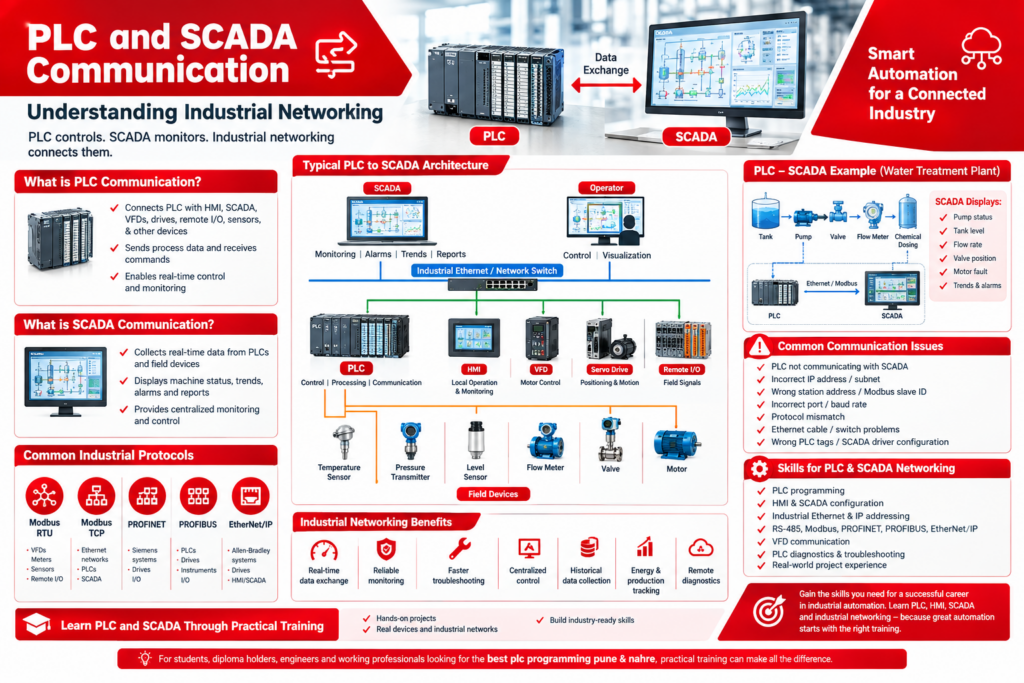
A typical industrial communication architecture can be understood as:
Field Devices → PLC → Industrial Network → SCADA → Operator
For example:
Temperature Sensor → PLC → Ethernet → SCADA → Operator Screen
The PLC receives information from field devices, processes the data according to the control program, and makes selected information available to the SCADA system.
SCADA then reads this information and presents it through graphical screens, alarms, trends, and reports.
Common Industrial Communication Protocols
Different communication protocols are used depending on the PLC, SCADA software, field devices, and application.
1. Modbus RTU
Modbus RTU is widely used for serial communication, especially over RS-485.
It is commonly used for:
- VFD communication
- Energy meters
- Temperature controllers
- Flow meters
- Remote I/O
- Other field instruments
2. Modbus TCP
Modbus TCP is the Ethernet-based version of Modbus.
It is useful when PLCs, SCADA systems, and other devices communicate through an industrial Ethernet network.
3. PROFINET
PROFINET is widely used with Siemens automation systems.
It provides high-speed Ethernet communication between PLCs, remote I/O, drives, HMIs, and other industrial devices.
4. PROFIBUS
PROFIBUS is a well-established industrial fieldbus technology used for communication between PLCs, remote I/O, drives, instruments, and other devices.
5. Ethernet/IP
EtherNet/IP is commonly used with Allen-Bradley and Rockwell Automation systems.
It supports communication between PLCs, HMIs, SCADA systems, remote I/O, drives, and other Ethernet-based industrial devices.
PLC to SCADA Communication Example
Consider a water treatment plant.
The PLC controls:
- Pumps
- Valves
- Level sensors
- Flow meters
- Chemical dosing systems
The SCADA system monitors the entire process.
The PLC can send parameters such as:
Pump 1 = ON
Pump 2 = OFF
Tank Level = 72%
Flow = 125 m³/hr
Valve = OPEN
Motor Fault = NO
SCADA displays this information on the operator screen and can also store the data for historical analysis.
Importance of Industrial Networking
A reliable industrial network is essential for modern automation systems.
Good networking helps provide:
- Real-time data exchange
- Reliable machine monitoring
- Faster troubleshooting
- Centralized control
- Historical data collection
- Production monitoring
- Energy monitoring
- Remote diagnostics
Poor network configuration, incorrect IP addresses, communication settings, or protocol mismatches can cause PLC-SCADA communication failures.
Common PLC-SCADA Communication Problems
Automation engineers frequently troubleshoot problems such as:
- PLC not communicating with SCADA
- Incorrect IP address
- Wrong subnet configuration
- Incorrect PLC station address
- Incorrect Modbus slave ID
- Wrong communication port
- Incorrect baud rate
- Protocol mismatch
- Ethernet cable problems
- Network switch problems
- Incorrect PLC tags
- SCADA driver configuration errors
Understanding both PLC programming and industrial networking makes troubleshooting much easier.
Skills Required for PLC and SCADA Networking
An automation engineer should understand:
- PLC programming
- HMI programming
- SCADA configuration
- Industrial Ethernet
- IP addressing
- RS-485 communication
- Modbus RTU
- Modbus TCP
- PROFINET
- PROFIBUS
- EtherNet/IP
- VFD communication
- PLC diagnostics
- SCADA tag configuration
- Industrial network troubleshooting
Practical knowledge is particularly important because industrial networking is best understood by working with actual PLCs, HMIs, drives, switches, and SCADA systems.
Learn PLC and SCADA Through Practical Training
Students, diploma holders, engineers, and working professionals who want to build a career in industrial automation should learn PLC and SCADA through practical projects.
A good practical training program should cover PLC programming, HMI development, SCADA configuration, industrial communication, VFD integration, troubleshooting, and real-world automation projects.
For students and professionals searching for best plc programming pune & nahre, practical training can provide a strong foundation for developing PLC, HMI, SCADA, and industrial networking skills.
Conclusion
PLC and SCADA communication is an important part of modern industrial automation. PLCs perform control operations, while SCADA systems provide centralized monitoring, visualization, alarms, trends, and data management.
Understanding industrial communication protocols such as Modbus, PROFINET, PROFIBUS, and EtherNet/IP helps automation engineers design and troubleshoot reliable industrial networks.
With practical knowledge of PLC programming, SCADA, HMI, industrial networking, and communication protocols, engineers can develop the skills required to work on real-world automation projects.
#PLCProgramming #SCADA #IndustrialAutomation #IndustrialNetworking #PLCTraining #SCADATraining #Modbus #PROFINET #PLCProgrammingPune