Many industrial processes do not run continuously. Instead, products are manufactured in batches, where raw materials are added, processed, mixed, heated, cooled, and transferred according to a defined sequence.
PLC-Based Batch Process Automation uses a Programmable Logic Controller to control these operations step by step. It is widely used in industries such as pharmaceuticals, chemicals, food and beverage, paints, cosmetics, specialty chemicals, and manufacturing.
Understanding batch automation through practical examples helps engineers and students learn how PLC programming is applied to real industrial processes.
What is Batch Process Automation?
Batch process automation means controlling a production process according to a predefined sequence or recipe.
A simple batch process can be represented as:
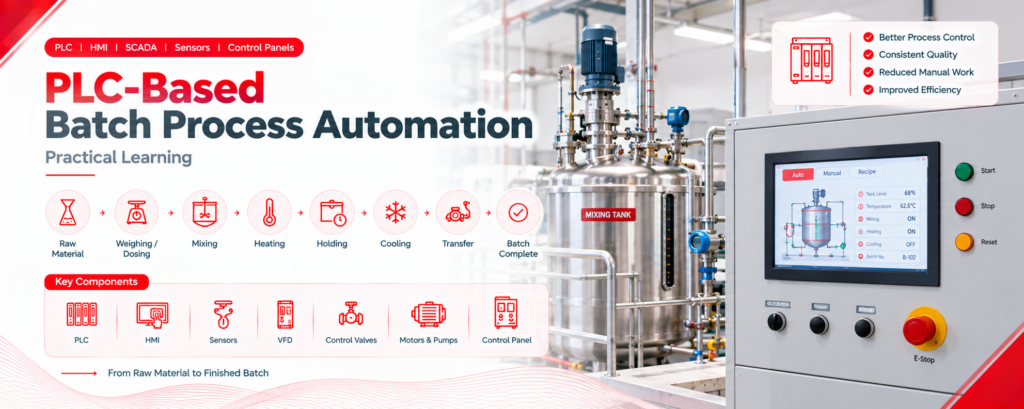
Raw Material → Weighing/Dosing → Mixing → Heating → Holding → Cooling → Transfer → Batch Completion
The PLC controls each stage according to process conditions, timers, sensor feedback, and programmed logic.
How PLC Controls a Batch Process
A PLC receives signals from field devices such as:
- Level sensors
- Temperature sensors
- Pressure sensors
- Flow sensors
- Proximity sensors
- Push buttons
- Limit switches
Based on these inputs, the PLC controls:
- Pumps
- Motors
- Mixers
- Valves
- Heaters
- Conveyors
- Agitators
- Dosing systems
The basic control concept is:
Sensors → PLC → Control Logic → Outputs → Process Equipment
Practical Batch Process Example
Consider an automated mixing tank.
The batch sequence could be:
Step 1: Check tank empty condition
Step 2: Open raw material valve
Step 3: Fill the tank up to the required level
Step 4: Start agitator
Step 5: Start heating
Step 6: Maintain the required temperature
Step 7: Hold the material for a defined time
Step 8: Stop heating
Step 9: Start cooling
Step 10: Transfer the finished batch
Step 11: Complete the batch and reset the sequence
This type of sequence can be implemented using PLC programming.
PLC Programming for Batch Processes
A PLC program can divide the complete process into different steps or states.
For example:
| Step | Operation | PLC Condition |
|---|---|---|
| 1 | Tank filling | Level below setpoint |
| 2 | Mixing | Required level reached |
| 3 | Heating | Mixing completed |
| 4 | Temperature holding | Set temperature reached |
| 5 | Cooling | Heating completed |
| 6 | Transfer | Required temperature reached |
| 7 | Batch complete | Tank empty |
This makes the PLC program easier to understand, troubleshoot, and modify.
Timers and Counters in Batch Automation
Timers are frequently used in batch processes.
For example:
- Mixing for 5 minutes
- Heating for 10 minutes
- Holding temperature for 15 minutes
- Cooling for 8 minutes
PLC counters can also be used for:
- Batch counting
- Product counting
- Production cycles
- Number of completed operations
Timers and counters help automate repetitive process sequences.
Recipe-Based Batch Automation
Different products may require different process parameters.
For example:
| Parameter | Recipe A | Recipe B |
|---|---|---|
| Material Quantity | 100 kg | 150 kg |
| Mixing Time | 10 min | 15 min |
| Temperature | 60°C | 75°C |
| Holding Time | 10 min | 20 min |
| Cooling Temperature | 30°C | 35°C |
A recipe-based system allows operators to select the required production recipe and apply predefined process parameters.
Recipe management can be integrated with HMI or SCADA systems.
HMI for Batch Process Automation
An HMI (Human Machine Interface) allows operators to monitor and control the batch process.
An HMI screen can display:
- Current batch number
- Active process step
- Tank level
- Temperature
- Pressure
- Mixing status
- Valve status
- Pump status
- Timer values
- Recipe parameters
- Alarms
- Batch completion status
Operators can also use HMI screens for suitable manual controls, recipe selection, and process parameter settings.
SCADA for Batch Monitoring
SCADA (Supervisory Control and Data Acquisition) can provide centralized monitoring of multiple batch processes.
SCADA can support:
- Batch status monitoring
- Historical trends
- Alarm management
- Production reports
- Batch data logging
- Recipe management
- Equipment status
- Process parameter monitoring
This is particularly useful when multiple production lines or process areas need to be monitored from one control room.
Sensors and Instrumentation
Accurate measurement is essential for reliable batch process automation.
Common instruments include:
| Instrument | Application |
|---|---|
| Level Sensor | Tank filling |
| Temperature Sensor | Heating/cooling |
| Pressure Sensor | Pressure monitoring |
| Flow Meter | Material transfer |
| Load Cell | Weighing/dosing |
| Proximity Sensor | Position detection |
| Control Valve | Flow control |
| Conductivity Sensor | Process monitoring |
The PLC uses these signals to make decisions during different stages of the batch.
VFD Automation in Batch Processes
VFDs (Variable Frequency Drives) can be used when motor speed needs to be controlled according to the process.
Typical applications include:
- Mixing motors
- Pumps
- Agitators
- Fans
- Blowers
- Conveyors
For example, a mixer may operate at a lower speed during material addition and increase its speed during the main mixing stage.
Interlocking in Batch Automation
Interlocking prevents equipment from operating under unsafe or incorrect conditions.
For example:
- Pump cannot start when the tank is empty.
- Heater cannot start when the required liquid level is not reached.
- Transfer valve cannot open while the mixing operation is active.
- Mixer cannot start if the tank cover is open.
- Pump cannot run if a motor fault is detected.
Interlocking is an important part of PLC programming and industrial process control.
Alarm and Fault Management
The PLC and HMI can generate alarms when abnormal conditions occur.
Examples include:
- High temperature
- Low tank level
- High pressure
- Pump fault
- Motor overload
- Valve failure
- Sensor failure
- Emergency stop
- Communication failure
Clear alarm messages help operators identify problems and take corrective action.
Practical Learning Approach
Learning batch automation practically can be divided into stages:
Step 1 – Understand the Process
First understand what the process is supposed to do.
Step 2 – Identify Inputs and Outputs
Prepare an I/O list containing sensors, switches, motors, valves, heaters, and other equipment.
Step 3 – Create the Sequence
Divide the process into individual steps.
Step 4 – Develop PLC Logic
Create ladder logic or another suitable PLC programming method for each step.
Step 5 – Configure HMI
Create screens for:
- Start/Stop
- Auto/Manual
- Process status
- Parameters
- Alarms
- Batch information
Step 6 – Test the Sequence
Test each step using simulation or a PLC training setup before connecting actual equipment.
Step 7 – Troubleshoot
Check sensor signals, PLC logic, outputs, interlocks, timers, and communication when the sequence does not operate correctly.
Applications of PLC-Based Batch Automation
Batch automation is commonly used in:
- Chemical processing
- Pharmaceutical manufacturing
- Food and beverage processing
- Paint manufacturing
- Cosmetics production
- Dairy processing
- Water and wastewater treatment
- Specialty chemical production
- Mixing and blending systems
- Material dosing systems
Benefits of PLC-Based Batch Process Automation
PLC-based batch automation can provide:
- Consistent batch production
- Repeatable process sequences
- Accurate process control
- Reduced manual intervention
- Better recipe management
- Faster fault identification
- Improved production monitoring
- Batch data recording
- Easier process modification
- Better equipment coordination
Industry 4.0 and Batch Automation
Modern batch automation systems can connect PLC, HMI, SCADA, industrial networks, and production databases.
A typical architecture is:
Sensors → PLC → HMI/SCADA → Industrial Network → Production Database → Reports & Analysis
This can support:
- Batch traceability
- Production reporting
- Historical data
- Equipment performance monitoring
- Recipe management
- Remote monitoring
- Data-based process improvement
Conclusion
PLC-Based Batch Process Automation provides a practical way to understand how industrial PLC systems control real production sequences.
By learning I/O configuration, PLC programming, timers, counters, sequencing, interlocking, HMI, SCADA, VFDs, sensors, and recipe management, engineers can develop a strong understanding of practical industrial automation.
For industries looking for an Industrial Automation System Integrator in Pune, solutions involving PLC Programming, SCADA Automation, HMI Programming, VFD Automation, Industrial Instrumentation, Control Panel Manufacturing, Batch Process Automation, and IIoT can be designed according to specific process requirements.
#BatchProcessAutomation #PLCProgramming #PLCAutomation #BatchAutomation #IndustrialAutomation #ProcessAutomation #SCADA #SCADAAutomation #HMI #VFDAutomation #PLCControlPanel #IndustrialInstrumentation #RecipeManagement #ProcessControl #FactoryAutomation #ManufacturingAutomation #SmartManufacturing #Industry40 #IIoT #ChemicalAutomation #PharmaAutomation #FoodProcessingAutomation #IndustrialAutomationSolutions #PuneAutomation