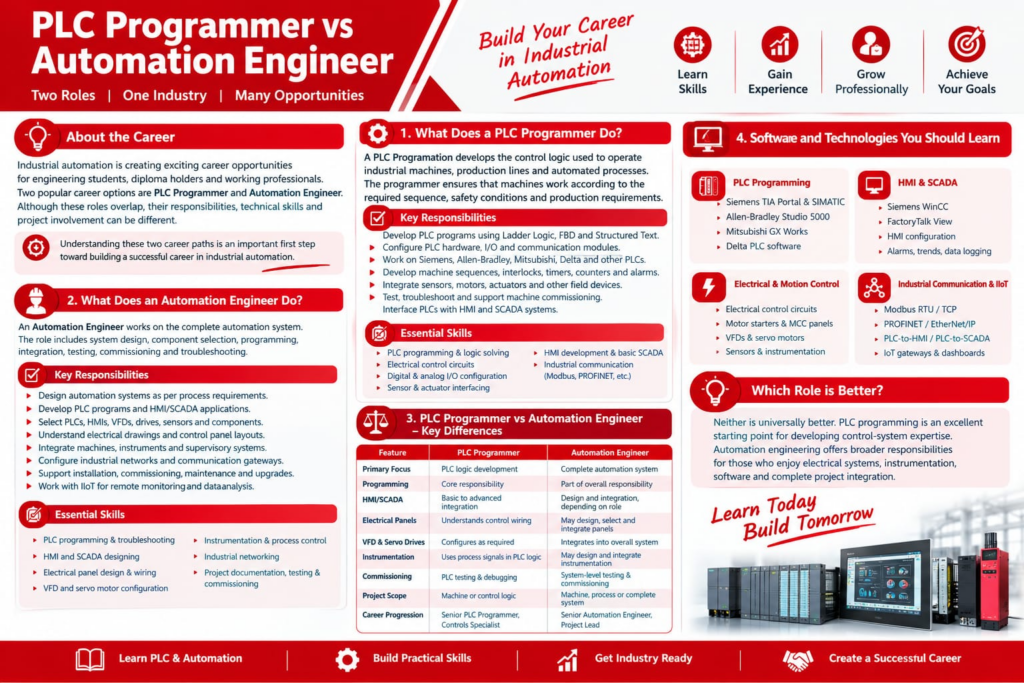
Industrial automation is creating exciting career opportunities for engineering students, diploma holders, and working professionals. Two popular career options are PLC Programmer and Automation Engineer. Although these roles overlap, their responsibilities, technical skills, and project involvement can be different.
A PLC Programmer mainly focuses on developing and troubleshooting PLC logic, while an Automation Engineer may handle the complete automation system, including PLCs, HMI, SCADA, VFDs, sensors, electrical panels, and industrial communication.
For candidates searching for the best plc programming pune & nahre, understanding these two career paths is an important first step toward building a successful career in industrial automation.
1. What Does a PLC Programmer Do?
A PLC Programmer develops the control logic used to operate industrial machines, production lines, and automated processes. The programmer ensures that machines operate according to the required sequence, safety conditions, and production requirements.
Key Responsibilities
- Develop PLC programs using Ladder Logic, Function Block Diagram (FBD), and Structured Text.
- Configure PLC hardware, digital and analog inputs/outputs, and communication modules.
- Program Siemens, Allen-Bradley, Mitsubishi, Delta, and other PLC platforms.
- Develop machine sequences, interlocks, timers, counters, and alarm logic.
- Integrate sensors, proximity switches, transmitters, motors, and actuators.
- Test programs, troubleshoot faults, and support machine commissioning.
- Interface PLCs with HMI systems and SCADA software.
Essential Skills for a PLC Programmer
- PLC programming and logical problem-solving.
- Electrical control circuit understanding.
- Digital and analog I/O configuration.
- Sensor and actuator interfacing.
- HMI development and basic SCADA integration.
- Industrial communication protocols such as Modbus TCP, Modbus RTU, and PROFINET.
2. What Does an Automation Engineer Do?
An Automation Engineer works on a broader range of industrial control and automation activities. Depending on the company and project, the role may include system design, component selection, programming, integration, testing, commissioning, and troubleshooting.
Key Responsibilities
- Design industrial automation systems according to process requirements.
- Develop PLC programs and HMI/SCADA applications.
- Select PLCs, HMIs, VFDs, servo drives, sensors, and control components.
- Understand electrical drawings, control panel layouts, and wiring diagrams.
- Integrate machines, instruments, drives, and supervisory control systems.
- Configure industrial networks and communication gateways.
- Support installation, commissioning, maintenance, and system upgrades.
- Work with IIoT technologies for remote monitoring, data logging, and production analysis.
Essential Skills for an Automation Engineer
- PLC programming and troubleshooting.
- HMI and SCADA designing.
- Electrical panel design and control wiring.
- VFD and servo motor configuration.
- Instrumentation and process control fundamentals.
- Industrial networking and system integration.
- Project documentation, testing, and commissioning.
3. PLC Programmer vs Automation Engineer: Key Differences
| Comparison | PLC Programmer | Automation Engineer |
|---|---|---|
| Primary focus | PLC logic development | Complete automation system |
| Programming | Core responsibility | Important responsibility |
| HMI/SCADA | Basic to advanced integration | Design and integration, depending on role |
| Electrical panels | Understands control wiring | May design, select, and integrate panels |
| VFD and servo drives | Configures as required | Integrates drives into the overall system |
| Instrumentation | Uses process signals in PLC logic | May design and integrate instrumentation |
| Commissioning | PLC testing and debugging | System-level testing and commissioning |
| Project scope | Machine or control logic | Machine, process, or complete system |
| Career progression | Senior PLC Programmer, Controls Specialist | Senior Automation Engineer, Project Lead |
Which role is better? Neither is universally better. PLC programming is an excellent starting point for developing control-system expertise. Automation engineering can offer broader responsibilities for professionals who enjoy electrical systems, instrumentation, software, and complete project integration.
4. Software and Technologies You Should Learn
To build a strong career in PLC programming and industrial automation, focus on practical knowledge of commonly used platforms.
PLC Programming
- Siemens TIA Portal and SIMATIC PLCs
- Allen-Bradley Studio 5000
- Mitsubishi GX Works
- Delta PLC programming software
HMI and SCADA
- Siemens WinCC
- FactoryTalk View
- Industrial HMI configuration and screen development
- Alarms, trends, data logging, and operator interfaces
Electrical and Motion Control
- Electrical control circuits and panel wiring
- Motor starters, MCC panels, and VFDs
- Servo motor basics and positioning applications
- Sensors, transmitters, and industrial instrumentation
Industrial Communication and IIoT
- Modbus RTU and Modbus TCP
- PROFINET and EtherNet/IP
- PLC-to-HMI and PLC-to-SCADA communication
- Industrial IoT gateways and dashboard monitoring
You do not need to master every platform immediately. Start with one PLC family, understand the fundamentals, and then expand your skills to other platforms and applications.
5. Practical Projects to Develop Your Skills
Hands-on projects help you apply theoretical knowledge and demonstrate your capabilities during technical interviews.
Project 1: Automatic Bottle Filling System
Develop PLC logic for bottle detection, conveyor control, filling time, counting, and automatic stopping.
Project 2: Motor Control Using a VFD
Configure a VFD for motor start/stop, speed reference, fault handling, and PLC communication.
Project 3: Tank Level Monitoring and Control
Use a level transmitter, PLC analog input, pump control logic, and HMI display to monitor and control tank levels.
Project 4: PLC-Based Conveyor Sorting
Integrate sensors, pneumatic actuators, conveyor motors, and PLC sequencing to sort products automatically.
Project 5: SCADA-Based Process Monitoring
Build an operator interface with live process values, alarms, trends, and historical data logging.
These projects provide experience with real industrial concepts and help prepare candidates for automation-related job roles.
6. Career Opportunities in Industrial Automation
After acquiring relevant technical skills and practical experience, candidates can explore roles such as:
- Junior PLC Programmer
- PLC and SCADA Engineer
- Industrial Automation Engineer
- Electrical Control Panel Design Engineer
- Commissioning Engineer
- Instrumentation and Control Engineer
- IIoT and Industrial Connectivity Engineer
- Senior Controls Engineer or Automation Project Engineer
Opportunities exist across manufacturing, automotive, food and beverage, pharmaceutical, chemical, packaging, water treatment, and process industries. Actual job responsibilities depend on the employer, project requirements, and experience level.
7. How to Choose the Right Industrial Automation Training
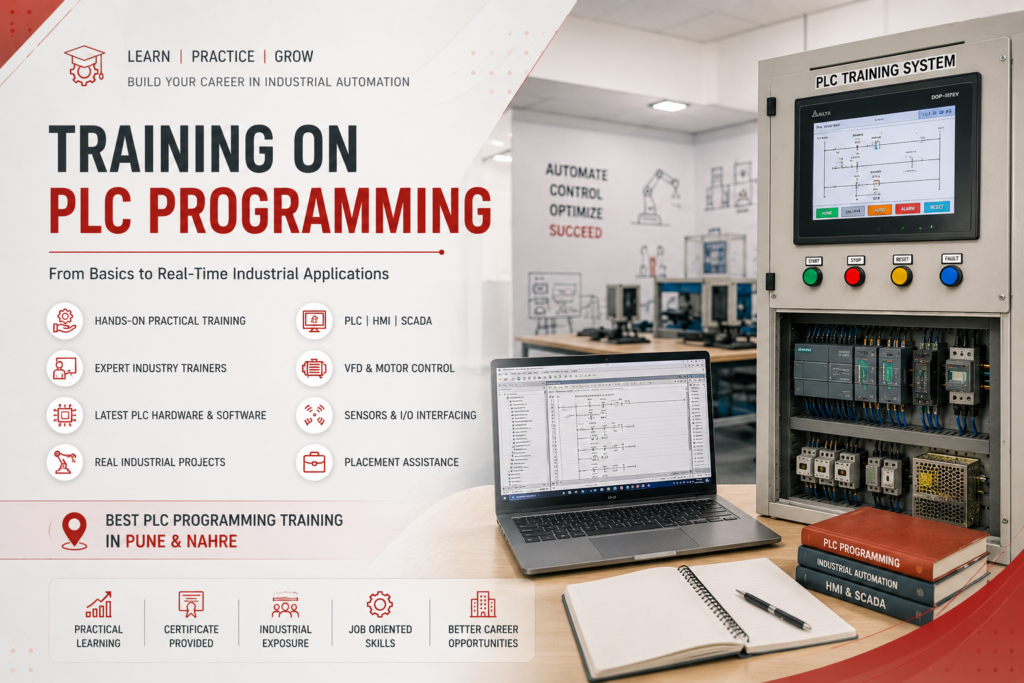
When comparing industrial automation training options, look beyond the course certificate. Choose a program that includes practical work with PLC hardware, electrical control circuits, HMI/SCADA applications, sensors, VFDs, and troubleshooting.
Before enrolling, check whether the course offers:
- Practical PLC programming on industrial trainer kits.
- Siemens and Allen-Bradley PLC exposure.
- HMI and SCADA development exercises.
- Electrical wiring and control circuit practice.
- Industrial communication and instrumentation fundamentals.
- Realistic automation projects and commissioning exercises.
- Technical interview preparation and project documentation.
For candidates exploring the best plc programming pune & nahre, selecting hands-on industrial automation training can help bridge the gap between engineering education and practical industry requirements.
Automate Engineering focuses on industrial automation technologies, PLC programming, HMI/SCADA, electrical control systems, and practical technical training to help learners understand industrial applications.
8. Step-by-Step Roadmap to Become an Automation Professional
Step 1: Learn electrical fundamentals, relay logic, sensors, and control circuits.
Step 2: Start PLC programming with timers, counters, interlocks, sequences, and analog signals.
Step 3: Practise HMI development and learn how operators interact with machines.
Step 4: Learn VFD configuration, motor control, and industrial communication.
Step 5: Develop SCADA applications with alarms, trends, and data logging.
Step 6: Complete practical projects and document your PLC logic, wiring diagrams, and testing results.
Step 7: Apply for trainee, junior PLC programmer, commissioning, or automation engineer positions.
Consistent practice and real project exposure are important for developing the troubleshooting and integration skills employers expect.
Conclusion
PLC Programmers and Automation Engineers both play important roles in modern manufacturing. PLC Programmers specialise in machine logic and control sequences, while Automation Engineers may work across the wider automation system, from electrical design and instrumentation to SCADA integration and commissioning.
If you are starting your career, begin with PLC programming fundamentals and gradually expand into HMI, SCADA, VFDs, industrial networking, and IIoT. The right combination of technical knowledge and practical experience can help you build a long-term career in industrial automation.
For learners searching for the best plc programming pune & nahre, focus on training that provides practical exposure, industry-relevant projects, and a clear learning path from PLC fundamentals to complete automation systems.
#PLCProgramming #AutomationEngineer #IndustrialAutomation #PLCSCADATraining #AutomateEngineering