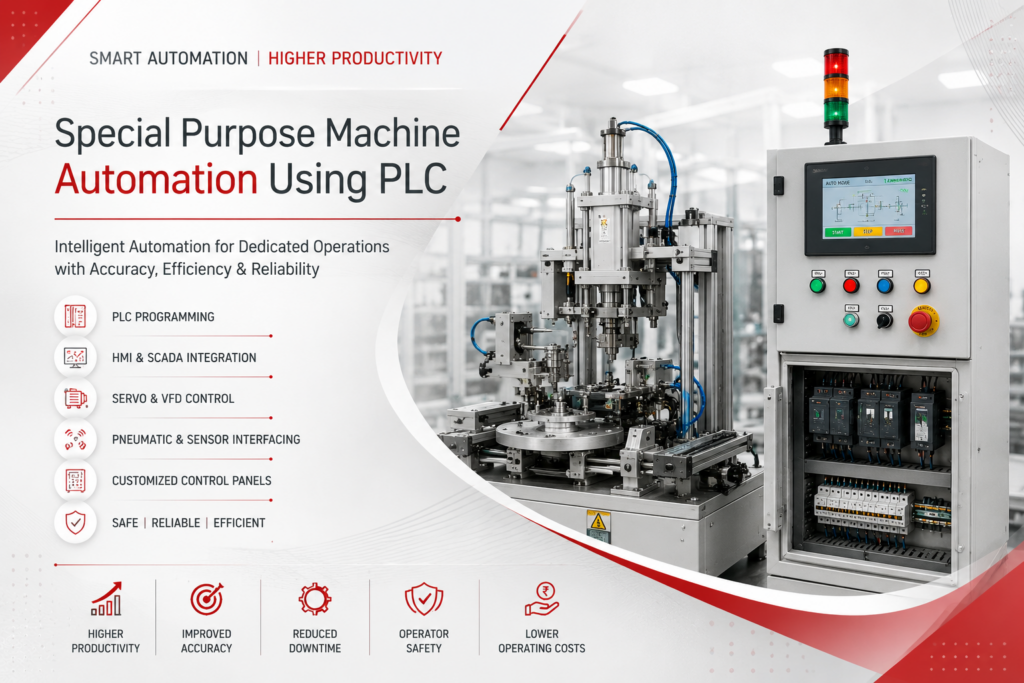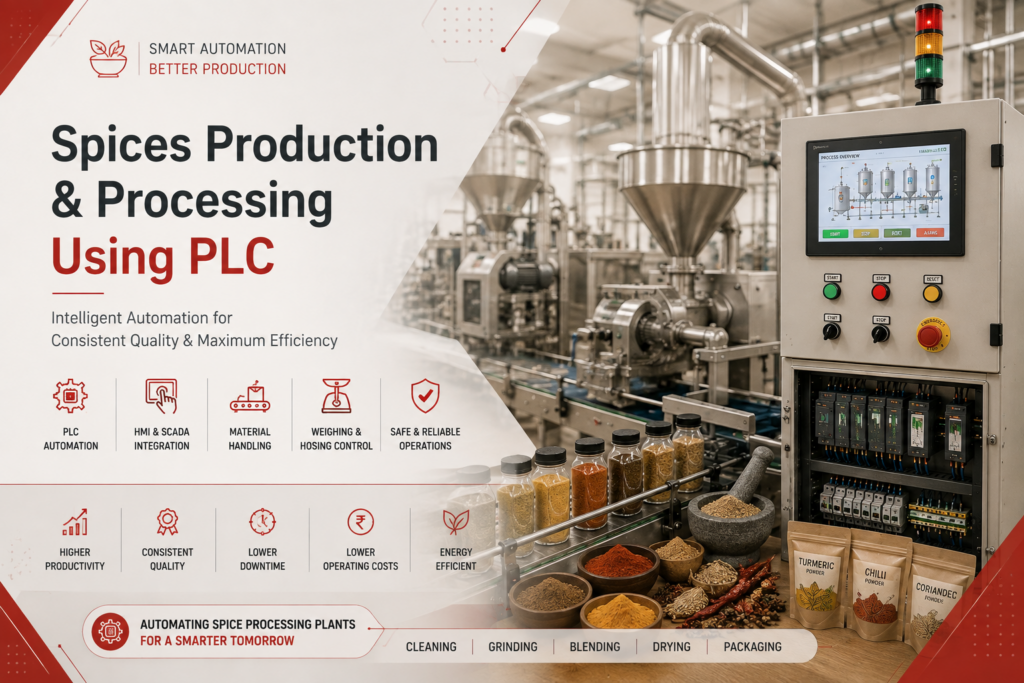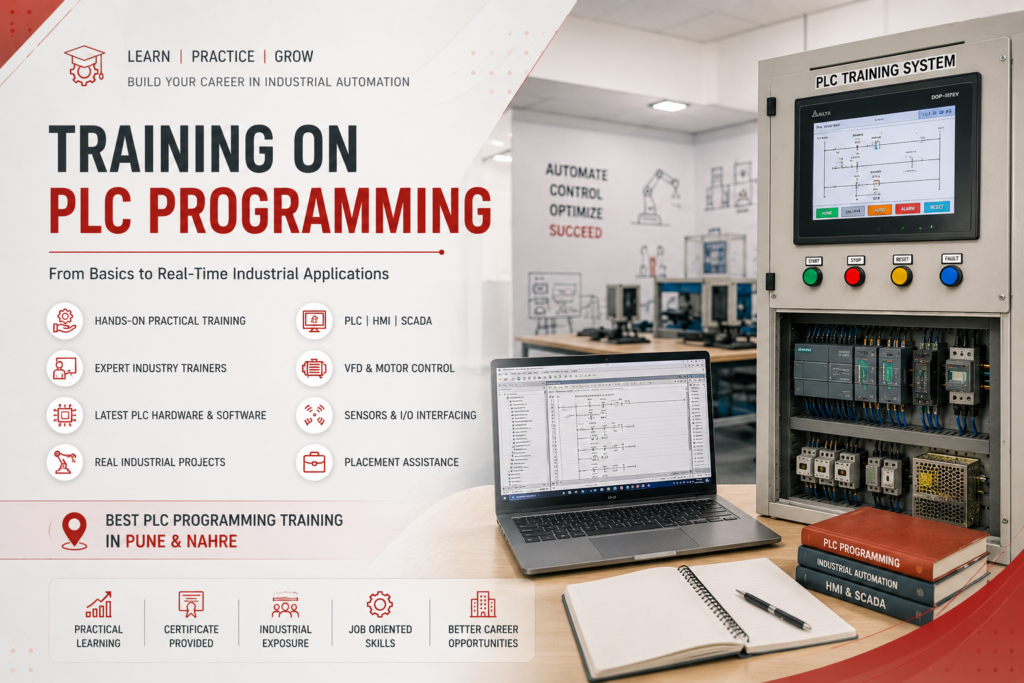
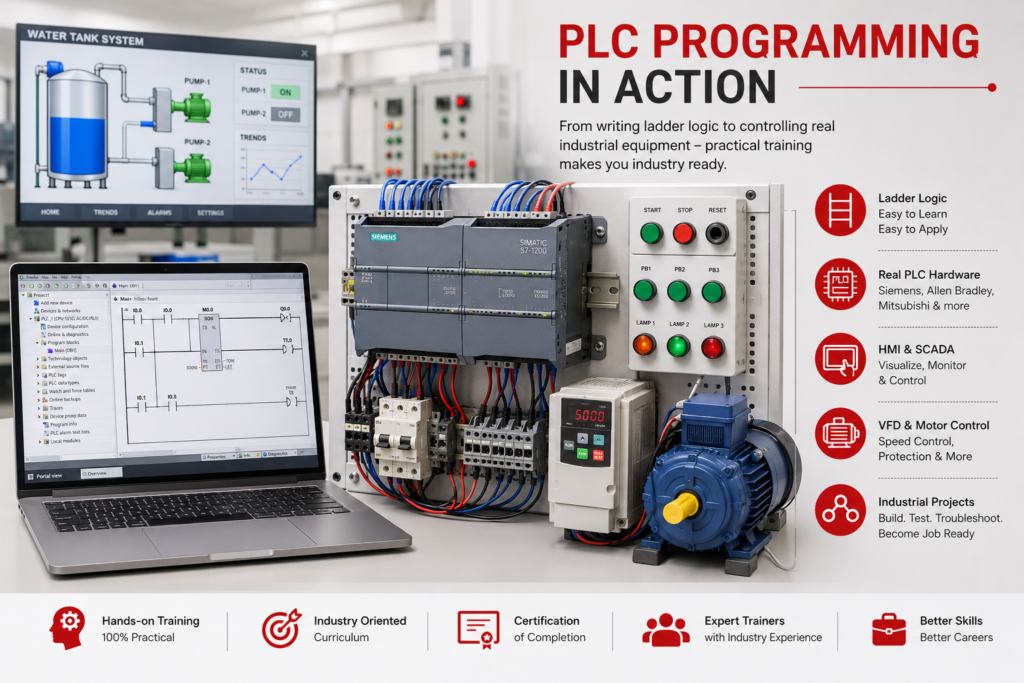
Starting a career in industrial automation can be an exciting opportunity for engineering and diploma freshers. Among the most important skills to learn is PLC programming, which is widely used in manufacturing plants, process industries, machine automation, packaging, food and beverage, pharmaceuticals, and many other industries.
For students looking for best PLC programming Pune, learning PLCs through practical, industry-oriented training can provide a strong foundation for an automation career. Areas such as Pune and Nahre have growing opportunities for students who want to build skills in PLC, HMI, SCADA, electrical control systems, and industrial automation.
What is PLC Programming?
A Programmable Logic Controller (PLC) is an industrial computer used to control machines and automated processes.
A PLC receives signals from field devices such as:
- Push buttons
- Proximity sensors
- Limit switches
- Temperature sensors
- Pressure sensors
- Level sensors
It processes these signals according to the programmed logic and controls output devices such as:
- Motors
- Contactors
- Solenoid valves
- Relays
- VFDs
- Actuators
- Indicator lamps
In simple terms:
Input → PLC Program → Output → Machine Action
Why Should Freshers Learn PLC Programming?
PLC programming is one of the most valuable technical skills for students interested in industrial automation.
Freshers who develop practical PLC knowledge can explore career opportunities such as:
- PLC Programmer
- Automation Engineer
- Control Engineer
- PLC-SCADA Engineer
- Maintenance Engineer
- Commissioning Engineer
- Electrical Automation Engineer
- Service Engineer
A combination of PLC + HMI + SCADA + VFD + Electrical Control knowledge can make a fresher more industry-ready.
Basic PLC Concepts Freshers Should Learn
Before writing advanced programs, beginners should understand the basic architecture of a PLC.
1. PLC CPU
The CPU is the main processing unit of the PLC. It executes the user program and manages communication between inputs, outputs, and other devices.
2. Digital Inputs
Digital inputs generally represent ON/OFF signals.
Examples include:
- Start push button
- Stop push button
- Emergency stop
- Proximity sensor
- Limit switch
3. Digital Outputs
Digital outputs control devices such as:
- Contactors
- Relays
- Solenoid valves
- Lamps
- Buzzers
4. Analog Inputs and Outputs
Analog signals are used when a continuously varying value needs to be measured or controlled.
Common signals include:
- 0–10 V
- 4–20 mA
Examples include temperature, pressure, flow, level, and speed control.
PLC Programming Languages
Freshers should become familiar with commonly used PLC programming languages.
Ladder Logic
Ladder Logic is one of the most popular PLC programming methods, particularly for beginners.
It resembles electrical relay control circuits and is relatively easy to understand.
For example, a basic motor-starting sequence may use:
Start Push Button → PLC Logic → Motor Contactor
Function Block Diagram
FBD represents control logic using graphical function blocks. It is useful for process control and more complex control functions.
Structured Text
Structured Text is a text-based programming language suitable for mathematical calculations, data processing, sequencing, and advanced control logic.
PLC Brands Freshers Can Learn
Students should ideally gain hands-on experience with at least one commonly used PLC platform.
Popular PLC platforms include:
- Siemens
- Allen-Bradley
- Mitsubishi
- Delta
- Schneider
- Omron
For a beginner, understanding PLC fundamentals is more important than learning many brands simultaneously. Once the basic concepts are clear, moving between PLC platforms becomes easier.
Important PLC Topics for Beginners
A practical beginner-level PLC course should cover topics such as:
- PLC hardware and architecture
- Digital input/output
- PLC addressing
- Ladder Logic
- Timers
- Counters
- Internal relays/bits
- Latching logic
- Interlocking
- Motor control
- Analog signals
- VFD control
- HMI communication
- PLC troubleshooting
- Industrial communication
Start With Simple PLC Projects
The best way for freshers to learn PLC programming is through practical projects.
Project 1: Motor Start/Stop Control
Learn how to control a motor using:
- Start push button
- Stop push button
- Contactor
- Overload relay
- PLC
Project 2: Conveyor Automation
Develop a program where sensors detect products and control a conveyor motor.
This introduces concepts such as:
- Sensors
- Timers
- Counters
- Motor control
- Sequencing
Project 3: Traffic Light Control
A traffic-light project helps beginners understand timers, sequencing, and output control.
Project 4: Tank Level Control
Use level sensors to automatically control a pump based on tank level.
This project introduces:
- Level sensing
- Pump control
- Interlocking
- Automatic operation
Project 5: VFD Speed Control
Learn how a PLC can communicate with a VFD to start, stop, and control motor speed.
PLC + HMI + SCADA: The Next Step
After learning basic PLC programming, freshers should move toward HMI and SCADA.
An HMI allows operators to interact with machines through graphical screens.
A typical HMI can display:
- Motor status
- Alarm status
- Temperature
- Pressure
- Production count
- Machine operating status
SCADA systems can provide centralized monitoring, data logging, alarms, trends, and supervisory control.
Therefore, a strong automation learning path is:
PLC → HMI → VFD → SCADA → Industrial Communication → IIoT
PLC Programming Training in Pune & Nahre
For students searching for best PLC programming Pune, practical exposure should be an important consideration when selecting training.
A good industrial automation training program should include:
- Live PLC hardware
- Industrial sensors
- Motors and contactors
- VFDs
- HMI systems
- SCADA software
- Electrical control panels
- Industrial communication
- Troubleshooting exercises
- Practical automation projects
Students in Nahre, Pune and nearby areas can particularly benefit from training that combines classroom concepts with hands-on industrial automation practice.
Skills Freshers Should Develop Along With PLC
PLC programming alone is not enough for a complete automation profile. Freshers should gradually develop knowledge of:
PLC Programming + Electrical Control + HMI + SCADA + VFD + Sensors + Industrial Networking
Soft skills are also important. Engineers should be able to understand electrical drawings, troubleshoot machines, communicate with maintenance teams, and document automation projects.
Common Mistakes Freshers Should Avoid
Only Learning Software
Watching PLC simulation videos without working with actual hardware can limit practical understanding.
Memorizing Programs
Instead of memorizing ladder programs, understand why each contact, coil, timer, counter, and interlock is used.
Ignoring Electrical Basics
PLC engineers often work with control panels and field devices. Basic knowledge of relays, contactors, overloads, sensors, MCBs, VFDs, and control circuits is extremely useful.
Avoiding Troubleshooting
Industrial automation is not only about writing programs. Engineers must also identify wiring faults, sensor problems, communication errors, and PLC faults.
Career Roadmap for a PLC Fresher
A simple roadmap is:
Step 1: Learn electrical fundamentals
↓
Step 2: Understand PLC hardware
↓
Step 3: Learn Ladder Logic
↓
Step 4: Practice PLC projects
↓
Step 5: Learn HMI
↓
Step 6: Learn VFD and motor control
↓
Step 7: Learn SCADA
↓
Step 8: Learn industrial communication
↓
Step 9: Build automation projects
↓
Step 10: Apply for PLC/Automation Engineer positions
Conclusion
PLC programming is an excellent starting point for freshers who want to build a career in industrial automation. By combining theoretical knowledge with hands-on projects, students can develop the practical skills required to work with modern automated machines and industrial processes.
For students searching for best PLC programming Pune or PLC programming training near Nahre, the key is to choose a practical, industry-oriented learning path covering PLC, HMI, SCADA, VFD, electrical control systems, troubleshooting, and industrial communication.
With consistent practice and real-world project exposure, a fresher can gradually progress from basic PLC programming to becoming a skilled Industrial Automation Engineer.