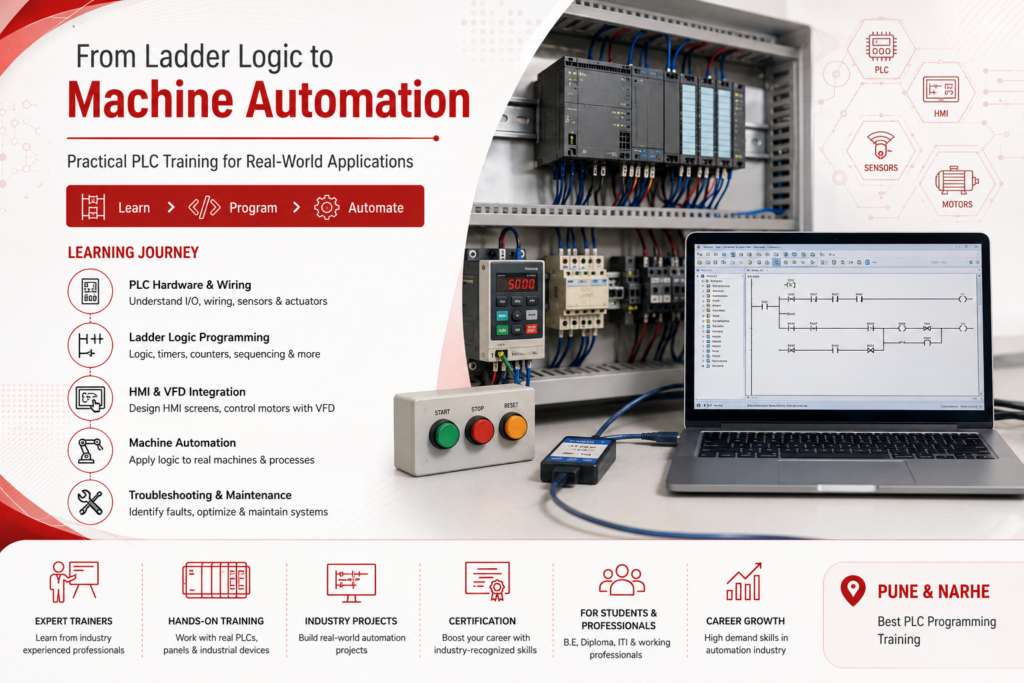
Industrial automation is transforming modern manufacturing by making machines faster, safer, more accurate, and easier to monitor. At the heart of many automated machines is the Programmable Logic Controller (PLC). Learning PLC programming practically is therefore an important skill for students, electrical engineers, electronics engineers, instrumentation professionals, and automation technicians.
If you are looking for PLC training in Pune, practical exposure is far more valuable than learning only PLC theory. A good training program should take you from understanding PLC hardware and wiring to developing ladder logic, troubleshooting programs, communicating with HMIs, and finally controlling a real machine or automation system.
What Is Practical PLC Training?
Practical PLC training focuses on learning by actually working with PLC hardware, software, sensors, switches, motors, contactors, relays, VFDs, HMIs, and industrial communication.
Instead of only studying ladder logic on a computer, learners should understand how a PLC receives signals from field devices, processes the control program, and operates outputs connected to machines.
A typical practical learning sequence includes:
- PLC hardware and architecture
- Digital and analog input/output
- PLC wiring and electrical connections
- Ladder logic programming
- Timers and counters
- Motor control
- Interlocking and sequencing
- VFD control
- HMI programming
- PLC-HMI communication
- Sensors and actuators
- Industrial communication
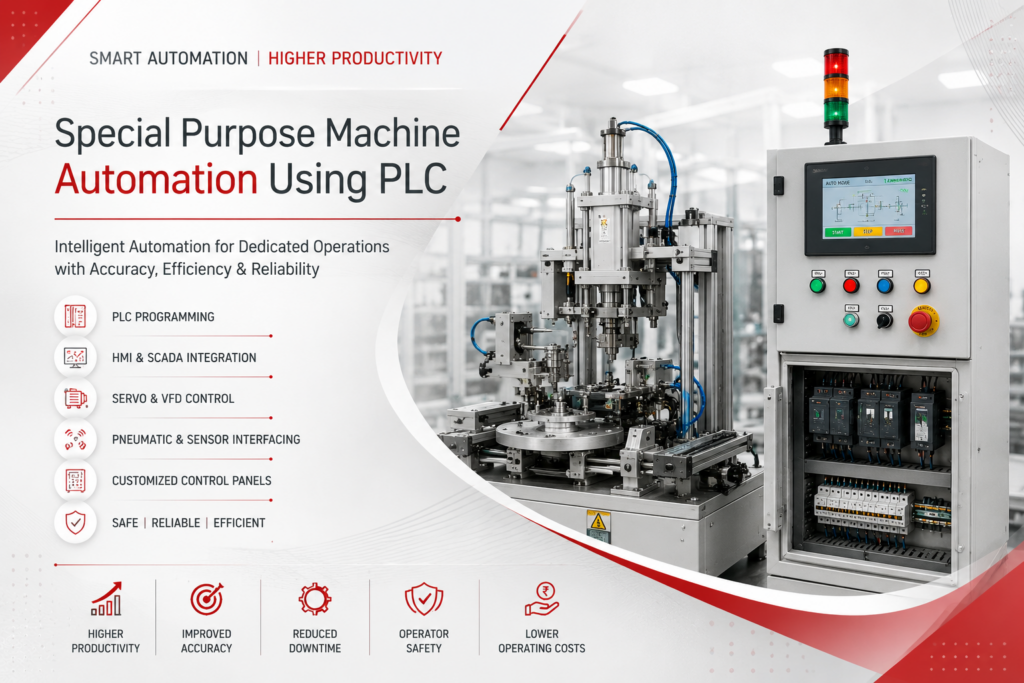
- Machine automation
- Troubleshooting and fault diagnosis
From Ladder Logic to Machine Automation
The most important objective of PLC training is to understand how a simple PLC program becomes a complete machine-control system.
For example, consider a conveyor automation application.
A sensor detects a product on the conveyor. The PLC receives the sensor signal as an input. The ladder logic evaluates the condition and activates an output. That output may start a motor through a contactor or VFD.
The basic automation sequence can be understood as:
Sensor → PLC Input → Ladder Logic → PLC Output → Motor/VFD → Machine Operation
By gradually building such applications, students can understand how industrial machines actually operate.
Learning Ladder Logic Practically
Ladder Logic Programming is one of the most widely used PLC programming methods in industrial automation.
A practical PLC programming course should begin with simple logic and progressively move toward industrial applications.
Important topics include:
1. Basic Logic
Students learn:
- NO and NC contacts
- Coils
- AND logic
- OR logic
- Start/stop circuits
- Latching circuits
- Interlocking
2. Timers
Timers are extensively used in machine automation.
Examples include:
- Motor start delay
- Conveyor delay
- Cylinder extension timing
- Alarm delay
- Sequential machine operations
3. Counters
Counters can be used for:
- Product counting
- Batch counting
- Production monitoring
- Packaging applications
- Machine cycle counting
4. Sequential Logic
Once basic ladder programming is understood, students can develop sequence-based automation.
For example:
Start → Conveyor ON → Product Detection → Cylinder ON → Cylinder Retract → Conveyor ON → Cycle Complete
This approach helps learners move from basic programming toward complete machine automation.
PLC Programming with Industrial Hardware
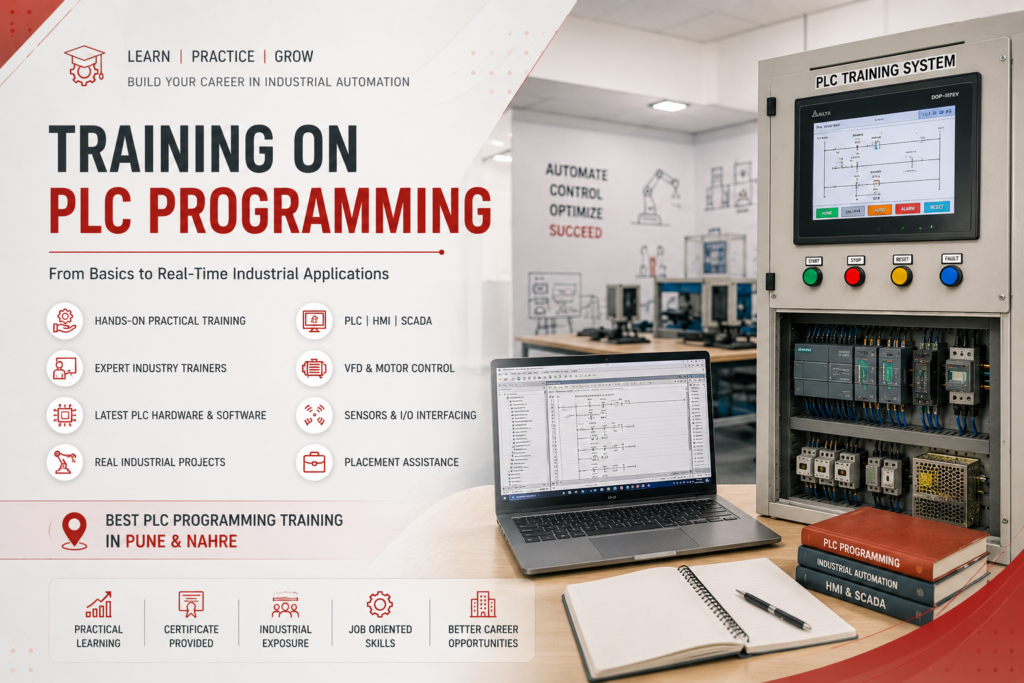
A major advantage of practical PLC training is working with actual industrial PLC platforms.
Depending on the training laboratory, learners may work with PLCs such as:
- Siemens
- Allen-Bradley
- Mitsubishi
- Delta
- Other commonly used industrial PLC platforms
The objective is not simply to memorize software commands. Students should understand the common PLC programming concepts that can be applied across different manufacturers.
HMI and PLC Integration
Modern machines generally require an operator interface. This is where an HMI (Human Machine Interface) becomes important.
During practical PLC training, students can learn how to connect an HMI with a PLC and create screens for:
- Start/stop control
- Motor status
- Machine parameters
- Production counters
- Alarm display
- Manual/auto operation
- Fault indication
- Setpoint entry
For example, an operator may select AUTO MODE from the HMI, enter a production quantity, and start the machine. The PLC then executes the programmed sequence while the HMI displays machine status and alarms.
PLC + VFD + Motor Automation
A practical automation course should also introduce VFD-based motor control.
Students can learn how to:
- Start and stop motors using PLC outputs
- Control motor direction
- Provide speed references
- Configure basic VFD parameters
- Interface PLC and VFD
- Implement motor interlocking
- Monitor faults
This creates a more realistic industrial automation project compared with PLC programming alone.
Sensors and Actuators
Machine automation depends heavily on field devices.
Practical training should introduce sensors such as:
- Proximity sensors
- Photoelectric sensors
- Limit switches
- Pressure sensors
- Level sensors
- Temperature sensors
Students should understand how these devices are connected to PLC inputs and how their signals are used within ladder logic.
Actuators may include:
- Motors
- Solenoid valves
- Pneumatic cylinders
- Contactors
- Relays
- VFDs
This gives learners a complete understanding of the relationship between PLC programming and physical machine operation.
Troubleshooting: A Critical PLC Skill
Knowing how to write a PLC program is only one part of industrial automation. Engineers and technicians also need to know how to troubleshoot machines.
Practical PLC training should therefore include real-world fault scenarios such as:
- Sensor not detecting a product
- Motor not starting
- PLC input not receiving a signal
- Output not activating
- Emergency-stop circuit fault
- Incorrect interlocking
- Communication failure
- VFD fault
- HMI communication problem
- Incorrect PLC addressing
Learners should practice identifying whether a problem originates from the field device, wiring, PLC program, communication network, or machine hardware.
Best PLC Programming Pune & Narhe
For students and working professionals searching for best PLC programming Pune or PLC programming classes in Narhe, the most important factor should be practical industrial exposure.
A good PLC programming Pune training program should provide hands-on practice rather than focusing exclusively on classroom theory.
For learners specifically looking for PLC training in Narhe, accessibility to a practical automation laboratory can be particularly useful because students can repeatedly practice PLC wiring, programming, HMI integration, VFD control, and troubleshooting.
When comparing best PLC programming Pune & Narhe options, consider:
- Availability of real PLC hardware
- Practical ladder programming sessions
- Industrial automation projects
- HMI and SCADA exposure
- VFD and motor-control practice
- Sensors and pneumatic systems
- PLC troubleshooting exercises
- Industrial communication training
- Experienced automation trainers
- Project-based learning
- Internship or industrial exposure
From Student Project to Industrial Automation
The ultimate objective of practical PLC training is to develop the ability to convert an automation requirement into a working control system.
A typical project development process can be:
Understand Machine → Prepare I/O List → Design Control Logic → Develop Ladder Program → Wire PLC → Configure HMI → Integrate VFD → Test Sequence → Troubleshoot → Commission Machine
This process closely resembles the workflow followed in real industrial automation projects.
Career Opportunities After PLC Training
Practical PLC knowledge can help learners prepare for roles such as:
- PLC Programmer
- Automation Engineer
- Control Engineer
- Commissioning Engineer
- Electrical Automation Engineer
- PLC-HMI Programmer
- SCADA Engineer
- Maintenance Engineer
- Industrial Automation Technician
- Application Engineer
Additional skills in SCADA, HMI, VFD, electrical control panels, instrumentation, pneumatics, robotics, and Industrial IoT can further strengthen an automation professional’s career profile.
Why Practical Learning Matters
PLC programming becomes much easier to understand when learners can immediately see the result of their logic on real hardware.
Writing a ladder program that turns ON a virtual output is useful. But connecting a sensor to a PLC, processing its signal, activating a motor or pneumatic actuator, displaying the status on an HMI, and then troubleshooting the system provides a much deeper understanding.
That is the difference between learning PLC programming and learning industrial automation practically.
Conclusion
Practical PLC training should take learners beyond basic ladder logic and prepare them to develop, test, troubleshoot, and commission real automation systems.
From PLC hardware and ladder programming to HMI, VFD, sensors, actuators, communication, and machine automation, each skill contributes to becoming a capable industrial automation professional.
Whether you are searching for best PLC programming Pune, PLC training in Pune, or PLC programming classes in Narhe, choose training that emphasizes hands-on PLC programming, real industrial hardware, machine automation projects, and troubleshooting.
The real goal is not simply to learn how to write ladder logic. It is to understand how ladder logic controls a complete machine.