Introduction
Predictive maintenance is an important application of industrial automation that helps industries identify potential equipment failures before they cause unexpected breakdowns. Instead of following only fixed maintenance schedules or repairing machines after failure, predictive maintenance uses equipment data, sensors, and performance trends to estimate when maintenance may be required.
By integrating industrial sensors, PLCs, SCADA systems, IIoT platforms, and data analytics, industries can monitor machine health, reduce unplanned downtime, and improve equipment reliability.
What Is Predictive Maintenance?
Predictive maintenance is a maintenance strategy that uses real-time measurements and historical equipment data to identify abnormal operating conditions and assess the risk of equipment failure.
For example, a motor may operate normally for several months, but a gradual increase in vibration or bearing temperature may indicate developing wear. A monitoring system can identify this change and alert the maintenance team to inspect the motor before a major breakdown occurs.
Predictive maintenance is commonly used for motors, pumps, compressors, conveyors, gearboxes, fans, and other critical industrial equipment.
How Predictive Maintenance Works in Industrial Automation
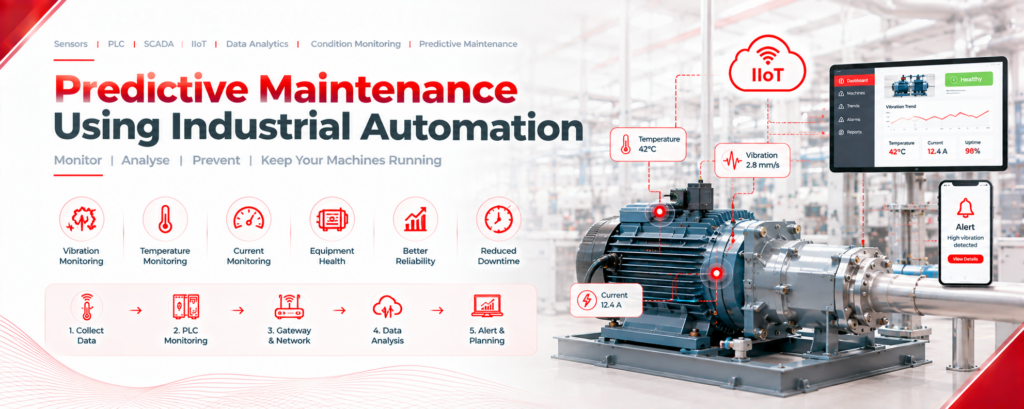
A predictive maintenance system collects equipment data, analyses changes in operating conditions, and provides alerts when maintenance may be necessary.
The typical process involves:
- Data Collection: Sensors measure vibration, temperature, pressure, current, speed, and other relevant parameters.
- PLC Monitoring: The PLC monitors operating conditions and executes control logic, alarms, and protective actions as configured.
- Data Transmission: Selected equipment data is transferred through an industrial network or gateway.
- Data Analysis: Monitoring software compares measurements with operating limits, historical trends, or analytical models.
- Fault Detection: Abnormal patterns indicate that an equipment inspection may be required.
- Maintenance Planning: The maintenance team investigates the alert and schedules the necessary inspection or repair.
The accuracy of predictions depends on sensor quality, suitable data, operating conditions, and the analytical method used.
Key Technologies Used in Predictive Maintenance
1. Industrial Sensors
Sensors provide the measurements required to assess machine health.
- Vibration Sensors: Help identify imbalance, misalignment, and certain bearing or mechanical problems.
- Temperature Sensors: Detect abnormal heating in motors, bearings, and other components.
- Current Sensors: Monitor electrical load patterns and changes in motor operation.
- Pressure Sensors: Help identify abnormal pressure conditions in pumps, compressors, and process systems.
- Flow Sensors: Monitor flow variations that may indicate process or equipment issues.
2. PLC and SCADA Integration
PLCs monitor machine conditions and control equipment according to programmed logic. SCADA systems display operating parameters, trends, alarms, and historical data.
This integration helps operators and maintenance teams identify abnormal readings and review equipment performance over time.
3. IIoT and Remote Monitoring
Industrial Internet of Things (IIoT) technologies connect equipment data to monitoring platforms. Authorised users can review machine conditions, receive notifications, and compare equipment performance across different production areas.
Remote monitoring can be especially useful for large plants or equipment installed in locations that are difficult to access.
4. Data Analytics and Machine Learning
Analytics tools can compare current readings with historical operating patterns. More advanced systems may use machine learning to identify complex patterns associated with specific failure modes.
These models require suitable training data and validation. They should support, rather than replace, engineering judgement and appropriate safety protections.
Practical Example: Predictive Maintenance for an Industrial Motor
Consider an industrial motor driving a conveyor in a manufacturing plant.
<box gap={3}> <row align=”start” gap={3}> <AsyncImage query=”industrial electric motor mounted on conveyor gearbox in manufacturing factory close up” aspectRatio=”4:3″ maxWidth=”120px” /> <box flex=”1″ gap={1}> **Step 1: Normal Operation**
  The motor runs within its expected operating range while the system records vibration, temperature, and current readings.
</box>
</row> <divider color=”subtle” /> <row align=”start” gap={3}> <AsyncImage query=”industrial vibration sensor mounted on electric motor bearing maintenance inspection” aspectRatio=”4:3″ maxWidth=”120px” /> <box flex=”1″ gap={1}> **Step 2: Abnormal Condition**
  Vibration gradually increases compared with the motor's normal baseline, indicating a possible mechanical issue that needs investigation.
</box>
</row> <divider color=”subtle” /> <row align=”start” gap={3}> <AsyncImage query=”industrial SCADA computer screen motor condition monitoring vibration temperature trend charts” aspectRatio=”4:3″ maxWidth=”120px” /> <box flex=”1″ gap={1}> **Step 3: Alert and Analysis**
  The monitoring system displays a warning, and the maintenance team checks the trend and operating conditions to determine the next action.
</box>
</row> <divider color=”subtle” /> <row align=”start” gap={3}> <AsyncImage query=”industrial maintenance technician inspecting electric motor bearing with handheld vibration analyzer factory” aspectRatio=”4:3″ maxWidth=”120px” /> <box flex=”1″ gap={1}> **Step 4: Planned Maintenance**
  Technicians inspect the motor, identify the cause, and carry out the required maintenance before the problem develops into a more serious failure, where conditions allow.
</box>
</row> </box>
This approach helps the plant respond to equipment condition rather than relying only on fixed maintenance intervals.
Applications Across Industries
1. Manufacturing and Automotive
Predictive maintenance can monitor motors, robotic equipment, conveyors, gearboxes, and production machinery. Early identification of developing faults can help reduce unexpected line stoppages.
2. Water and Wastewater Treatment
Pump vibration, motor temperature, operating current, and pressure trends can help maintenance teams identify potential issues in pumping systems.
3. Oil and Gas
Critical rotating equipment, compressors, and pumps can be monitored for abnormal vibration, temperature, and operating conditions. Monitoring strategies must suit the site’s safety and reliability requirements.
4. Food and Beverage Processing
Predictive maintenance can support monitoring of mixers, conveyors, refrigeration equipment, packaging machines, and production motors.
5. Pharmaceutical Manufacturing
Equipment monitoring can help maintenance teams assess the condition of motors, pumps, HVAC equipment, and selected process machinery while maintaining applicable documentation and quality requirements.
6. Power and Renewable Energy
Monitoring can support maintenance planning for motors, fans, pumps, generators, and selected solar plant equipment, depending on the system design and available data.
Benefits of Predictive Maintenance
- Reduced Unplanned Downtime: Helps identify developing equipment problems earlier.
- Improved Equipment Reliability: Supports condition-based maintenance decisions.
- Better Maintenance Planning: Allows teams to investigate issues and arrange suitable maintenance work.
- Lower Repair Costs: Early intervention may prevent some failures from becoming more expensive.
- Improved Equipment Life: Appropriate maintenance can reduce damage caused by undetected operating problems.
- Better Production Planning: Helps maintenance teams coordinate work with production schedules.
- Remote Equipment Monitoring: Enables authorised personnel to review equipment trends without always visiting the machine.
Results vary by equipment type, monitoring strategy, and the quality of implementation; predictive maintenance does not eliminate all failures.
Predictive Maintenance vs Preventive Maintenance
| Feature | Preventive Maintenance | Predictive Maintenance |
|---|---|---|
| Maintenance timing | Based on fixed intervals or usage | Based on equipment condition and data |
| Data requirements | May require limited monitoring data | Usually requires suitable sensor or operating data |
| Fault identification | May not detect every early-stage fault | Can identify abnormal trends when detectable |
| Planning | Scheduled in advance | Planned using condition information |
| Typical example | Replacing a filter every defined interval | Inspecting a motor after abnormal vibration is detected |
Both strategies can be used together. Critical equipment may also require routine inspections and manufacturer-recommended maintenance regardless of monitoring results.
Challenges in Predictive Maintenance
Successful implementation requires more than installing sensors. Common challenges include selecting suitable measurements, collecting reliable data, setting appropriate alarm thresholds, integrating older equipment, and training maintenance teams to interpret results.
Industrial networks and IIoT platforms must also be protected through appropriate cybersecurity controls. Predictive maintenance alerts should be integrated with established maintenance procedures, and safety-critical protection must remain independent where required by the system’s risk assessment.
Role of Industrial Automation in Predictive Maintenance
Industrial automation provides the foundation for collecting and using equipment data. PLCs, sensors, SCADA, VFDs, industrial communication systems, and IIoT platforms can work together to monitor machine operation and support maintenance decisions.
For example, a VFD may provide motor current, speed, and fault information, while an external vibration sensor measures mechanical behaviour. Combining these sources can give maintenance teams a more complete view of equipment condition.
A properly designed system can connect machine-level monitoring with plant-wide reporting and maintenance workflows.
Conclusion
Predictive maintenance using industrial automation helps industries move towards data-driven equipment maintenance. By monitoring parameters such as vibration, temperature, current, pressure, and flow, organisations can identify potential problems earlier and plan inspections more effectively.
Integrating PLC, SCADA, IIoT, sensors, and data analytics supports improved equipment visibility and more informed maintenance decisions. For reliable implementation, industries should select appropriate monitoring technologies, establish normal operating baselines, and connect alerts to practical maintenance procedures.
Automate Engineering works with industrial automation technologies, PLC and SCADA integration, instrumentation, VFD applications, and control panel solutions that can support equipment monitoring and industrial process automation.
SEO Keywords
Predictive Maintenance Using Industrial Automation, Industrial Predictive Maintenance, Predictive Maintenance Systems, PLC and SCADA Integration, IIoT-Based Monitoring, Machine Condition Monitoring, Vibration Monitoring, Industrial Sensors, Motor Predictive Maintenance, Equipment Health Monitoring, Industrial Automation Solutions, Smart Manufacturing, Industry 4.0, Industrial Automation System Integrator in Pune, Best Automation Company in Narhe.
#PredictiveMaintenance #IndustrialAutomation #ConditionMonitoring #IIoT #PLCAutomation #SCADA #MachineMonitoring #IndustrialSensors #PreventiveMaintenance #SmartManufacturing #Industry40 #MotorMonitoring #PuneAutomation