Manufacturing industries are moving from traditional manual operations toward connected and automated production systems to improve productivity, product quality, safety, and process consistency. Production line automation helps manufacturers coordinate machines, conveyors, sensors, motors, robots, and control systems so that production activities can be performed with less manual intervention.
A modern automated production line can combine PLC automation, HMI, SCADA, VFDs, servo motors, industrial sensors, robotics, and control panels to create a complete manufacturing solution. This approach is suitable for industries such as automotive, food and beverage, pharmaceuticals, chemicals, packaging, electronics, and general manufacturing.
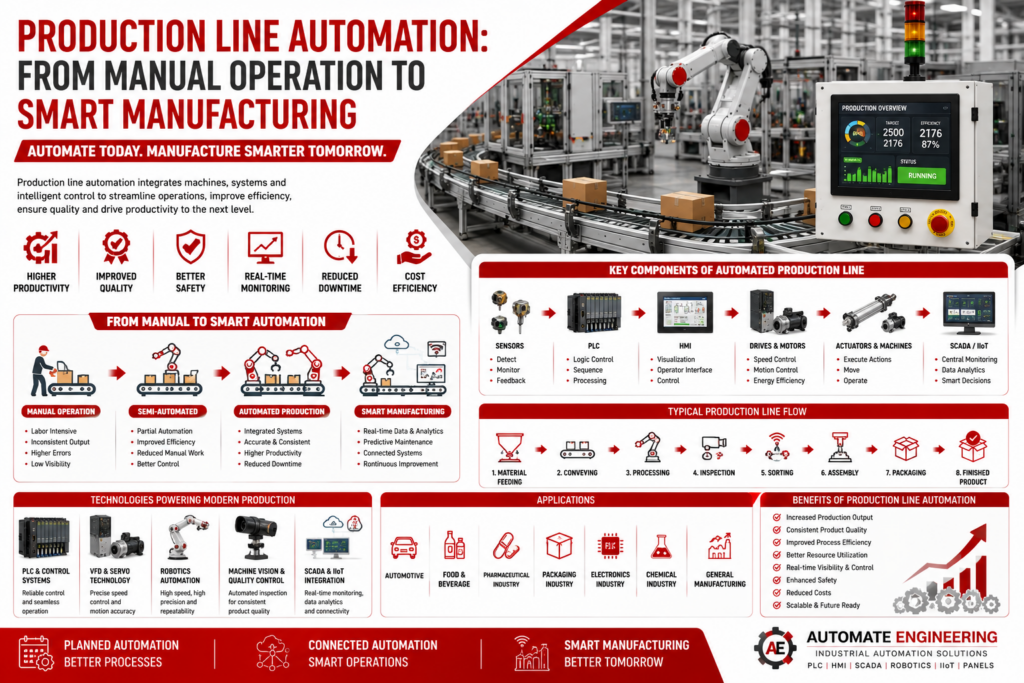
From Manual Operation to Automated Production
In a conventional production line, operators may be required to manually transfer materials, operate machines, inspect products, record production quantities, and coordinate different stages of manufacturing. This can result in inconsistent production speeds, operator dependency, material handling errors, and limited process visibility.
With industrial automation, these repetitive operations can be controlled automatically.
A typical automated production flow can be:
Material Feeding → Conveyor Movement → Processing → Inspection → Sorting → Assembly → Packaging → Finished Product
PLC programming controls the sequence while sensors provide real-time information about the position and condition of products.
PLC-Based Production Line Automation
A PLC-based production line automation system acts as the central control system for coordinating different machines and processes. Sensors send signals to the PLC, and the PLC executes the programmed logic to control motors, VFDs, servo drives, pneumatic cylinders, valves, and other equipment.
For example, a photoelectric sensor can detect a product arriving at a workstation. The PLC can stop the conveyor, activate an assembly mechanism, wait for a completion signal, and then restart the conveyor automatically.
PLC programming for industrial automation can include:
- Sequential machine operation
- Conveyor control
- Product counting
- Sensor-based operation
- Motor control
- VFD speed control
- Servo positioning
- Timers and counters
- Machine interlocking
- Fault detection
- Automatic/manual modes
- Safety logic
For manufacturers searching for PLC programming services in Pune, customized PLC logic can be developed according to the production sequence and machine requirements.
Conveyor and Material Handling Automation
Conveyors are an important part of automated production lines. Conveyor automation using PLC and VFD allows products to be transported between different production stages at controlled speeds.
Sensors can detect product presence, while VFDs can adjust conveyor speed according to production requirements. Multiple conveyors can also be synchronized using PLC logic.
This type of material handling automation can reduce manual product movement and improve the flow of materials throughout the production line.
Inspection and Quality Control
Automation can also improve product inspection by integrating sensors, cameras, measuring devices, and other inspection equipment into the production line.
A PLC can receive an OK/NG signal from an inspection system and automatically control a sorting mechanism. Defective products can be diverted without stopping the entire production process.
This creates a more consistent approach to automated quality inspection and reduces dependency on manual inspection for repetitive checks.
HMI for Production Line Monitoring
An HMI for industrial automation provides operators with a visual interface for monitoring the production line.
An HMI can display:
- Production quantity
- Machine status
- Conveyor status
- Product count
- Motor speed
- Fault conditions
- Alarm messages
- Cycle time
- Production parameters
Operators can also control individual machines, select operating modes, acknowledge alarms, and monitor the overall production sequence.
SCADA and Smart Manufacturing
For larger production facilities, SCADA integration with PLC automation can provide centralized monitoring of multiple machines and production lines.
SCADA systems can collect production data and provide information about:
- Machine performance
- Production output
- Downtime
- Alarms
- Energy consumption
- Process parameters
- Historical trends
This information becomes particularly valuable when implementing smart manufacturing automation and Industry 4.0 automation solutions.
Instead of simply automating a machine, manufacturers can connect multiple machines and use production data to understand how the entire manufacturing process is performing.
VFD and Servo Automation
Different production-line applications require different motion-control technologies.
VFD-based motor automation is commonly used for conveyors, pumps, fans, and applications where variable motor speed is required.
For applications requiring high-speed and precise positioning, servo motor automation can be used. Servo systems are suitable for pick-and-place machines, packaging equipment, cutting systems, assembly machines, and other high-precision applications.
The integration of PLC, VFD and servo systems allows different sections of a production line to operate in a coordinated manner.
Industrial Control Panels
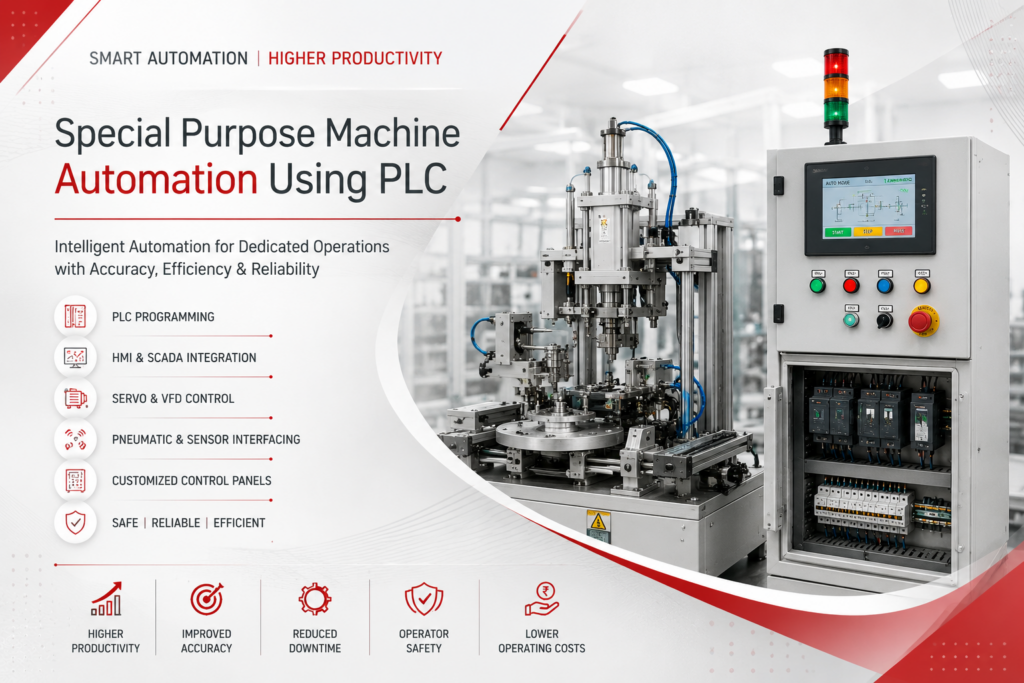
The electrical and automation components of a production line are generally organized through industrial control panels. A typical PLC control panel may contain PLCs, I/O modules, VFDs, servo drives, circuit protection, contactors, power supplies, relays, communication modules, and safety components.
Professional industrial control panel design and manufacturing helps ensure organized wiring, proper component selection, electrical safety, easier troubleshooting, and reliable machine operation.
Manufacturers searching for a PLC control panel manufacturer in Pune or a VFD panel manufacturer in Pune can implement customized panels according to the machine and production-line requirements.
Benefits of Production Line Automation
Moving from manual operation to automated production can provide several benefits:
- Higher production efficiency
- Consistent production cycles
- Reduced manual intervention
- Improved product quality
- Better material handling
- Reduced operator errors
- Improved workplace safety
- Real-time production monitoring
- Faster fault identification
- Better production data
- Reduced production downtime
- Improved scalability
The exact benefits depend on the application, production volume, machine design, and level of automation implemented.
From Automation to Smart Manufacturing
The next stage of production-line development is smart manufacturing. Instead of isolated automated machines, connected machines can share information through industrial communication networks.
Sensors, PLCs, HMIs, SCADA, robotics, VFDs, servo drives, and IIoT devices can work together to create a connected manufacturing environment.
For example, production data from a PLC can be collected by SCADA, analyzed for downtime trends, and used to identify potential improvements in the manufacturing process.
This creates a pathway from basic machine automation solutions toward complete smart manufacturing automation.
Production Line Automation Solutions in Pune
Manufacturers looking for industrial automation solutions in Pune can implement automation at different levels—from automating a single machine to developing a complete production line.
An industrial automation system integrator in Pune can bring together PLC programming, HMI development, SCADA integration, VFD and servo control, sensor integration, robotics, industrial networking, control panel design, and machine safety into one coordinated system.
For businesses searching for the best automation company in Narhe, production-line automation can provide a practical way to modernize existing manufacturing processes and move toward more connected and efficient production.
Whether the requirement is conveyor automation, automated assembly, inspection, packaging, material handling, or complete factory automation, the transition from manual operation to smart manufacturing begins by identifying repetitive processes and designing the right level of automation around them.
From manual movement to automated control. From isolated machines to connected production. From traditional manufacturing to smart manufacturing.