Industrial automation is transforming manufacturing plants by making machines smarter, processes faster, and production more efficient. For students and beginners entering the automation industry, learning SCADA (Supervisory Control and Data Acquisition) through practical projects is one of the best ways to understand industrial monitoring and control.
SCADA works closely with PLC, HMI, sensors, VFDs, industrial communication networks, and field devices. If you are planning a career in industrial automation, working on small SCADA projects can help you develop practical skills that are useful in real manufacturing environments.
For students searching for best PLC programming Pune, combining PLC programming with SCADA training can provide a stronger understanding of complete industrial automation systems.
What Is SCADA?
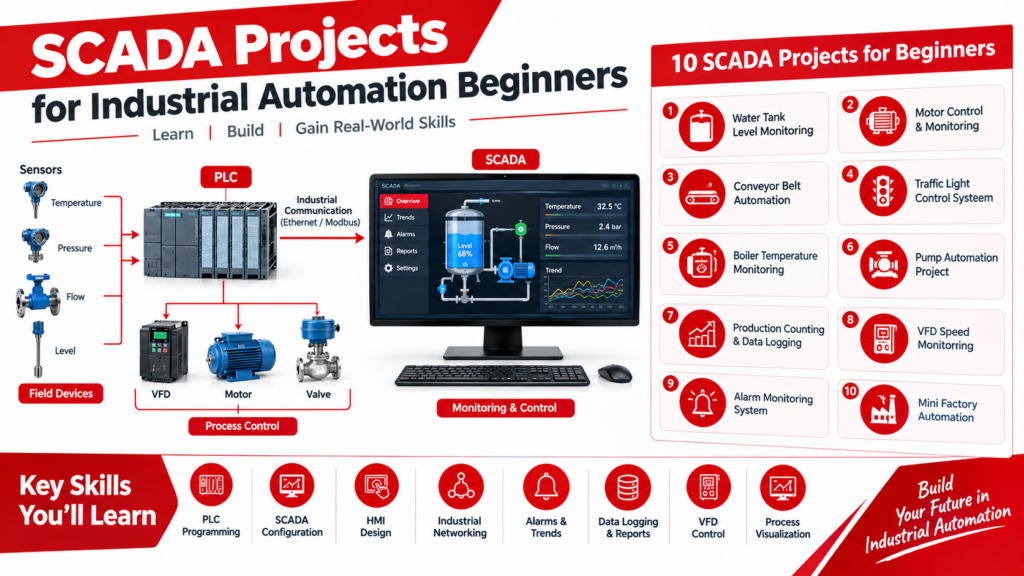
SCADA is a software-based industrial automation system used to monitor, control, and collect data from machines and processes.
A typical SCADA system consists of:
- PLC
- SCADA software
- HMI
- Sensors and transmitters
- VFDs
- Industrial communication networks
- Motors and actuators
- Industrial PCs or servers
- Data logging and alarm systems
The PLC collects information from field devices and controls the process. SCADA receives this information and presents it to operators through graphical screens.
For example, an operator can monitor:
- Motor ON/OFF status
- Tank level
- Temperature
- Pressure
- Flow
- Production count
- VFD speed
- Machine alarms
Why Beginners Should Work on SCADA Projects
Simply learning SCADA software is not enough for an industrial automation career. Beginners should understand how SCADA communicates with PLCs and how real industrial processes are represented on graphical screens.
Project-based learning helps you understand:
- PLC-SCADA communication
- Tag creation
- Digital and analog signals
- Alarm configuration
- Data logging
- Trends and graphs
- User management
- Process visualization
- Industrial networking
- Basic troubleshooting
These skills are particularly useful for students attending PLC and SCADA training in Pune and those preparing for automation engineering jobs.
10 SCADA Projects for Beginners
1. Water Tank Level Monitoring Project
A water tank monitoring system is one of the simplest SCADA projects for beginners.
The project can include:
- Water level sensors
- PLC
- Pump motor
- SCADA screen
- High-level and low-level alarms
The SCADA screen can display the tank level graphically.
SCADA Features
You can create:
- Tank level indication
- Pump ON/OFF status
- High-level alarm
- Low-level alarm
- Auto/manual mode
- Level trend
This project teaches the basics of PLC-SCADA communication and process visualization.
2. Motor Control and Monitoring Project
Motor control is an important part of industrial automation.
A beginner project can include a motor controlled through PLC and monitored through SCADA.
The SCADA screen can provide:
- Start command
- Stop command
- Motor running indication
- Fault indication
- Running hours
- Speed monitoring
If a VFD is used, you can also display:
- Motor frequency
- Motor speed
- Current
- Fault status
This project provides practical experience with PLC, SCADA and VFD automation.
3. Conveyor Belt Automation Project
Conveyor systems are widely used in manufacturing, packaging, logistics, and material-handling applications.
A basic SCADA conveyor project can include:
- Start button
- Stop button
- Conveyor motor
- Object sensor
- Counter
- Emergency stop
- SCADA monitoring screen
The SCADA screen can display the conveyor status and production count.
Beginner Learning Outcomes
You can learn:
- Digital I/O
- PLC logic
- Object detection
- Counter programming
- Motor control
- Alarm handling
- SCADA animation
4. Traffic Light Control System
A traffic light project is another simple project for understanding PLC sequencing and SCADA visualization.
The PLC controls:
- Red light
- Yellow light
- Green light
SCADA can display the complete sequence using animated indicators.
You can also add:
- Countdown timer
- Manual/automatic mode
- Emergency mode
- Fault indication
This project helps beginners understand timers, sequences, PLC programming and SCADA graphics.
5. Boiler Temperature Monitoring
Temperature monitoring is common in process industries.
A basic project can use:
- Temperature sensor
- PLC analog input
- Heater
- Temperature controller
- SCADA system
The SCADA screen can display the current temperature along with a temperature trend.
Useful SCADA Functions
- Real-time temperature display
- High-temperature alarm
- Low-temperature alarm
- Setpoint adjustment
- Historical trend
- Data logging
This type of project introduces beginners to analog signals and process monitoring.
6. Pump Automation Project
Pump automation is commonly used in water treatment, chemical plants, food processing, and other industries.
A basic system can include two pumps:
- Pump 1
- Pump 2
- Level sensor
- Pressure sensor
- PLC
- SCADA
The PLC can automatically control the pumps based on tank level or pressure.
SCADA can show:
- Pump status
- Tank level
- Pressure
- Auto/manual mode
- Pump fault
- Runtime
You can also implement lead-lag pump control, which makes the project more closely related to industrial applications.
7. Production Counter and Monitoring System
Production monitoring is an excellent beginner SCADA project.
A sensor detects every product passing through a conveyor.
The PLC counts the products and sends the value to SCADA.
The SCADA screen can display:
- Current production
- Target production
- Remaining quantity
- Production rate
- Shift production
- Machine status
A trend can also be created to visualize production performance over time.
This project introduces beginners to industrial data acquisition and production monitoring.
8. VFD Speed Monitoring Project
VFDs are widely used to control motor speed.
In this project, the PLC communicates with the VFD through a suitable communication protocol.
SCADA can display:
- Frequency
- Motor speed
- Current
- Voltage
- Motor status
- VFD fault
- Speed setpoint
You can also create a SCADA control screen where an authorized operator can change the speed reference.
This is particularly useful for students learning PLC programming, VFD control, HMI and SCADA together.
9. Industrial Alarm Monitoring System
Alarm management is an important SCADA function.
A beginner can create a project where different machine conditions generate alarms.
Examples include:
- Motor overload
- High temperature
- Low tank level
- High pressure
- Sensor failure
- Emergency stop
- Communication failure
The SCADA alarm window can display:
- Alarm description
- Date and time
- Alarm status
- Acknowledgement status
Learning alarm configuration gives beginners a better understanding of how operators interact with industrial automation systems.
10. Mini Factory Automation Project
Once you understand individual projects, combine several processes into one mini factory automation system.
For example:
Raw Material → Conveyor → Processing Tank → Pump → Filling → Production Counter
The PLC controls the complete process while SCADA provides centralized monitoring.
The SCADA system can include:
Main Overview Screen
Shows the complete plant process.
Motor Screen
Displays motor and VFD status.
Tank Screen
Displays level, temperature and pump status.
Alarm Screen
Displays active and historical alarms.
Trend Screen
Displays process values over time.
Production Screen
Displays production quantity and machine performance.
This type of project gives beginners an introduction to plant-level SCADA architecture.
SCADA Skills Beginners Should Learn
While developing these projects, beginners should focus on the following skills.
1. SCADA Graphics
Learn how to create professional process screens using:
- Motors
- Pumps
- Valves
- Tanks
- Conveyors
- Indicators
- Buttons
- Numerical displays
2. Tag Management
Understand the relationship between:
PLC Address → Communication Tag → SCADA Tag → Graphic Object
This is one of the most important concepts in SCADA.
3. PLC-SCADA Communication
Learn industrial communication protocols such as:
- Modbus TCP
- Modbus RTU
- Ethernet/IP
- PROFINET
- OPC UA
The exact protocol depends on the PLC, SCADA platform, and system architecture.
4. Alarms
Learn how to configure:
- High alarms
- Low alarms
- Fault alarms
- Communication alarms
- Alarm acknowledgement
- Alarm history
5. Trends
Trends help operators understand how process values change over time.
For example:
Temperature vs Time
Pressure vs Time
Tank Level vs Time
Production vs Time
6. Data Logging
SCADA can store process information in databases or historical systems.
Beginners should understand:
- Historical data
- Sampling intervals
- Reports
- Production data
- Event logging
PLC + HMI + SCADA: What Should Beginners Learn First?
A common question among beginners is whether they should learn PLC, HMI, or SCADA first.
A practical learning sequence is:
Electrical Basics → PLC Programming → HMI → SCADA → Industrial Communication → VFD → Advanced Automation
Learning PLC first makes SCADA easier because you understand where the data comes from.
For students looking for the best PLC programming Pune training options, selecting a course that includes PLC, HMI, SCADA, VFD and practical industrial projects can be more valuable than learning SCADA software alone.
Why Practical Training Matters
Industrial automation is a practical field. Watching SCADA tutorials can help you understand software functions, but working with an actual PLC and automation hardware provides much deeper experience.
A good practical training setup should include:
- PLC
- HMI
- SCADA computer
- VFD
- Sensors
- Motors
- Industrial communication
- Control panel
- Real-time troubleshooting
Students in Nahre and nearby Pune areas can benefit from hands-on industrial automation training where they can work on PLC-SCADA projects and understand how automation systems are implemented.
Career Opportunities After Learning SCADA
SCADA knowledge can support career opportunities such as:
- Automation Engineer
- PLC Programmer
- SCADA Engineer
- Control Engineer
- Electrical Automation Engineer
- Commissioning Engineer
- Maintenance Automation Engineer
- Instrumentation Engineer
- Industrial IoT Engineer
Combining SCADA with PLC programming, electrical control panels, VFDs, HMI and industrial communication can make your technical profile stronger.
Final Thoughts
SCADA projects are an excellent way for beginners to move from theoretical automation concepts to practical industrial applications.
Start with simple projects such as water tank monitoring, motor control and conveyor automation. Then gradually move toward VFD control, alarm management, production monitoring and complete mini-factory SCADA systems.
If your goal is to become an industrial automation professional, don’t learn SCADA in isolation. Build your skills across PLC programming + HMI + SCADA + VFD + industrial communication and practice on real-world automation projects.
For students searching for best PLC programming Pune, practical project-based training can provide the foundation needed to work confidently with industrial automation systems.