Modern manufacturing machines require accurate, fast, and reliable motion control. Servo motors are widely used in industrial automation applications where precise position, speed, acceleration, and motion control are required. Servo systems combine a motor, feedback device such as an encoder, servo drive, and controller to achieve accurate movement.
For students, technicians, electrical engineers, maintenance professionals, and automation engineers, practical Servo Motor Training for Industrial Automation can provide valuable knowledge of PLC-based motion control and industrial servo applications.
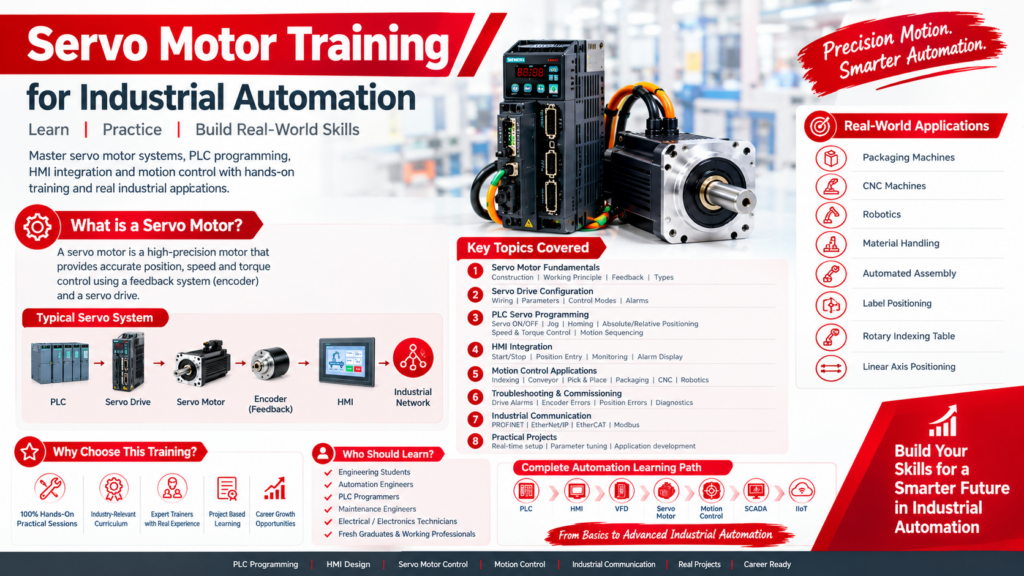
What is a Servo Motor?
A servo motor is a motor used for precise motion control. Unlike a conventional motor application where only speed may be controlled, a servo system can be used for accurate positioning and coordinated motion.
A typical industrial servo system consists of:
- Servo motor
- Servo drive or servo amplifier
- Encoder or feedback device
- PLC or motion controller
- HMI
- Industrial communication network
- Mechanical transmission or linear axis
The feedback device continuously provides information about motor movement to the control system, allowing the servo system to perform accurate motion control.
Why Servo Motor Training is Important
Servo technology is commonly associated with applications such as packaging, robotics, CNC machines, automated assembly, material handling, indexing, and precision manufacturing.
Practical training helps learners understand the complete process from servo wiring and drive configuration to PLC programming, positioning, commissioning, and troubleshooting.
A hands-on training setup can also demonstrate position, velocity, and torque control concepts and feedback-based motion control.
Servo Motor and PLC Programming
One of the most important parts of industrial servo training is understanding how a PLC communicates with and controls a servo drive.
Depending on the PLC and servo system, communication and motion commands can be implemented using methods such as:
- Pulse and Direction
- Analog control
- PROFINET
- EtherNet/IP
- EtherCAT
- Other industrial motion-control networks
Modern PLC platforms can provide dedicated motion-control functions for servo applications. Mitsubishi’s positioning training, for example, covers PLC-based parameterisation, absolute and relative positioning, home return, programming, monitoring, and troubleshooting.
Important Topics Covered in Servo Motor Training
A practical Servo Motor Training Course can include the following modules:
1. Servo Motor Fundamentals
Students learn:
- Servo motor construction
- Servo motor working principle
- Encoder feedback
- Servo motor vs induction motor
- Servo motor vs stepper motor
- Servo drive fundamentals
- Position, speed, and torque control
2. Servo Drive Configuration
Training can include:
- Servo drive wiring
- Motor and encoder connections
- Drive parameter settings
- Control mode selection
- Acceleration and deceleration settings
- Electronic gearing
- Alarm and fault parameters
- Servo enable and reset
3. PLC Servo Programming
Learners can develop PLC programs for:
- Servo ON/OFF
- Jog operation
- Homing
- Absolute positioning
- Relative positioning
- Speed control
- Acceleration/deceleration
- Position presets
- Motion sequencing
- Servo alarm handling
PLC-based servo training commonly includes absolute and relative positioning as well as home-return operations.
4. HMI Integration
The HMI can be used to create an operator interface for:
- Servo start/stop
- Jog Forward/Reverse
- Position entry
- Speed setting
- Acceleration/deceleration setting
- Home command
- Actual position monitoring
- Servo status
- Alarm display
This gives learners practical experience in integrating PLC + HMI + Servo Drive + Servo Motor.
5. Motion Control Applications
Training projects can include:
- Indexing system
- Conveyor positioning
- Pick-and-place mechanism
- Linear-axis positioning
- Packaging machine simulation
- Automated cutting
- Label positioning
- Assembly machine
- Rotary indexing table
Servo positioning systems are particularly useful when an application requires controlled movement between predefined positions.
Practical Servo Motor Training
The best way to understand servo technology is through practical implementation rather than only theoretical learning.
A training setup can include an industrial servo motor, servo drive, PLC, HMI, encoder feedback and mechanical positioning mechanism. Such integrated training platforms are used to teach servo programming, tuning, feedback, PLC-HMI integration and industrial motion control.
A typical practical project can follow this sequence:
PLC → Servo Drive → Servo Motor → Mechanical Axis → Encoder Feedback → PLC
Students can then develop a complete motion-control application and test different positioning commands.
Servo Motor Training with PLC and HMI
Combining PLC programming with servo motor control gives learners experience that is directly related to industrial automation.
For example, an operator can enter a target position through the HMI. The PLC processes the command and sends the required motion command to the servo system. The servo drive controls the motor while encoder feedback provides information about the actual movement.
This type of PLC-HMI-servo integration is commonly used for practical motion-control training.
Servo Motor Troubleshooting
Servo training should also include troubleshooting because industrial automation engineers frequently need to identify motion-related problems.
Important troubleshooting areas include:
- Servo drive alarms
- Encoder errors
- Position errors
- Incorrect parameter settings
- Servo overloading
- Excessive vibration
- Incorrect homing
- Wrong direction of rotation
- Communication errors
- Incorrect acceleration/deceleration
- Mechanical backlash
Learning commissioning and diagnostics is an important part of practical servo training.
Servo Motor Training in Industrial Automation
For students and working professionals looking for industrial automation training, servo motor programming is an important advanced topic after learning basic PLC and HMI programming.
A structured learning path can be:
Electrical Basics → PLC Programming → HMI Programming → VFD → Servo Motor → Motion Control → SCADA → IIoT → Industrial Automation Projects
This approach helps learners progress from basic control systems to advanced motion-control applications.
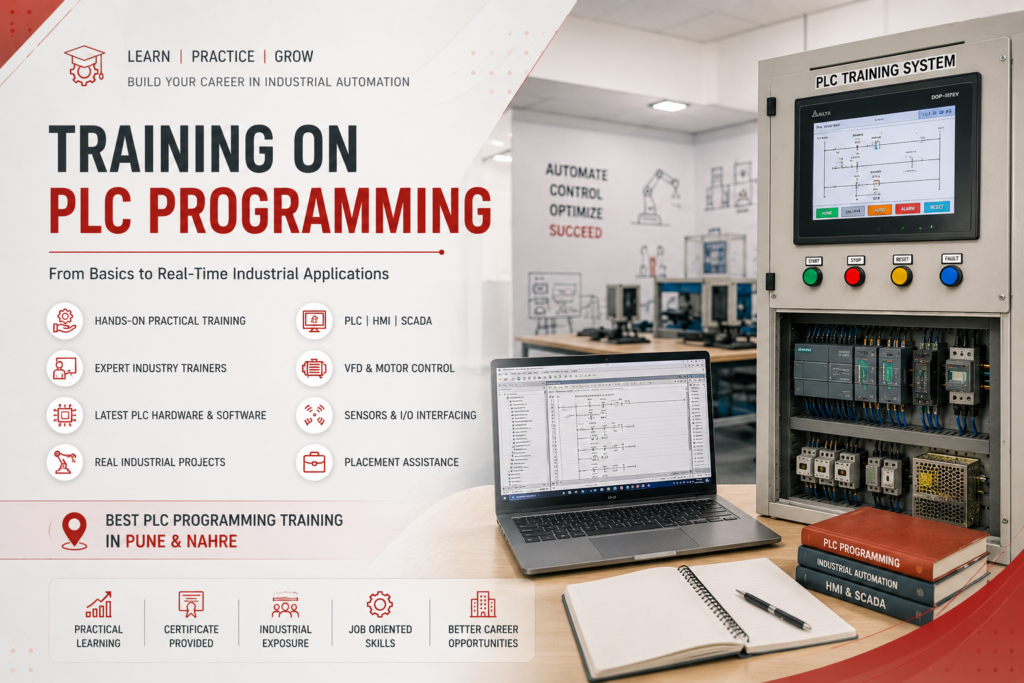
Best PLC Programming Pune & Nahre
For learners searching for best plc programming pune & nahre, practical industrial automation training should include more than basic ladder logic.
A complete training program can combine:
PLC Programming + HMI + VFD + Servo Motor + SCADA + Industrial Communication + IIoT + Practical Projects
Learning servo motor programming alongside PLC programming gives students and engineers exposure to advanced industrial automation and motion-control applications.
Who Should Learn Servo Motor Programming?
Servo motor training is useful for:
- Electrical Engineering students
- Electronics and Telecommunication students
- Mechanical Engineering students
- Mechatronics students
- Automation engineers
- PLC programmers
- Maintenance engineers
- Industrial electricians
- Technicians
- Fresh engineering graduates
- Working professionals
Basic PLC knowledge is generally helpful before starting advanced PLC-based servo programming.
Career Opportunities
Knowledge of servo systems can support careers involving:
- PLC Programming
- Industrial Automation
- Motion Control
- Machine Automation
- Robotics
- Packaging Automation
- CNC Automation
- Electrical Maintenance
- Automation Commissioning
- Control Panel Engineering
- Machine Building
Conclusion
Servo Motor Training for Industrial Automation provides practical knowledge of motion control, servo drives, feedback systems, PLC programming, HMI integration, positioning and troubleshooting.
By combining theoretical concepts with hands-on projects, learners can understand how servo systems are integrated into real industrial machines. For anyone searching for best plc programming pune & nahre, adding practical servo motor and motion-control training to PLC education can provide a broader understanding of modern industrial automation.
SEO Keywords
Servo Motor Training, Servo Motor Training Pune, Servo Motor Programming, Servo Drive Training, PLC Servo Programming, Servo Motor Control Using PLC, Industrial Automation Training, Motion Control Training, PLC Programming Training, HMI Training, Servo Positioning, PLC Motion Control, Industrial Automation Course, Servo Drive Programming, PLC HMI Servo Integration, best plc programming pune & nahre, PLC Programming Pune, PLC Training Pune, Industrial Automation Training Pune, Automation Training Narhe, PLC Training Narhe, Servo Training Pune, Motion Control Pune.
#ServoMotorTraining #ServoProgramming #PLCProgramming #IndustrialAutomation #MotionControl #ServoDrive #PLCTraining #AutomationTraining #HMIProgramming #PuneAutomation