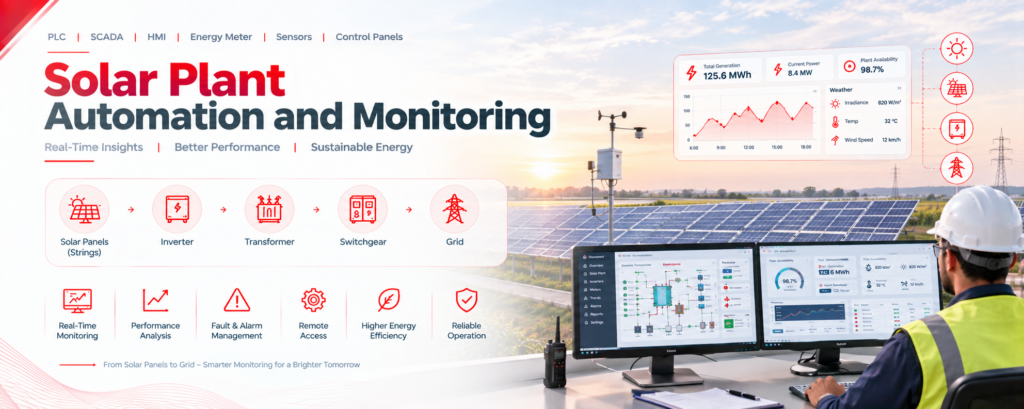
Solar power plants require continuous monitoring and coordinated control to achieve reliable energy generation. From solar panels and string monitoring to inverters, transformers, weather stations, and grid connection systems, automation plays an important role in managing plant performance.
Solar Plant Automation and Monitoring uses technologies such as PLC, SCADA, HMI, industrial communication, sensors, energy meters, control panels, and remote monitoring systems to collect real-time data and improve operational visibility.
What is Solar Plant Automation?
Solar plant automation refers to the use of automation and monitoring systems to supervise and manage different equipment in a solar power plant.
A typical solar plant monitoring architecture can be represented as:
Solar Panels → String Monitoring → Inverter → Transformer → Switchgear → Grid
Automation systems collect information from field equipment and make it available through HMI, SCADA, or centralized monitoring platforms.
Role of PLC in Solar Plant Automation
A PLC (Programmable Logic Controller) can be used for controlling auxiliary equipment and monitoring plant processes.
PLC applications include:
- Equipment start/stop control
- Motor control
- Cooling system control
- Tracker control
- Pump control
- Auxiliary system monitoring
- Interlocking
- Alarm generation
- Digital and analog signal monitoring
- Automatic equipment sequencing
PLC systems can communicate with field instruments, energy meters, VFDs, remote I/O, and other industrial devices.
SCADA for Solar Plant Monitoring
SCADA (Supervisory Control and Data Acquisition) is an important technology for centralized solar plant monitoring.
SCADA can display:
- Solar power generation
- Inverter status
- DC and AC voltage
- DC and AC current
- Energy generation
- Frequency
- Grid parameters
- Transformer status
- Weather data
- Equipment alarms
- Communication status
SCADA systems can also provide:
- Real-time monitoring
- Historical data logging
- Trend analysis
- Alarm management
- Energy reports
- Equipment status
- Performance monitoring
- Remote monitoring
HMI in Solar Automation
An HMI (Human Machine Interface) provides operators with a local interface for monitoring and controlling solar plant equipment.
HMI screens can display:
- Equipment status
- Motor status
- Inverter information
- Temperature
- Voltage
- Current
- Power
- Energy
- Faults
- Alarms
Operators can use HMI systems to monitor plant conditions and access suitable control functions.
Inverter Monitoring and Automation
Solar inverters convert DC power generated by solar panels into AC power suitable for electrical distribution.
Automation and monitoring systems can collect inverter information such as:
- DC input voltage
- DC input current
- AC output voltage
- AC output current
- Active power
- Reactive power
- Frequency
- Energy generation
- Inverter temperature
- Fault conditions
Monitoring multiple inverters through SCADA provides centralized visibility of plant performance.
Solar String Monitoring
In large solar plants, multiple PV strings are connected to combiner boxes and inverter systems.
String monitoring can help identify:
- Low current
- String failure
- Abnormal voltage
- Fuse failure
- Open circuits
- Performance differences between strings
This helps maintenance teams identify underperforming sections of the solar array.
Weather Monitoring System
Weather conditions directly influence solar power generation.
A solar plant weather monitoring system can measure:
| Parameter | Typical Instrument |
|---|---|
| Solar Irradiance | Pyranometer |
| Temperature | Temperature Sensor |
| Wind Speed | Anemometer |
| Wind Direction | Wind Vane |
| Humidity | Humidity Sensor |
| Module Temperature | Temperature Sensor |
This information can be integrated into the SCADA system for plant performance analysis.
Solar Tracker Automation
Some solar power plants use tracking systems to adjust the position of solar panels according to the sun’s movement.
Tracker automation can control:
- Tracker motors
- Panel positioning
- Position feedback
- Limit switches
- Tracking sequences
- Fault conditions
PLC-based control and position feedback can help coordinate tracker movement while maintaining suitable operating limits.
VFD Automation in Solar Plants
Although the main power conversion is handled by solar inverters, VFDs can be used for auxiliary motors and equipment.
Typical applications include:
- Cooling fans
- Water pumps
- Ventilation systems
- HVAC systems
- Cleaning systems
- Material handling equipment
VFDs provide controlled motor operation according to equipment requirements.
Energy Metering and Monitoring
Energy meters provide important information for evaluating solar plant performance.
Monitoring systems can collect:
- Voltage
- Current
- Active power
- Reactive power
- Power factor
- Frequency
- Daily energy
- Monthly energy
- Total energy generation
This data can be displayed through SCADA dashboards and used for energy reporting and performance analysis.
Solar Plant Control Panels
Automation control panels provide the interface between field equipment and the control system.
A solar plant control panel may include:
- PLC
- Remote I/O
- HMI
- Communication modules
- Power supplies
- MCB/MCCB
- Relays
- Terminal blocks
- Industrial Ethernet switches
- Control components
Proper control panel design and manufacturing helps organize automation equipment and simplify maintenance.
Alarm and Fault Monitoring
Solar plant automation systems can generate alarms for abnormal operating conditions.
Common alarms include:
- Inverter fault
- Communication failure
- High temperature
- Low generation
- Overvoltage
- Undervoltage
- Overcurrent
- Transformer fault
- Grid failure
- Equipment communication loss
SCADA alarm management helps operators identify abnormal conditions quickly.
Benefits of Solar Plant Automation and Monitoring
Solar automation can provide:
- Real-time plant monitoring
- Centralized equipment visibility
- Faster fault detection
- Energy generation monitoring
- Inverter performance tracking
- Weather data monitoring
- Historical data analysis
- Automated reporting
- Remote monitoring
- Better maintenance planning
- Improved operational efficiency
Industry 4.0 and IIoT in Solar Power Plants
Modern solar plants can integrate Industry 4.0 and IIoT technologies with PLC and SCADA systems.
A typical architecture can be represented as:
Sensors & Meters → PLC / RTU → SCADA → Industrial Network → Data Collection → Analytics & Reporting
IIoT-based solar monitoring can support:
- Remote plant monitoring
- Performance analysis
- Energy dashboards
- Equipment condition monitoring
- Predictive maintenance
- Fault analysis
- Historical trend analysis
- Centralized reporting
Solar Plant Monitoring Dashboard
A centralized monitoring dashboard can provide operators with a complete overview of plant performance.
Important dashboard parameters can include:
- Total power generation
- Inverter-wise generation
- Energy generated today
- Energy generated this month
- Plant availability
- Weather conditions
- Equipment status
- Active alarms
- Grid parameters
- Historical trends
This allows maintenance and operations teams to identify performance issues more quickly.
Conclusion
Solar Plant Automation and Monitoring combines PLC, SCADA, HMI, energy meters, sensors, industrial communication, control panels, and monitoring systems to improve visibility and management of solar power generation.
From solar panels and string monitoring to inverters, weather stations, transformers, and grid systems, automation helps operators monitor plant conditions, identify faults, analyze energy generation, and manage equipment more effectively.
For companies looking for an Industrial Automation System Integrator in Pune, solutions involving PLC Programming, SCADA Automation, HMI Programming, VFD Automation, Industrial Instrumentation, Control Panel Manufacturing, Energy Monitoring, and IIoT can be developed according to specific solar plant requirements.
#SolarPlantAutomation #SolarAutomation #SolarPowerPlant #SolarMonitoring #RenewableEnergyAutomation #IndustrialAutomation #PLCAutomation #PLCProgramming #SCADA #SCADAAutomation #HMI #VFDAutomation #EnergyMonitoring #SolarSCADA #InverterMonitoring #IndustrialInstrumentation #ControlPanel #PLCControlPanel #RemoteMonitoring #SmartEnergy #Industry40 #IIoT #FactoryAutomation #IndustrialAutomationSolutions #PuneAutomation