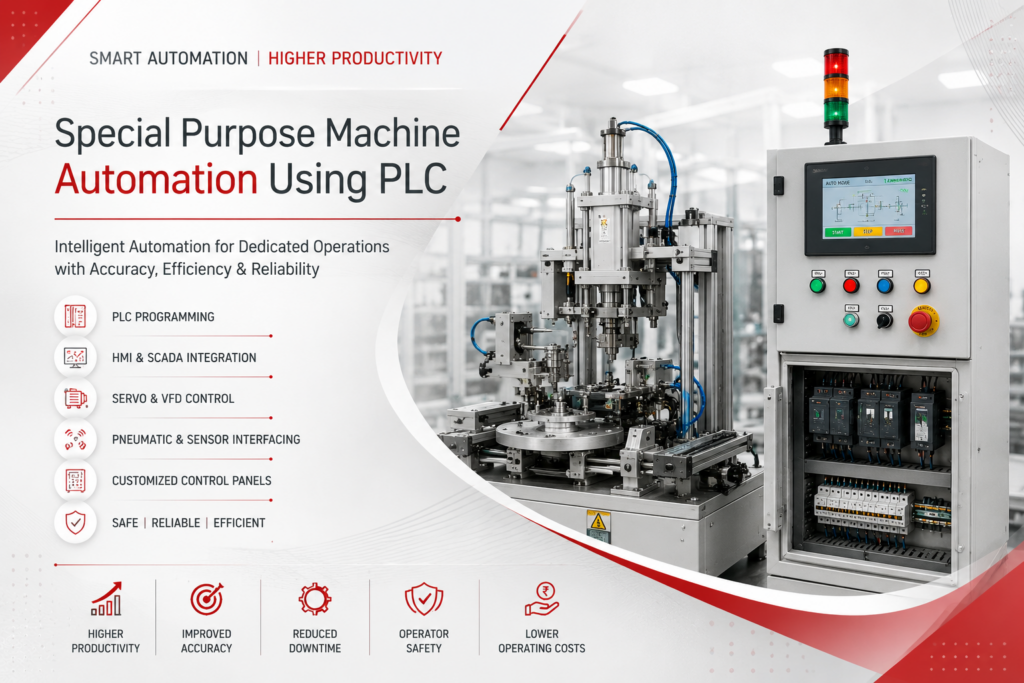
Special Purpose Machines (SPMs) are automated machines designed for specific manufacturing operations such as assembly, drilling, pressing, testing, inspection, material handling, packaging, feeding, and machining. PLC programming is one of the most important skills required for developing reliable and efficient SPM automation systems.
For engineers looking to build a career in industrial automation, learning PLC programming for Special Purpose Machine Automation provides practical exposure to machine sequencing, sensors, actuators, motors, pneumatic systems, VFDs, servo systems, HMI, safety circuits, and industrial communication.
What is Special Purpose Machine Automation?
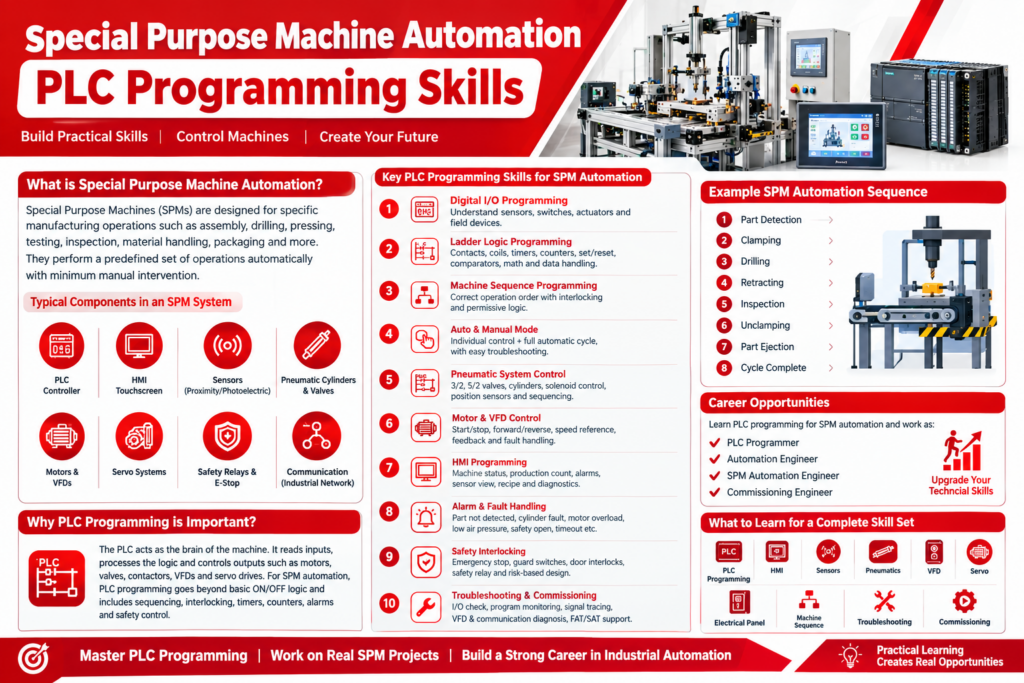
A Special Purpose Machine is designed around a particular production requirement. Unlike general-purpose machines, an SPM performs a predefined set of operations automatically with minimum manual intervention.
A typical SPM automation system may include:
- PLC controller
- HMI touchscreen
- Proximity and photoelectric sensors
- Limit switches
- Pneumatic cylinders and solenoid valves
- Servo motors and drives
- AC motors and VFDs
- Safety relays and emergency-stop circuits
- Industrial communication networks
- Control panels
- Vision or inspection systems
- Barcode/RFID systems
The PLC coordinates these devices according to the machine sequence.
Why PLC Programming is Important in SPM Automation
The PLC acts as the main control system of an automated machine. It receives signals from sensors, processes the programmed logic and operates outputs such as motors, solenoid valves, contactors, VFDs and servo drives.
Industrial PLC training commonly covers inputs and outputs, ladder programming, troubleshooting and practical machine-control applications.
For SPM automation, PLC programming must go beyond basic ON/OFF logic. The programmer needs to understand sequence control, interlocking, timers, counters, alarms, fault handling, auto/manual modes and machine safety.
Important PLC Programming Skills for SPM Automation
1. Digital Input and Output Programming
The first step in SPM programming is understanding how field devices communicate with the PLC.
Typical inputs include:
- Proximity sensors
- Photoelectric sensors
- Limit switches
- Push buttons
- Selector switches
- Pressure switches
- Safety switches
Typical outputs include:
- Solenoid valves
- Contactors
- Relays
- Motor starters
- Indicator lamps
- Buzzers
2. Ladder Logic Programming
Ladder Logic is widely used for industrial machine control.
An SPM PLC programmer should be comfortable with:
- NO and NC contacts
- Coils
- Latching circuits
- Set/Reset logic
- Timers
- Counters
- Compare instructions
- Mathematical operations
- Data handling
- One-shot/rising-edge logic
- Fault detection
3. Machine Sequence Programming
Sequence programming is one of the most important skills for SPM automation.
For example:
Part Detection → Clamping → Drilling → Retracting → Inspection → Unclamping → Part Ejection
Each operation must occur only when the required conditions are satisfied.
The PLC program should also prevent incorrect sequences through proper interlocking and permissive logic.
4. Auto and Manual Mode
A professionally designed SPM normally requires both:
Manual Mode
- Individual cylinder operation
- Motor ON/OFF
- Valve testing
- Sensor checking
- Jog operation
Automatic Mode
- Complete machine sequence
- Automatic part detection
- Cycle execution
- Fault monitoring
- Cycle completion
This makes machine commissioning and troubleshooting easier.
5. Pneumatic System Control
Many SPMs use pneumatic cylinders for clamping, pressing, pushing, lifting and part transfer.
PLC programmers should understand:
- 3/2 and 5/2 directional control valves
- Single-acting cylinders
- Double-acting cylinders
- Solenoid valve control
- Cylinder position sensors
- Pneumatic sequencing
- Pressure monitoring
For example:
Part Sensor ON → Clamp Cylinder Extend → Clamp Sensor ON → Drilling Motor ON → Operation Complete → Drill Retract → Clamp Release
6. Motor and VFD Control
SPMs frequently use induction motors and VFDs.
PLC programming may include:
- Motor start/stop
- Forward/reverse control
- VFD speed reference
- Run feedback
- Fault feedback
- Speed selection
- Acceleration/deceleration control
For more advanced machines, servo motors may be used for accurate positioning and motion control.
7. HMI Programming
The HMI provides the operator interface for the machine.
An SPM HMI can display:
- Auto/Manual selection
- Machine status
- Production count
- Cycle time
- Alarm messages
- Sensor status
- Motor status
- Fault information
- Recipe parameters
- Maintenance counters
A good PLC programmer should understand how to connect PLC tags with HMI screens and create useful diagnostic information.
8. Alarm and Fault Handling
Machine automation is incomplete without proper fault handling.
Examples include:
- Part not detected
- Cylinder not extended
- Cylinder not retracted
- Motor overload
- VFD fault
- Servo fault
- Safety circuit open
- Emergency stop activated
- Low air pressure
- Sensor failure
- Cycle timeout
The PLC should identify the fault and provide a clear message to the operator.
9. Safety Interlocking
SPM automation requires appropriate safety provisions.
PLC programmers should understand the interaction between:
- Emergency stop
- Safety relay
- Guard switches
- Door interlocks
- Motor contactors
- Pneumatic isolation
- Safety PLCs where applicable
Safety logic should be designed according to the machine’s risk assessment and applicable standards rather than relying only on ordinary PLC logic.
10. PLC Troubleshooting and Commissioning
A machine programmer must be able to troubleshoot the complete automation system.
Important practical skills include:
- Online PLC monitoring
- I/O diagnosis
- Sensor testing
- Output testing
- Program monitoring
- Fault identification
- Signal tracing
- HMI troubleshooting
- VFD troubleshooting
- Communication diagnosis
- Machine sequence testing
- FAT and SAT support
Practical PLC training programs in Pune also emphasize troubleshooting and hands-on industrial applications.
PLC Programming for SPM Automation in Pune
For engineers searching for PLC programming training in Pune, the most useful approach is to learn PLC programming through actual machine-control applications rather than only theoretical examples.
Pune has a strong industrial automation ecosystem, with training and automation companies operating across areas including Narhe, Pimpri-Chinchwad, Deccan, Shivajinagar and other industrial locations.
For students and working engineers specifically looking for PLC programming in Narhe, practical exposure to control panels, PLC hardware, sensors, pneumatic systems, VFDs, HMI and machine sequences can help connect classroom concepts with real industrial applications.
What Should You Learn for a Career in SPM Automation?
A practical SPM automation skill set should include:
Electrical Fundamentals → Control Panel → PLC → Sensors → Pneumatics → VFD → Servo → HMI → Communication → Machine Sequence → Troubleshooting → Commissioning
You should also learn how to read:
- Electrical control drawings
- PLC I/O drawings
- Pneumatic circuits
- Machine sequence diagrams
- P&ID where applicable
- Panel wiring diagrams
- Sensor and actuator specifications
Example SPM PLC Sequence
Consider an automatic drilling SPM:
Step 1: Operator presses Start
↓
Step 2: PLC checks safety conditions
↓
Step 3: Part detection sensor confirms component
↓
Step 4: Pneumatic clamp extends
↓
Step 5: Clamp sensor confirms clamping
↓
Step 6: Drill motor starts
↓
Step 7: Drill cylinder moves forward
↓
Step 8: Drilling operation completes
↓
Step 9: Drill retracts
↓
Step 10: Clamp releases
↓
Step 11: Finished component is ejected
↓
Step 12: PLC increments production counter
↓
Step 13: Machine returns to Ready condition
This type of sequence develops the core programming skills required for real SPM automation projects.
Best PLC Programming Skills for SPM Engineers
If your goal is to work as a PLC Programmer, Automation Engineer, SPM Automation Engineer or Commissioning Engineer, focus on these practical skills:
| Skill | Importance in SPM |
|---|---|
| Ladder Logic | Machine sequence control |
| Digital I/O | Sensor and actuator interfacing |
| Timers & Counters | Sequence and cycle control |
| Interlocking | Preventing incorrect machine operation |
| Pneumatics | Cylinder and valve automation |
| VFD | Motor speed and control |
| Servo | Precision positioning |
| HMI | Operator interface |
| Alarm Logic | Fault diagnosis |
| Industrial Communication | PLC-device integration |
| Troubleshooting | Machine maintenance |
| Commissioning | Site implementation |
Why Practical PLC Training Matters
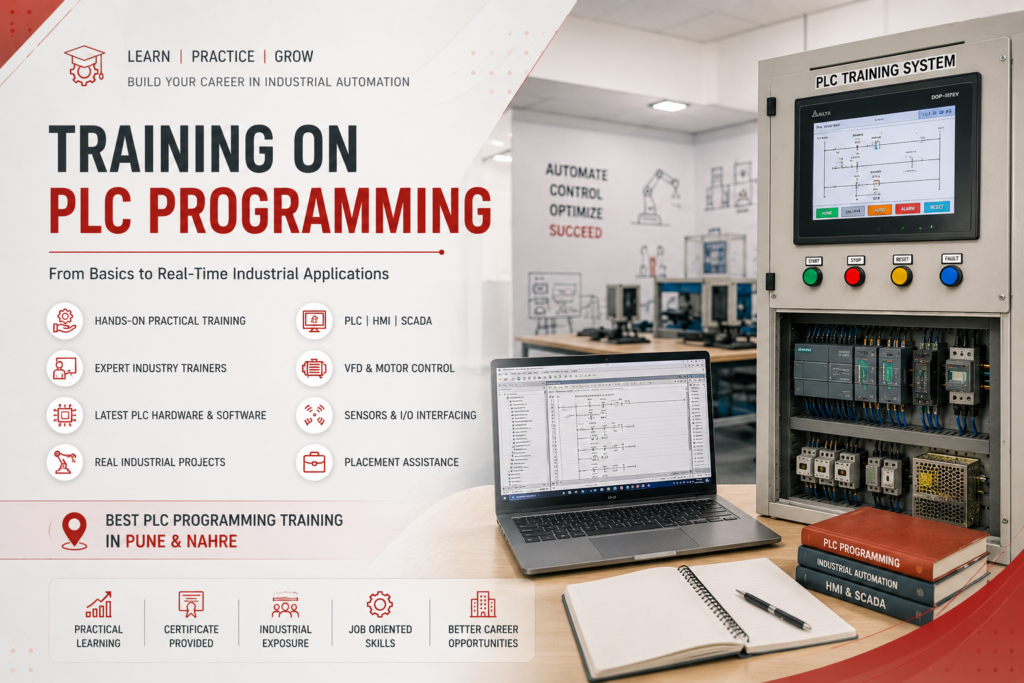
PLC programming becomes much easier when learners work with actual industrial hardware. A practical learning environment can include PLC panels, sensors, motors, VFDs, pneumatic cylinders, HMI systems and real machine sequences.
Industrial training organizations also emphasize hands-on learning using PLC/SCADA simulators and project-based applications rather than relying entirely on classroom theory.
Learn PLC Programming for SPM Automation in Pune and Narhe
If you are searching for PLC Programming in Pune, PLC Programming Training in Pune, PLC Automation Training in Narhe, or practical SPM Automation training in Narhe, focus on a program that provides exposure to real industrial automation concepts.
At Automate Engineering, Narhe, Pune, the focus can be positioned around practical industrial automation skills covering PLC programming, HMI, control panels, sensors, VFDs, pneumatics, industrial communication, machine sequencing, troubleshooting and commissioning.
The objective is not simply to learn PLC instructions, but to understand how a complete automated machine works from electrical input to mechanical output.
Key Skills to Build
PLC Programming + SPM Sequence + HMI + Sensors + Pneumatics + VFD + Servo + Electrical Panel + Troubleshooting + Commissioning
These skills form a strong technical foundation for engineers interested in Special Purpose Machine Automation and Industrial Automation careers in Pune.