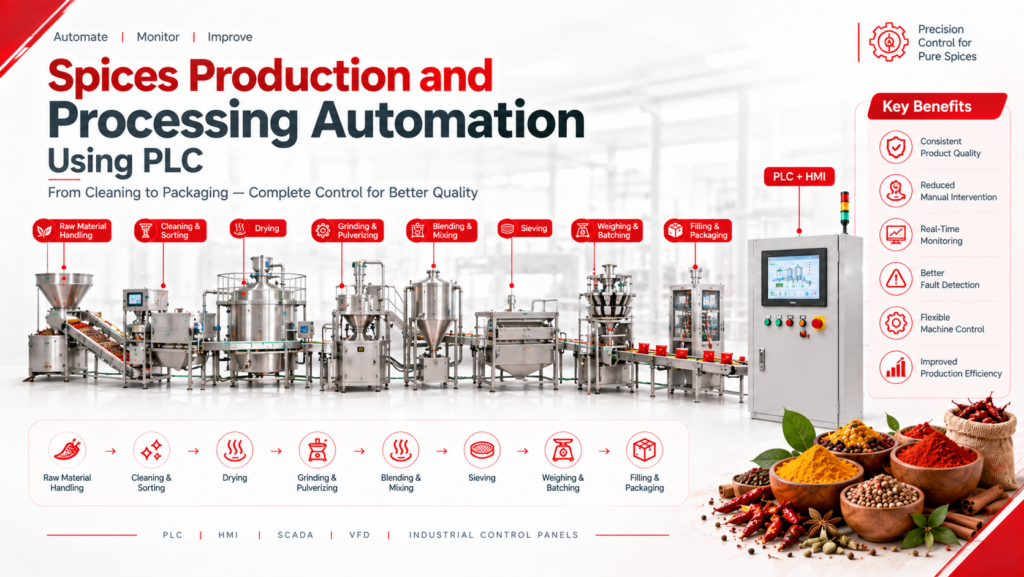
The spices industry involves several production stages such as cleaning, drying, grinding, blending, sieving, weighing, and packaging. Maintaining consistent quality and accurate processing across these stages can become challenging when operations depend heavily on manual control. Spices Production and Processing Automation Using PLC provides a reliable way to control, monitor, and coordinate these processes.
Modern Spices Processing Automation combines PLC, HMI, SCADA, VFDs, sensors, industrial control panels, and automation systems to improve process consistency, machine control, production monitoring, and operational efficiency.
What is Spices Processing Automation?
Spices Processing Automation uses industrial automation technologies to control different stages of spice manufacturing with reduced manual intervention.
A typical automated spice processing line may include:
- Raw material handling
- Cleaning and sorting
- Drying
- Grinding and pulverizing
- Blending and mixing
- Sieving
- Weighing and batching
- Filling and packaging
- Conveyor and material handling systems
Each stage can be integrated into a centralized PLC-based automation system for coordinated operation.
Role of PLC in Spice Processing
A PLC (Programmable Logic Controller) acts as the central control unit in many automated spice processing systems. It receives signals from sensors and field devices and operates motors, conveyors, valves, feeders, grinders, mixers, and other equipment according to programmed logic.
For example, a PLC can control the sequence between a feeding system, grinder, sieve, and collection system. Interlocks can be programmed to ensure that equipment operates in the correct sequence.
A simplified control architecture is:
Sensors → PLC → Programmed Logic → Motors/Drives/Actuators → Processing Equipment
PLC programming can also manage timers, counters, interlocks, alarms, automatic sequences, and production conditions.
HMI for Machine Monitoring
An HMI (Human Machine Interface) allows operators to monitor and control the spice processing line from a centralized interface.
An HMI can display:
- Machine operating status
- Motor and conveyor status
- Process parameters
- Batch information
- Production counts
- Equipment alarms
- Fault conditions
- Manual/automatic modes
- Setpoints and operating parameters
This makes HMI-based machine monitoring useful for operators who need quick visibility into the production process.
VFD Automation for Spice Processing Equipment
Motors are widely used in spice processing equipment such as grinders, pulverizers, mixers, conveyors, blowers, and feeders.
VFD Automation allows motor speed to be adjusted according to process requirements. For example, a VFD can control the speed of a conveyor or feeder to maintain a consistent material flow.
A VFD Control Panel can also provide controlled motor starting, speed adjustment, fault indication, and communication with the PLC.
SCADA for Spice Production Monitoring
For larger spice manufacturing facilities, SCADA Automation can provide centralized monitoring of multiple production processes.
A SCADA system can monitor:
- Production status
- Machine operation
- Motor running hours
- Batch information
- Process parameters
- Alarms and faults
- Energy consumption
- Production trends
Industrial SCADA Systems can also support historical data collection and production reporting, helping plant teams analyze machine and process performance.
Control Panels for Spice Processing Plants
A properly designed Industrial Control Panel provides centralized control and protection for spice processing machinery.
A PLC Control Panel may include:
- PLC and I/O modules
- HMI
- VFDs
- MCCBs and MCBs
- Contactors
- Overload relays
- Power supplies
- Relays and terminal blocks
- Communication modules
- Safety and protection devices
Proper Control Panel Manufacturing and electrical design are important for reliable operation, easy maintenance, and safe integration of production equipment.
Applications of PLC Automation in Spice Production
PLC-based Food Processing Automation can be applied across different spice manufacturing operations.
Cleaning and Sorting
Sensors, conveyors, and processing equipment can be coordinated through PLC-based control.
Grinding and Pulverizing
Motor operation and equipment sequencing can be automated while VFDs can provide variable speed control where required.
Blending and Mixing
Automated sequences can control mixers, feeders, and batch operations according to predefined process parameters.
Sieving
Automated material handling and machine sequencing can help maintain a consistent processing flow.
Weighing and Batching
PLC systems can coordinate feeders and weighing equipment for controlled batch processing.
Packaging
Conveyors, filling machines, sealing equipment, labeling systems, and other packaging equipment can be integrated into an automated production line.
Benefits of Spices Production Automation
Consistent Process Control
PLC-based automation helps maintain repeatable machine sequences and operating parameters.
Reduced Manual Intervention
Automation reduces repetitive manual operations and allows operators to focus on supervision and process management.
Improved Production Monitoring
HMI and SCADA systems provide real-time visibility into machine and process conditions.
Better Fault Detection
Alarm and fault monitoring can help identify equipment problems more quickly.
Flexible Machine Control
PLC programming allows machine sequences and control logic to be modified according to production requirements.
Improved Motor Control
VFDs provide flexible speed control for conveyors, grinders, mixers, feeders, and other motor-driven equipment.
Production Data Collection
SCADA systems can collect production and equipment information for reporting and performance analysis.
Smart Spice Processing with Industry 4.0
As food manufacturers move toward Smart Manufacturing and Industry 4.0, spice processing plants can integrate automation systems with industrial communication and IIoT technologies.
A connected system can bring together:
Sensors → PLC → HMI/SCADA → Production Data → Monitoring & Analysis
This approach can support machine monitoring, production reporting, alarm management, energy monitoring, and improved operational decision-making.
As an Industrial Automation System Integrator in Pune, Automate Engineering provides solutions involving PLC Programming, SCADA Automation, HMI Programming, VFD Automation, Control Panel Manufacturing, MCC Panels, Machine Automation, Process Automation, and Industrial Automation Solutions.
From raw material handling and grinding to blending, weighing, and packaging, Spices Production and Processing Automation Using PLC can help manufacturers achieve reliable machine control, consistent processes, better monitoring, and efficient production.
Automate Engineering – Industrial Automation Solutions for smarter spice processing, reliable machine control, and efficient food manufacturing.
#SpiceProcessingAutomation #SpicesProduction #SpiceIndustry #SpiceProcessing #FoodProcessingAutomation #PLC #PLCAutomation #PLCProgramming #SCADA #SCADAAutomation #HMI #VFDAutomation #ProcessAutomation #MachineAutomation #ControlPanel #PLCControlPanel #IndustrialControlPanel #FoodIndustryAutomation #FactoryAutomation #SmartManufacturing #Industry40 #IndustrialAutomation #IndustrialAutomationSolutions #AutomationEngineering #PuneAutomation