Introduction
A VFD (Variable Frequency Drive) control panel is an important component of industrial automation used to control the speed and operation of electric motors. It adjusts the frequency and voltage supplied to a motor, allowing equipment to operate according to process requirements.
VFD control panels are widely used in manufacturing plants, water treatment facilities, HVAC systems, pumping stations, and material handling applications. They help improve process control, reduce energy consumption, and support reliable motor operation.
What Is a VFD Control Panel?
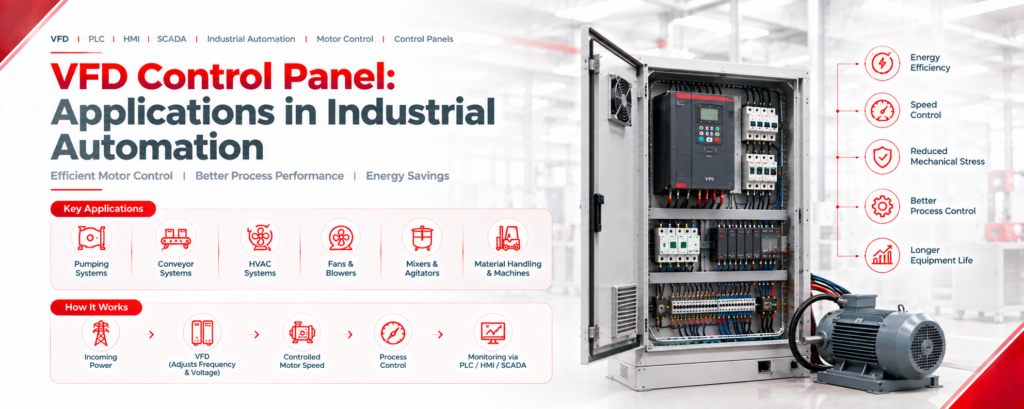
A VFD control panel is an electrical control panel that contains a Variable Frequency Drive along with protective devices, switching components, control circuits, and monitoring equipment.
The VFD controls motor speed by varying the output frequency and voltage. Operators can adjust speed through local controls, an HMI, a PLC, or a SCADA system, depending on the automation design.
Typical components include:
- Variable Frequency Drive: Controls motor speed and torque.
- Circuit Breaker or MCCB: Provides electrical protection.
- Contactor: Supports motor isolation and switching where required by the design.
- PLC: Executes automation logic and process commands.
- HMI: Allows operators to set speed and monitor motor status.
- Cooling and Ventilation: Helps maintain suitable operating temperatures.
- Protection and Monitoring Devices: Support safe and reliable operation.
How Does a VFD Control Panel Work?
The VFD receives electrical power and converts it into a controlled output with a variable frequency and voltage. This output regulates the speed of the connected AC motor.
The basic operating sequence is:
- The operator or PLC provides a start command.
- The VFD checks its configured operating conditions and receives the required speed reference.
- The drive supplies controlled power to the motor.
- The motor operates at the required speed.
- Feedback signals and drive status are monitored through the PLC, HMI, or SCADA system.
- If a configured fault occurs, the drive can stop the motor and report the fault for troubleshooting.
For example, in a water pumping system, a pressure transmitter measures pipeline pressure. The PLC or drive controller uses this feedback to adjust pump speed, helping maintain the required pressure.
Applications of VFD Control Panels in Industrial Automation
1. Pumping Systems
VFD panels control pump speed in water supply systems, wastewater treatment plants, and industrial process lines. They can adjust pump operation based on pressure, flow, or level requirements.
Example: When water demand decreases, the pump speed can be reduced instead of operating continuously at full speed.
2. Conveyor Systems
In manufacturing and packaging industries, VFD panels regulate conveyor speed according to production requirements. When integrated with PLCs and sensors, they help coordinate material movement between machines.
3. HVAC Systems
VFD panels control fans, blowers, and pumps in heating, ventilation, and air-conditioning systems. Adjusting motor speed according to airflow or temperature demand can reduce unnecessary energy use.
4. Industrial Fans and Blowers
In process industries, fan speed often needs to change according to ventilation, airflow, or combustion requirements. VFD control enables adjustable operation rather than relying only on fixed-speed motors.
5. Mixers and Agitators
VFDs help regulate mixing speed in chemical processing, food production, and other manufacturing applications. Operators can select suitable speeds for different stages of a process.
6. Material Handling and Manufacturing Machines
VFD control panels are used in machines such as winding systems, material handling equipment, and selected machine tools. They support controlled acceleration, deceleration, and speed adjustment according to application requirements.
Integration of VFD Panels with PLC, HMI and SCADA
Modern industrial automation systems often integrate VFD panels with PLC, HMI, and SCADA technologies.
- PLC Integration: The PLC sends start, stop, speed-reference, and operating commands to the drive and monitors feedback signals.
- HMI Integration: Operators can adjust permitted speed settings, view operating status, and identify drive faults.
- SCADA Integration: Supervisory systems can monitor motor speed, current, drive status, alarms, and other available parameters across a plant.
- Industrial Communication: Depending on the selected equipment, communication may use Modbus RTU, Modbus TCP, PROFINET, EtherNet/IP, or other supported protocols.
This integration supports centralized monitoring, coordinated machine operation, and faster fault identification.
Benefits of VFD Control Panels
- Energy Efficiency: Reduces energy use in suitable variable-load applications.
- Speed Control: Matches motor speed to process demand.
- Reduced Mechanical Stress: Controlled acceleration and deceleration can reduce stress on connected equipment.
- Improved Process Control: Helps maintain required flow, pressure, speed, or production rates.
- Monitoring and Diagnostics: Provides useful operating data and fault information.
- Automation Compatibility: Supports integration with PLC, HMI, and SCADA systems.
Actual energy savings depend on the application, motor loading, system design, and operating conditions.
Important Considerations in VFD Panel Design
Proper panel design is essential for safe and reliable operation. Engineers should consider motor power and current ratings, supply voltage, drive selection, enclosure rating, cooling requirements, cable selection, earthing, electromagnetic compatibility, and protection coordination.
The design should also account for the motor’s operating conditions, starting and stopping requirements, communication needs, and the possibility of electrical interference. Correct installation, parameter configuration, and maintenance are important for long-term performance.
Conclusion
VFD control panels play a significant role in modern industrial automation by enabling adjustable motor speed, improved process control, and more efficient equipment operation. When integrated with PLC, HMI, and SCADA systems, they support better monitoring and coordinated control across industrial processes.
For industries seeking reliable motor control, a properly engineered VFD control panel can be an important part of an effective automation solution.
Automate Engineering focuses on industrial automation systems, PLC and SCADA integration, VFD applications, and electrical control panel solutions for industrial requirements.
SEO Keywords
VFD Control Panel, VFD Panel Applications, Industrial Automation, VFD Panel Manufacturer in Pune, Motor Speed Control, PLC and VFD Integration, SCADA Automation, Industrial Control Panels, Variable Frequency Drive, Energy-Efficient Motor Control, Industrial Automation System Integrator in Pune, Best Automation Company in Narhe.
#VFDControlPanel #IndustrialAutomation #VariableFrequencyDrive #PLCAutomation #SCADA #MotorControl #ElectricalControlPanel #IndustrialAutomationSolutions #ProcessAutomation #PuneAutomation