In modern industries, electric motors are used to operate pumps, conveyors, compressors, fans, mixers, blowers, and various production machines. However, many applications do not require motors to operate continuously at a fixed speed. A VFD Control Panel (Variable Frequency Drive Control Panel) helps industries control motor speed according to process requirements, improving flexibility, machine control, and operational efficiency.
As part of modern Industrial Automation Solutions, VFD Control Panels can be integrated with PLCs, HMIs, SCADA systems, sensors, and industrial communication networks to provide intelligent motor control and real-time monitoring.
What is a VFD Control Panel?
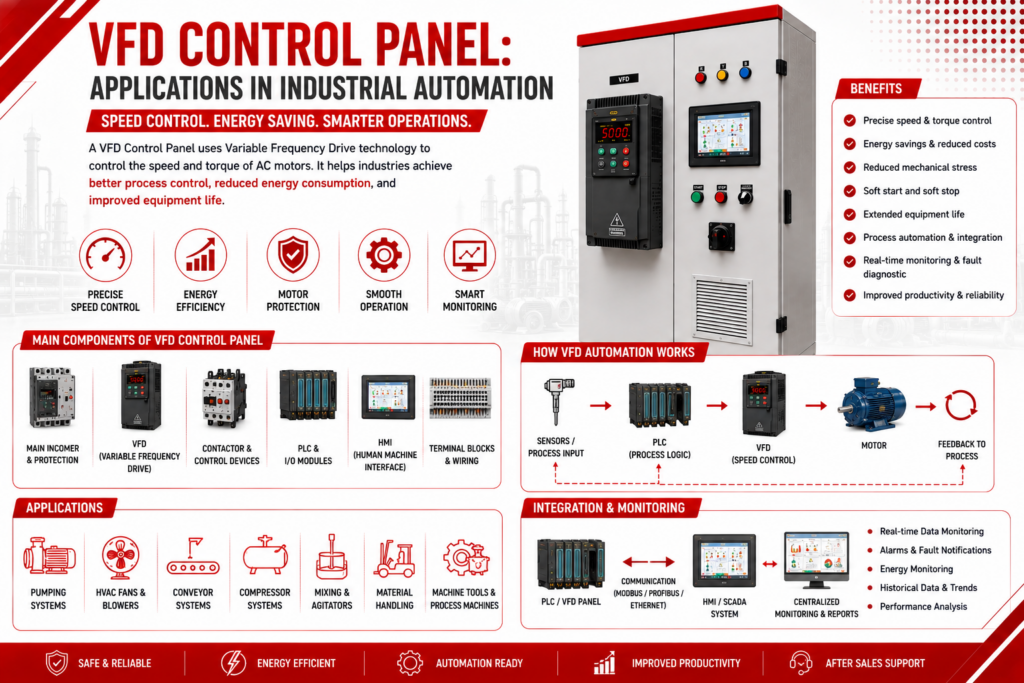
A VFD Control Panel is an electrical control panel designed to control the speed and operation of an AC motor using a Variable Frequency Drive.
The VFD controls the frequency and voltage supplied to the motor, allowing the motor speed to be adjusted according to application requirements. The panel may also include protection devices, control components, PLCs, HMIs, and communication modules.
A typical VFD Automation Panel provides:
- Motor start and stop control
- Variable speed control
- Forward and reverse operation
- Automatic and manual modes
- Motor protection
- Fault monitoring
- Process-based speed control
- Remote monitoring and communication
Main Components of a VFD Control Panel
The design of a VFD Panel depends on the motor rating and application requirements. Common components include:
1. VFD (Variable Frequency Drive)
The VFD is the main component responsible for controlling motor speed. It receives control commands and adjusts the motor output according to the required frequency and operating conditions.
2. Main Incomer and Protection Devices
The main incomer receives electrical power and distributes it within the panel. MCBs, MCCBs, fuses, and other protection devices help protect the electrical system.
3. Contactor and Control Components
Contactors, relays, selector switches, and push buttons can be used for motor control, isolation, and operational functions.
4. PLC and I/O Modules
In automated systems, a PLC can control the VFD based on sensor inputs and programmed process logic. The PLC can send commands such as start, stop, speed reference, direction, and operating mode.
5. HMI
An HMI (Human Machine Interface) allows operators to monitor motor status, adjust speed settings, view alarms, and select manual or automatic operating modes.
6. Industrial Communication Devices
Modern VFDs can communicate with PLCs, HMIs, and SCADA systems through industrial communication protocols, enabling centralized monitoring and control.
How VFD Automation Works
A VFD Control System can adjust motor speed automatically according to process requirements.
For example, a pressure sensor in a pumping system can send feedback to the PLC. The PLC compares the actual pressure with the required setpoint and sends an appropriate speed command to the VFD.
A simplified control sequence can be:
Sensor/Process Input → PLC → VFD Control Command → Motor Speed Adjustment → Process Feedback
This closed-loop approach allows industries to achieve more accurate and responsive process control.
Applications of VFD Control Panels
VFD Control Panels are widely used across different industrial automation applications.
Pumping Systems
VFDs can control pump speed according to pressure, flow, or tank-level requirements.
Conveyor Systems
Variable speed control allows conveyor speed to be adjusted according to production requirements and material flow.
HVAC Systems
Fans and blowers can be controlled according to temperature, pressure, or airflow requirements.
Compressors
VFD control can help match compressor motor operation with process demand.
Mixing and Process Applications
VFDs can control mixer and agitator speed according to product and process requirements.
Material Handling Systems
Variable motor speed can improve control and coordination in automated material handling applications.
Manufacturing Machines
VFDs are used in various production machines where adjustable motor speed is required.
Benefits of VFD Control Panels
A properly designed VFD Automation Panel provides several advantages for industrial operations.
Precise Speed Control: Motor speed can be adjusted according to process requirements.
Improved Process Control: VFDs allow smoother and more flexible control of motors.
Reduced Mechanical Stress: Controlled acceleration and deceleration can reduce sudden mechanical shocks in suitable applications.
Energy Efficiency: In variable-torque applications such as pumps and fans, reducing motor speed according to demand can significantly reduce energy consumption.
Improved Equipment Life: Smooth starting and controlled operation can help reduce mechanical stress on equipment.
Fault Monitoring: Modern VFDs provide information about motor and drive operating conditions, alarms, and faults.
Automation Integration: VFDs can be integrated with PLC, HMI, and SCADA systems for centralized control and monitoring.
VFD Panels in Smart Manufacturing
Modern Industrial Automation Systems require machines to be flexible, connected, and easy to monitor. A VFD Control Panel can be integrated with PLCs, HMIs, SCADA systems, sensors, energy meters, and IIoT platforms.
This allows industries to monitor motor status, speed, alarms, runtime, and energy-related parameters. The collected data can support improved maintenance planning, machine monitoring, and operational decision-making.
As an Industrial Automation System Integrator in Pune, Automate Engineering provides solutions involving VFD Control Panels, PLC Programming, HMI Programming, SCADA Automation, Industrial Motor Control, Machine Automation, MCC Panels, and Industrial Automation Solutions.
A properly engineered VFD Control Panel provides flexible and reliable motor control while supporting improved process performance and automation.
Automate Engineering – Industrial Automation Solutions for intelligent motor control, efficient processes, and smarter manufacturing.
#VFDControlPanel #VFD #VFDAutomation #VariableFrequencyDrive #IndustrialAutomation #MotorControl #IndustrialMotorControl #PLC #PLCAutomation #HMI #SCADA #MachineAutomation #FactoryAutomation #ControlPanel #IndustrialControlPanel #EnergyEfficiency #SmartManufacturing #Industry40 #IndustrialAutomationSolutions #AutomationEngineering #PuneAutomation