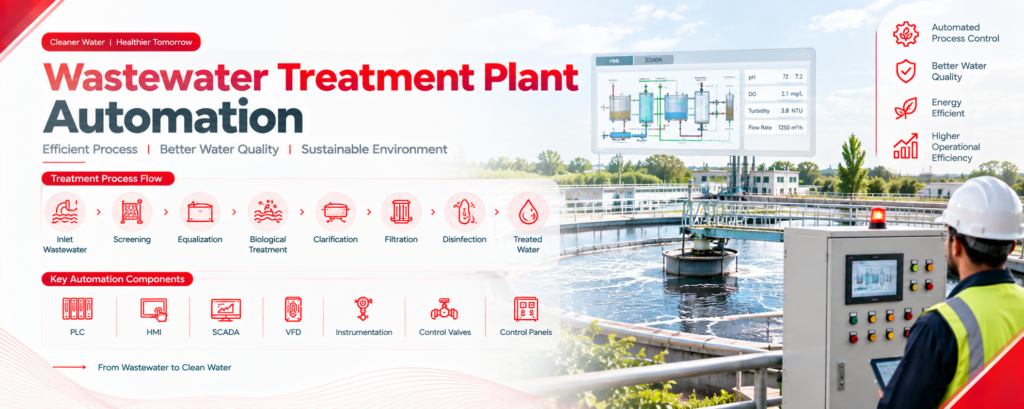
Wastewater treatment plants are essential for treating industrial and municipal wastewater before reuse or discharge. These plants involve processes such as screening, equalization, biological treatment, clarification, filtration, sludge handling, and water disinfection.
Wastewater Treatment Plant Automation uses PLC, SCADA, HMI, VFD, sensors, instrumentation, control valves, and industrial control panels to monitor and control these processes. Automation helps improve process control, reduce manual intervention, monitor water quality, and provide centralized plant visibility.
What is Wastewater Treatment Plant Automation?
Wastewater treatment plant automation refers to the use of industrial automation systems to monitor equipment and control treatment processes automatically.
A typical process flow is:
Inlet Wastewater → Screening → Equalization → Biological Treatment → Clarification → Filtration → Disinfection → Treated Water
Depending on the plant, additional processes such as chemical dosing, sludge treatment, membrane filtration, or water reuse may also be included.
Role of PLC in Wastewater Treatment
A PLC (Programmable Logic Controller) acts as the main control system for many automated wastewater treatment processes.
PLC applications include:
- Pump start/stop control
- Automatic valve operation
- Tank level control
- Chemical dosing
- Blower control
- Conveyor operation
- Sludge pump control
- Equipment sequencing
- Interlocking
- Alarm generation
- Automatic/manual operation
- Sensor monitoring
PLC programming allows different treatment stages to operate according to predefined process conditions.
HMI for Wastewater Plant Monitoring
An HMI (Human Machine Interface) provides operators with a visual interface for monitoring and controlling the treatment plant.
The HMI can display:
- Tank levels
- Pump status
- Blower status
- Flow rate
- pH
- Temperature
- Pressure
- Valve position
- Chemical dosing status
- Equipment alarms
- Motor status
- Process setpoints
Operators can also use the HMI to select Auto/Manual modes, change suitable process parameters, and identify equipment faults.
SCADA in Wastewater Treatment Plants
SCADA (Supervisory Control and Data Acquisition) provides centralized monitoring and data collection for wastewater treatment systems.
SCADA can monitor:
- Inlet and outlet flow
- Treatment tanks
- Pumps
- Blowers
- Chemical dosing systems
- Sludge handling systems
- Water quality parameters
- Tank levels
- Energy consumption
SCADA also supports:
- Historical data logging
- Alarm management
- Trend monitoring
- Production and process reports
- Remote monitoring
- Equipment status monitoring
This provides operators and plant management with better visibility of plant performance.
VFD Automation for Pumps and Blowers
Pumps and blowers are major equipment in wastewater treatment plants. VFD automation allows motor speed to be adjusted according to process requirements.
VFDs can be used for:
- Inlet pumps
- Transfer pumps
- Aeration blowers
- Sludge pumps
- Filter pumps
- Chemical dosing systems
- Recirculation pumps
For example, blower speed can be adjusted according to the required aeration conditions instead of operating continuously at a fixed speed.
Sensors and Instrumentation
Instrumentation is an important part of wastewater treatment automation because treatment processes depend on accurate measurement.
Common instruments include:
| Instrument | Typical Application |
|---|---|
| Flow Transmitter | Inlet/outlet flow measurement |
| Level Transmitter | Tank level monitoring |
| pH Sensor | Water quality monitoring |
| DO Sensor | Dissolved oxygen monitoring |
| Pressure Transmitter | Pump and pipeline monitoring |
| Turbidity Sensor | Water clarity monitoring |
| Temperature Sensor | Process temperature |
| ORP Sensor | Biological treatment monitoring |
| Conductivity Sensor | Water quality monitoring |
These instruments provide real-time process information to the PLC, DCS, or SCADA system.
Automation Applications in Wastewater Treatment
1. Screening Automation
Screens remove larger solid materials from incoming wastewater.
Automation can control:
- Screen motors
- Conveyors
- Level monitoring
- Automatic cleaning cycles
- High-level alarms
2. Equalization Tank Automation
Equalization tanks help balance wastewater flow and characteristics before further treatment.
Automation can monitor:
- Tank level
- Inlet flow
- Transfer pumps
- Agitators
- High/low-level conditions
3. Biological Treatment Automation
Biological treatment uses microorganisms to help remove pollutants from wastewater.
Automation can control:
- Aeration blowers
- Air flow
- Dissolved oxygen monitoring
- Recirculation pumps
- Mixer operation
- Process timing
4. Chemical Dosing Automation
Chemical dosing systems can be automated according to process requirements.
Automation can control:
- Dosing pumps
- Chemical flow
- Tank level
- Dosing sequence
- pH correction
- Alarms
5. Clarifier Automation
Clarifiers separate suspended solids from treated water.
Automation can monitor and control:
- Sludge scrapers
- Sludge pumps
- Return activated sludge pumps
- Tank levels
- Flow rates
6. Filtration Automation
Filtration systems remove remaining suspended particles from treated water.
Automation can control:
- Filter pumps
- Valves
- Differential pressure
- Backwashing sequence
- Flow
- Filter status
7. Sludge Handling Automation
Sludge management is an important part of wastewater treatment.
Automation can control:
- Sludge pumps
- Dewatering equipment
- Mixers
- Conveyors
- Sludge transfer
- Equipment sequencing
Control Panels for Wastewater Treatment Plants
An industrial automation control panel provides the electrical and control interface between field equipment and the automation system.
A typical wastewater treatment control panel may include:
- PLC
- HMI
- VFDs
- Remote I/O
- MCB/MCCB
- Contactors
- Relays
- Power supplies
- Terminal blocks
- Communication modules
- Motor control components
Proper PLC control panel design and manufacturing helps provide organized equipment control and easier maintenance.
Alarm and Fault Monitoring
Automation systems can continuously monitor equipment and process conditions.
Typical alarms include:
- High tank level
- Low tank level
- Pump failure
- Blower failure
- High pressure
- Low pressure
- Abnormal pH
- High turbidity
- High/low dissolved oxygen
- Motor overload
- Communication failure
Operators can receive alarms through HMI or SCADA for faster identification of abnormal conditions.
Benefits of Wastewater Treatment Plant Automation
Wastewater automation can provide:
- Real-time process monitoring
- Automatic equipment control
- Better process consistency
- Reduced manual intervention
- Faster fault detection
- Centralized plant monitoring
- Improved equipment management
- Historical process data
- Energy monitoring
- Automated reporting
- Support for remote monitoring
Industry 4.0 and IIoT in Wastewater Treatment
Modern wastewater treatment plants can integrate Industry 4.0 and IIoT technologies with conventional PLC and SCADA systems.
A typical architecture can be represented as:
Sensors & Instruments → PLC → HMI / SCADA → Industrial Network → Data Collection → Monitoring & Analysis
IIoT can support:
- Remote plant monitoring
- Energy consumption monitoring
- Pump and blower performance tracking
- Equipment condition monitoring
- Predictive maintenance
- Water quality data analysis
- Historical trend analysis
- Centralized dashboards
Conclusion
Wastewater Treatment Plant Automation combines PLC Programming, SCADA Automation, HMI, VFD Automation, industrial instrumentation, control panels, and process control to automate and monitor wastewater treatment operations.
From screening and equalization to biological treatment, clarification, filtration, disinfection, and sludge handling, automation helps operators maintain better visibility and control over plant processes.
For industries looking for an Industrial Automation System Integrator in Pune, solutions involving PLC Programming, SCADA Automation, HMI Programming, VFD Automation, Industrial Instrumentation, Control Panel Manufacturing, Process Automation, and IIoT can be developed according to plant requirements.
#WastewaterTreatmentAutomation #WastewaterTreatment #WaterTreatmentAutomation #IndustrialAutomation #PLCAutomation #PLCProgramming #SCADA #SCADAAutomation #HMI #VFDAutomation #ProcessAutomation #WaterTreatmentPlant #ETPAutomation #STPAutomation #IndustrialInstrumentation #ControlPanel #PLCControlPanel #PumpAutomation #SmartManufacturing #Industry40 #IIoT #FactoryAutomation #IndustrialAutomationSolutions #PuneAutomation