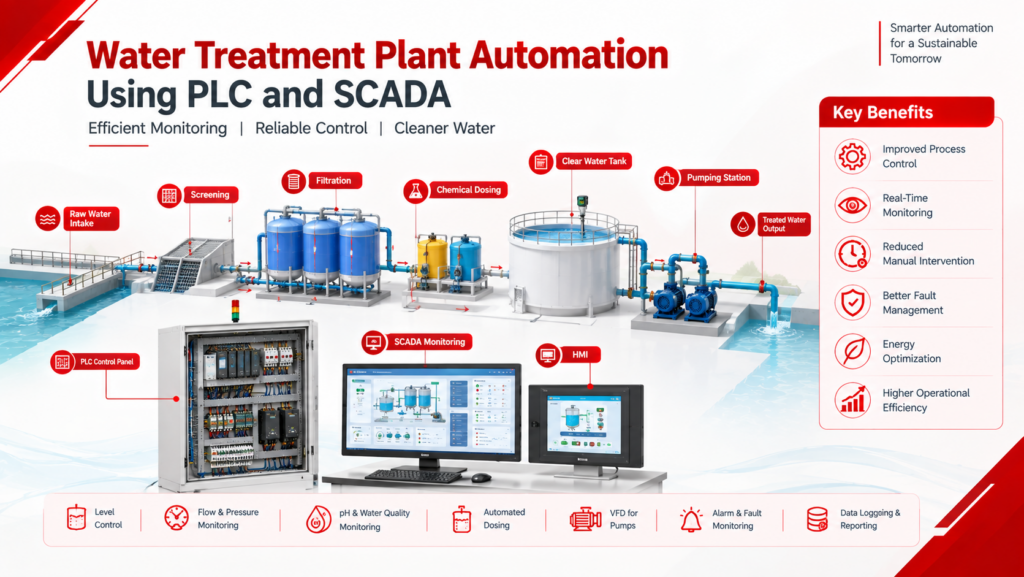
Water treatment plants involve multiple processes such as pumping, filtration, chemical dosing, tank-level control, flow regulation, and water quality monitoring. Managing these processes manually can be time-consuming and may make it difficult to maintain consistent plant performance. Water Treatment Plant Automation Using PLC and SCADA provides a reliable way to monitor, control, and optimize these processes from a centralized system.
Modern Industrial Automation Solutions for Water Treatment Plants combine PLC, SCADA, HMI, sensors, VFDs, control panels, and industrial communication systems to provide accurate and efficient process control.
Role of PLC in Water Treatment Automation
A PLC (Programmable Logic Controller) acts as the main control unit in an automated water treatment system. It receives signals from field devices such as level sensors, flow meters, pressure sensors, pH sensors, and other process instruments.
Based on programmed logic, the PLC can control pumps, valves, mixers, dosing systems, and other equipment.
A typical automation sequence can be represented as:
Sensors → PLC → Control Logic → Pumps/Valves/Actuators → Process → SCADA Monitoring
For example, if the water level in a storage tank falls below a defined setpoint, the PLC can automatically start a pump. When the required level is reached, the pump can be stopped according to the programmed control logic.
Role of SCADA in Water Treatment Plants
SCADA (Supervisory Control and Data Acquisition) provides centralized monitoring and supervision of the water treatment process.
Operators can use a SCADA system to monitor:
- Tank levels
- Pump status
- Flow and pressure
- Valve position
- Water quality parameters
- Chemical dosing
- Equipment alarms
- Energy consumption
- Process trends
- Equipment operating hours
SCADA also allows operators to view real-time process information and historical trends, helping them identify abnormal conditions and make informed operational decisions.
VFD Automation for Pumps
Pumps are one of the most important components in a water treatment plant. VFD Automation allows pump speed to be adjusted according to flow, pressure, or level requirements.
Instead of operating a pump continuously at a fixed speed, the VFD can receive a speed reference from the PLC based on process feedback. This provides better control and, in suitable applications, can contribute to energy savings.
A VFD Control Panel can also provide motor protection, fault monitoring, and communication with the PLC or SCADA system.
Control Panels for Water Treatment Plants
A properly engineered PLC Control Panel for Water Treatment brings together the electrical and automation components required for plant operation.
Depending on the application, the panel may include:
- PLC and I/O modules
- HMI
- VFDs
- MCCBs and MCBs
- Contactors and relays
- Power supplies
- Terminal blocks
- Communication modules
- Energy meters
- Safety and protection devices
An integrated Industrial Control Panel provides centralized control of pumps, motors, valves, and other equipment while making maintenance and troubleshooting easier.
Benefits of Water Treatment Plant Automation
Improved Process Control
PLC-based automation provides accurate and repeatable control of treatment processes.
Real-Time Monitoring
SCADA provides operators with real-time information about equipment and process conditions.
Reduced Manual Intervention
Automatic control of pumps, valves, dosing systems, and other equipment reduces repetitive manual operations.
Better Fault Monitoring
Alarms and equipment status information can help operators identify abnormal conditions quickly.
Energy Management
Integration of VFDs and energy meters can help monitor and manage energy consumption.
Improved Operational Efficiency
Centralized monitoring and automated process control can improve plant operation and reduce unnecessary downtime.
Smart Water Treatment with PLC and SCADA
Modern Water Treatment Plant Automation Systems can be connected with industrial communication networks and IIoT platforms to support remote monitoring and data collection.
By integrating PLC, SCADA, HMI, VFDs, sensors, MCC Panels, and Industrial Automation Control Panels, water treatment facilities can achieve better visibility into their processes and equipment.
As an Industrial Automation System Integrator in Pune, Automate Engineering provides solutions involving PLC Programming, SCADA Automation, HMI Programming, VFD Automation, MCC Panels, Control Panel Manufacturing, Process Automation, and Industrial Automation Solutions for industrial applications.
Whether it is pump automation, tank-level control, filtration, chemical dosing, or centralized plant monitoring, a properly designed PLC and SCADA Automation System can provide reliable control and better operational visibility.
Automate Engineering – Industrial Automation Solutions for smarter water treatment, reliable process control, and efficient plant operations.
#WaterTreatmentAutomation #WaterTreatmentPlant #PLCAutomation #PLCProgramming #SCADA #SCADAAutomation #WaterPlantAutomation #ProcessAutomation #IndustrialAutomation #VFDAutomation #PumpAutomation #ControlPanel #PLCControlPanel #MCCPanel #HMI #IndustrialControlPanel #IndustrialAutomationSolutions #SmartManufacturing #Industry40 #AutomationEngineering #PuneAutomation