Programmable Logic Controllers (PLCs) have become one of the most important technologies in modern industrial automation. From manufacturing plants and process industries to packaging, pharmaceuticals, food and beverage, and water treatment plants, PLCs are widely used to control machines and industrial processes.
With the rapid growth of automation and Industry 4.0, the demand for skilled PLC programmers is increasing. For students, freshers, diploma holders, and engineering professionals, learning PLC programming can open up several career opportunities in industrial automation.
What Is PLC Programming?
PLC programming is the process of creating control logic for a Programmable Logic Controller. A PLC receives signals from field devices such as sensors, switches, and transmitters, processes the programmed logic, and controls output devices such as motors, valves, cylinders, contactors, and relays.
Common PLC programming languages and technologies include:
- Ladder Logic
- Function Block Diagram (FBD)
- Structured Text (ST)
- Sequential Function Chart (SFC)
- PLC timers and counters
- Analog input/output programming
- PID control
- Communication protocols
- HMI and SCADA integration
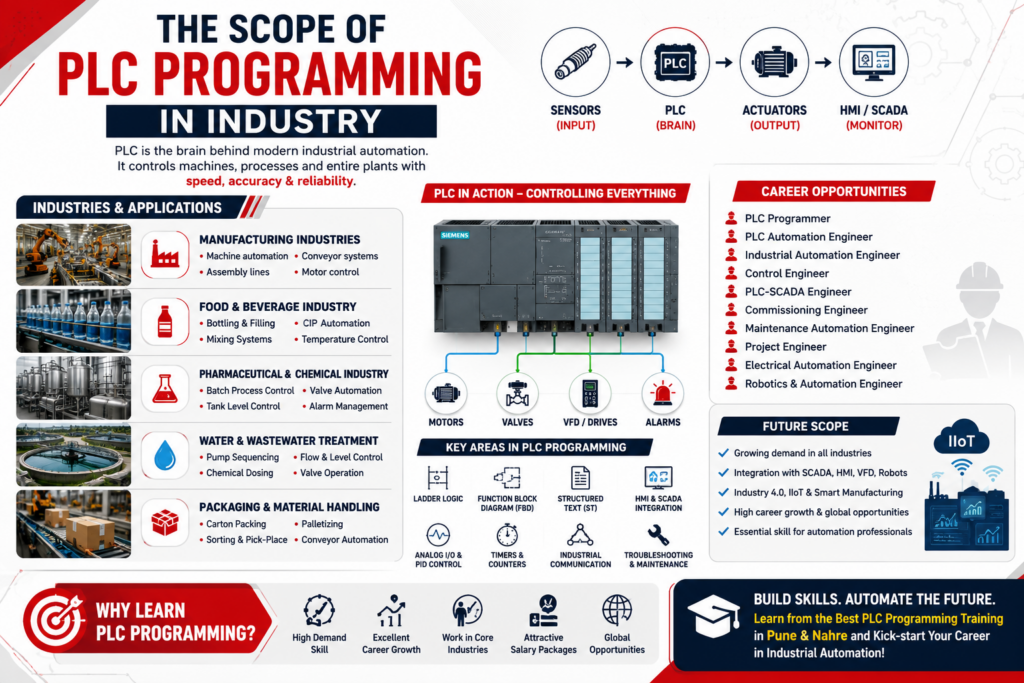
Scope of PLC Programming in Industry
The scope of PLC programming is not limited to a single industry. PLC-based automation is used wherever machines and processes need reliable and programmable control.
1. Manufacturing Industries
Manufacturing plants use PLCs for machine automation, conveyor systems, assembly lines, material handling, and production monitoring.
PLC programmers can work on:
- Conveyor automation
- Machine sequencing
- Motor control
- Sensor-based automation
- Production lines
- Packaging machines
- Assembly systems
2. Food & Beverage Industry
Food and beverage plants require reliable process automation for production, filling, packaging, and material handling.
PLCs are commonly used for:
- Bottling plants
- Filling machines
- Mixing systems
- Conveyor systems
- CIP automation
- Temperature control
- Pump and motor control
3. Pharmaceutical & Chemical Industries
Process industries depend heavily on PLCs for accurate and reliable control. PLCs can be integrated with SCADA and HMI systems to monitor critical process parameters.
Applications include:
- Batch process automation
- Temperature and pressure control
- Pump automation
- Valve control
- Tank-level control
- Alarm management
- Process monitoring
4. Water & Wastewater Treatment
Water Treatment Plants (WTP), Sewage Treatment Plants (STP), and Effluent Treatment Plants (ETP) use PLCs to automate pumps, valves, blowers, level control, and filtration systems.
A PLC programmer may develop automation logic for:
- Pump sequencing
- Level control
- Flow control
- Motor control
- Valve operation
- Chemical dosing
- Auto/manual operation
5. Packaging & Material Handling
Packaging automation is another major application area for PLC programming. PLCs control sensors, conveyors, pneumatic cylinders, motors, servo drives, and other equipment.
Applications include:
- Carton packing
- Bottle filling
- Labeling
- Sorting
- Palletizing
- Conveyor automation
- Pick-and-place systems
PLC + HMI + SCADA: Growing Career Scope
Modern industrial automation is not only about PLC programming. PLCs are increasingly integrated with HMI, SCADA, VFDs, servo drives, industrial communication, and IIoT systems.
A typical automation architecture can look like:
Sensors → PLC → VFD/Servo/Motors/Valves → HMI → SCADA → Industrial IoT
Because of this integration, professionals who understand PLC programming along with HMI, SCADA, VFD, instrumentation, and industrial networking can handle complete automation projects.
Career Opportunities in PLC Programming
After gaining practical PLC programming skills, candidates can explore roles such as:
- PLC Programmer
- PLC Automation Engineer
- Industrial Automation Engineer
- Control Engineer
- Automation Project Engineer
- PLC-SCADA Engineer
- Commissioning Engineer
- Maintenance Automation Engineer
- Electrical Automation Engineer
- Robotics & Automation Engineer
PLC professionals may work in manufacturing companies, system integrators, OEMs, process industries, engineering companies, and industrial automation solution providers.
Why Practical PLC Training Is Important
Learning PLC programming only through theoretical concepts may not be enough for an industrial career. Industrial projects require practical knowledge of PLC hardware, wiring, sensors, motors, drives, HMI, troubleshooting, and communication.
A good training program should provide hands-on exposure to:
- Siemens PLC
- Allen-Bradley PLC
- Mitsubishi PLC
- Delta PLC
- HMI programming
- SCADA
- VFD programming
- Electrical control panels
- Industrial sensors
- Pneumatics
- Modbus and Ethernet communication
- Industrial troubleshooting
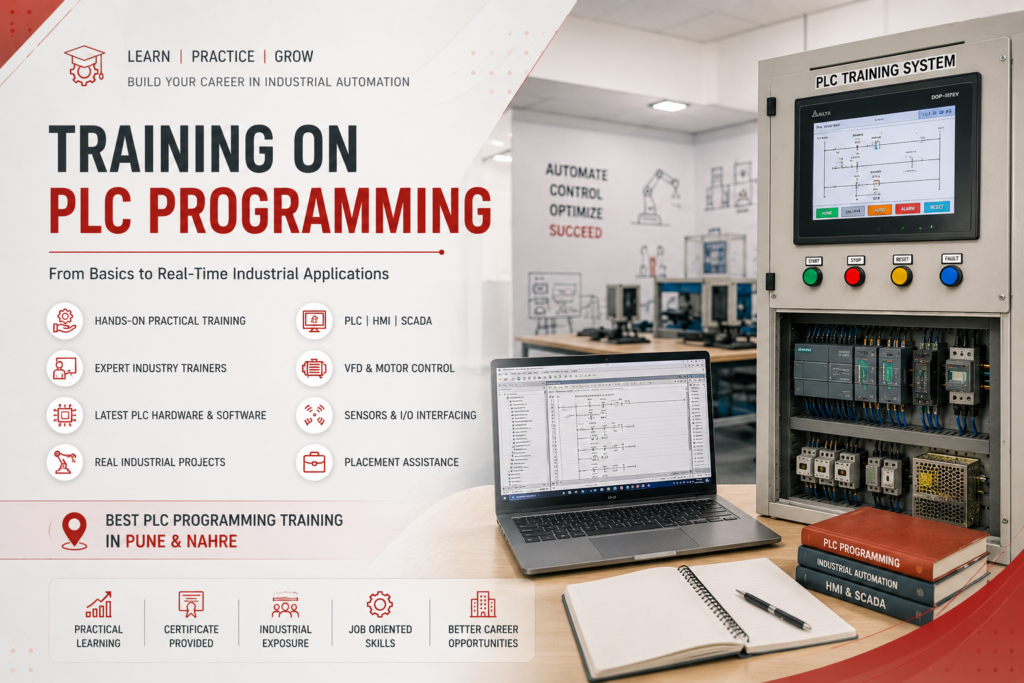
For students and professionals looking for best PLC programming Pune, practical project-based training can be particularly valuable because Pune has a strong ecosystem of manufacturing, automotive, engineering, and industrial automation companies.
Best PLC Programming Training in Nَahre, Pune
For students and working professionals located in Nahre, Pune, choosing training that combines PLC programming with real industrial applications can provide better exposure than theory-only courses.
A best PLC programming Pune training program should ideally cover PLC programming from basic to advanced levels, including ladder logic, HMI, SCADA, VFD, industrial communication, troubleshooting, and practical automation projects.
Training in the Nahre Pune area can also be convenient for students from nearby locations such as Katraj, Ambegaon, Narhe, Dhayari, Sinhagad Road, and surrounding areas.
Future Scope of PLC Programming
The future of PLC programming remains strong because industries are continuously moving toward automation, smart manufacturing, and Industry 4.0.
Emerging areas include:
PLC + SCADA + IIoT + Cloud/Data Analytics + Industrial Networking
Modern PLC programmers are increasingly expected to understand machine connectivity, production data, remote monitoring, industrial Ethernet, and IIoT technologies.
Conclusion
PLC programming has a broad scope across manufacturing, automotive, food and beverage, pharmaceutical, chemical, packaging, water treatment, power, and process industries. As industrial automation continues to expand, skilled PLC professionals will remain important for machine development, plant automation, commissioning, maintenance, and troubleshooting.
For students and professionals planning a career in automation, developing practical skills in PLC programming, HMI, SCADA, VFD, industrial networking, instrumentation, and IIoT can create strong career opportunities.
If you are searching for best PLC programming Pune or practical PLC programming training in Nahre, focus on a training program that provides real PLC hardware practice, industrial projects, troubleshooting experience, and exposure to multiple PLC platforms rather than only classroom theory.